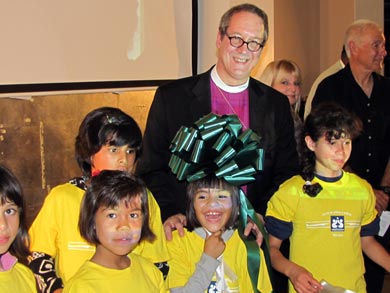
Advent Calendar Day 2: The Bishop’s Appeal

The Bishop’s Appeal

Our bishop, the Rt. Rev. James Mathes, appeals to us every year in order to further the ministry of our diocese in southern California and eastern Arizona.

“Every gift directly and positively touches lives; every dollar provides for pressing human need. This year, more than $100,000 in donations have been distributed, thanks to your generosity.”

Read the Bishop’s Appeal Letter

Advent Calendar 2011


For further reflection

Who we are

We are a diverse community committed to living out the message of Jesus Christ. This message is one of hope for the oppressed, love for the outcast, home for the alien, and peace for all people.

We strive to build relationships across ideological, political and socio-economic divides as a way responding to Jesus’ call to love our neighbors as ourselves.

We believe in God’s redeeming love through the person of Jesus Christ. We value human relationships above all else as reflected by the incarnation of God in the body and person of Jesus.

We embrace the awe and mystery of God through traditional liturgy while being open to the movement of the Holy Spirit to experience new forms of expression.

We are rooted in the ancient church and our eyes and hearts look to the future.

We welcome all people to experience the love of God.

Source: The Episcopal Diocese of San Diego

Advent Calendar Day 1: Angel Tree

Angel Tree Ministries

Starting today, November 27, 2011, the people of St. Margaret’s will again participate in the Angel Tree Christmas ministry. What is Angel Tree Ministries? Here is their Mission Statement:

Every child has a story. For 1.7 million American children, that story is filled with the abandonment, loneliness, and shame that comes from having a mom or dad in prison. For many, it may also include following their parents down the same destructive road to incarceration.

Angel Tree is a ministry that reaches out to the children of inmates and their families with the love of Christ. This unique program gives your church an opportunity to share Christ’s love by helping to meet the physical, emotional, and spiritual needs of the families of prisoners.

Angel Tree Christmas works by connecting parents in prison with their children through the delivery of Christmas gifts. Every Christmas, thousands of churches like yours help brighten the lives of countless children by purchasing, wrapping and delivering gifts on behalf of their incarcerated parent—not only delivering a message of love from parent to child, but also the true meaning of Christmas—the good news of Jesus Christ.

But Angel Tree doesn’t end with Christmas. For you and your church, that first Christmas connection can be the beginning of a rewarding ongoing relationship with these children and their families. Continue your Angel Tree ministry throughout the year and God will use your church to help these children and their families grow in their faith, strengthen their relationships with imprisoned parents, and fulfill the purposes that God has for their lives.

Read more about Angel Tree Ministries

Advent Calendar 2011


For further reflection

When Mom or Dad is in prison, it is the children who do the hard time, but you can let them know they aren’t forgotten. You can give the child of a prisoner the joy of Christmas this year.

After Thanksgiving Angel Tree Tags will be available. Please take one or more and buy the gifts for the children. Donations can also be made for the party that is given for the families.Return the donations/wrapped gifts to the church on or before December 12th.

Volunteers will be needed to sort through the gifts and organize by families. Please contact Debby at 760-346-2697 if you can help.

St. Margaret’s Parish Life Bulletin for November 27, 2011

Looking for gift ideas this year? Do we have something for you!

Proudly introducing the St. Margaret’s Online Advent Calendar.

Beginning with the First Sunday of Advent (11/27/2011) a new posting will be made everyday to introduce you to a person, an organization, or a fund that embodies the Gospel imperative to “love your neighbor as yourself.” This Advent you will become aware of the many needs that surround us and the many persons, individually and collectively, working to meet those needs.

Every day during Advent come to the Online Calendar to open a new “window” and look upon the world into which Christ is to be born. In quiet and prayer, hear what the Spirit is saying to you.

Advent Calendar 2011


For further reflection
Culturally we are bombarded with messages in this season to go and buy gifts for others. We are immersed in the notion that if we are a decent human being we will go and buy lots of gifts to give to our loved ones; furthermore, if we have been good, then we can expect to receive lots of gifts from our loved ones who have been (like us) buying things like crazy.

Spiritually, of course, we hear readings and prayers about the end of time, the second coming of Christ, and judgment. We hear, too, of the foretelling of the birth of Jesus and we prepare ourselves to remember the birth of Jesus (Christmas) and the revelation of God’s love to the whole world (Epiphany, January 6). This year we enter Advent having just heard that we encounter Jesus in the hungry, the thirsty, the naked, the stranger, the one who is sick and the one in prison; we encounter Jesus in the “least” among us. Matthew 25:31-46

The St. Margaret’s Online Advent Calendar is a response to what we hear the Spirit saying in the Sunday Morning Forum. Sunday after Sunday, in a variety of ways, we hear the truth of the Apostle’s teaching:

What good is it, my brothers and sisters, if you say you have faith but do not have works? Can faith save you? If a brother or sister is naked and lacks daily food, and one of you says to them, “Go in peace; keep warm and eat your fill,” and yet you do not supply their bodily needs, what is the good of that? So faith by itself, if it has no works, is dead. But someone will say, “You have faith and I have works.” Show me your faith apart from your works, and I by my works will show you my faith. For just as the body without the spirit is dead, so faith without works is also dead. James 2:14-18, 26

Instead of purchasing another item to give to a loved one you will be invited to consider gifting the money (you would have spent) to a person, organization, or fund on behalf of your loved one.


Can we by searching find out God or formulate his ways?

Paul exclaimed, “I want to know Christ…” (Philippians 3:10). On Sunday 10/2/2011 we explored this statement in our Sunday Morning Forum. “How do YOU know Christ? Where have YOU encountered Christ?” were among the questions we asked, sharing our answers around the table.

Once again, music was mentioned, specifically hymns used in worship, as a place of encounter and inspiration and knowledge. Bill shared one of his favorites, which happens to follow our readings from Philippians pretty closely: “Can we by searching find out God or formulate his ways?” which Hymn 476 in the 1982 Episcopal Hymnal.

Here are the lyrics

Can we by searching find out God
or formulate his ways?
Can numbers measure what he is
or words contain his praise?

Although his being is too bright
for human eyes to scan,
his meaning lights our shadowed world
through Christ, the Son of Man.

Our boastfulness is turned to shame,
our profit counts as loss,
when earthly values stand beside
the manger and the cross.

There God breaks in upon our search,
makes birth and death his own;
he speaks to us in human terms
to make his glory known. [1]

Let us hear what the Spirit is saying. Share your favorite hymn of encounter, inspiration, encouragement, or knowledge by leaving a reply and continuing the Sunday conversation here.

____________
[1] Words: Elizabeth Cosnett (b. 1936), alt.
Music: Epworth, melody att. Charles Wesley (1757–1834), alt.; harm. Martin Fallas Shaw (1875–1958), alt.

But, I’m not covetous…

The discussion in the Forum yesterday was quite lively. Understandings and opinions varied widely. Karl Jacobson, in his commentary on this parable for WorkingPreacher.org reminded us “A parable is essentially an elaborate allegory. We are invited to see ourselves in the story, and then apply it to ourselves.” I invite you to re-read the parable. Then I invite you to consider Jacobson’s commentary as you see yourself in the story and apply it to yourself.

We covet what God chooses to give to others. A parable is essentially an elaborate allegory. We are invited to see ourselves in the story, and then apply it to ourselves. The wages at stake (even at the moment of Jesus’ first telling of the parable) are not actual daily wages for vineyard-laborers, but forgiveness, life, and salvation for believers. We need not literally be laborers in a vineyard, as we are all of us co-workers in the kingdom (1 Corinthians 3:9).

And in relationship, one believer to another, covetousness is a problem. The point here isn’t necessarily that other folks receive blessings from God that we don’t — that they get more or better or lovelier gifts from God. The problem is that they get the same as us; and they don’t deserve it, do they? They are less worthy, or later arrivals, or just plain worse sinners. They don’t deserve the same as we get, do they? Not nothing maybe, but certainly not the same. The parable’s day laborers parallel perfectly with today’s forgiven-sinners in both our pews and pulpits.

We have a tendency, as the parable aptly illustrates, to covet and to be resentful of what others receive from God. The owner of the vineyard asks those who have worked longest and (presumably) hardest for him, “Am I not allowed to do what I choose with what belongs to me? Or are you envious because I am generous?” The point is that God’s grace, mercy, and forgiveness are God’s to give away as God sees fit.

Read the entire post at WorkingPreacher.org. “Gospel” for September 18, 2011

What do you hear in this parable? What do you feel as you listen to the story and apply it yourself and journey into the Kingdom of God where the first are last and the last are first? Leave a comment, continue the conversation.


The Will of God: A reflection from a bombed out city

On Sunday David introduced the Forum to Leslie Weatherhead and his reflection on the will of God. The reflection was given at the London City Temple during the bombing of London (1940-41). Here is the extended quote from which David spoke:

We therefore divided our subject into three as follows:

  1. The intentional will of God – God’s ideal plan for man.
  2. The circumstantial will of God – God’s plan within certain circumstances
  3. The ultimate will of God – God’s final realization of his purposes.

Once again, even at the risk of being tiresome, let us look at the supreme illustration of the Cross.

  1. It was not the intentional will of God, surely, that Jesus should be crucified, but that he should be followed.  If the nation had understood and received his message, repented of its sins, and realized his kingdom, the history of the world would have been very different.  Those who say that the Crucifixion was the will of God should remember that it was the will of evil men.
  2. But when Jesus was faced with circumstances brought about by evil and was thrust into the dilemma of running away or of being crucified, then in those circumstances the Cross was his Father’s will.  It was in this sense that Jesus said, “Not what I will, but what thou wilt.”
  3. The ultimate will of God means, in the case of the Cross, that the high goal of man’s redemption, or to use simpler English, man’s recovery to a unity with God – a goal which would have been reached by God’s intentional plan had it not been frustrated – will still be reached through his circumstantial will.  In a sentence, no evil is finally able to defeat God or to cause any “value” to be lost.

Leslie Weatherhead, The Will of God (from a series of addresses given at the London City Temple at the time of the German bombing raids)

The Forum then spoke to these questions:

  1. Have you ever said “it is the will of God” (or had that said to you) in a way that was offensive? How do you picture the will of God?
  2. How do you discern the will of God for yourself? Where is there an authoritative source for you?
  3. Ten years later, do you think the “attack on America” was God’s will? If so, how so? How about America’s attack on al-Qaida?

You may join this conversation (ongoing) by leaving a comment. Thank you for being part of the Sunday Morning Forum.

Who is my neighbor?

In the Forum on Sunday (9/4) we considered Paul’s wisdom “The commandments, “You shall not commit adultery; You shall not murder; You shall not steal; You shall not covet”; and any other commandment, are summed up in this word, “Love your neighbor as yourself.”  Romans 8:9

In a previous post I shared a “spiritual exercise” with you and invited you to, well . . . exercise. In the Forum we discussed the notion of “neighbor.” Of course, “Who is my neighbor?” was the question put to Jesus who answered by telling the story of the Good Samaritan and then asked the questioner (at the conclusion of the story) “Which of these three, do you think, was a neighbor to the man who fell into the hands of the robbers?” Luke 10:36 “The one who showed mercy” was the (correct) answer and Jesus instructed his questioner (a lawyer) to go and do likewise.

Within the Forum as we wrestled with the question ourselves some began with the “neighbor” they could see and touch and interact with—beginning in their own families. To love this flesh and blood neighbor was their challenge. Others looked into the immediate community—the homeless, the hungry, even the violent—as the neighbor they were called to love. Still others looked into the “whole world” and included “enemies” in their neighborhood. All this to say that there are many answers to this question and that the best place to start to answer is the place you find yourself in right now.

Jesus through his stories, through his teaching, in his life and in his death opened his heart and opened his arms wide enough to embrace all who came to be in his presence, beginning with the flesh and blood family into which he was born, the flesh and blood group of disciples he gathered around him, and then he kept expanding his embrace until he opened his arms wide upon the cross and embraced us all. He sent his apostles and disciples into the whole world. Over the centuries, at our best, we the church have understood our mission as being an inclusive mission. At our worst we have drawn boundaries and counted some in and some out (and sadly this practice continues into our own day).

Let’s behave well, be on our best, as we answer the question, “Who is my neighbor” for ourselves. We have lots of information, now we need to match that with our actions.

Your attention please . . .

This past Sunday (8/28/11) we talked about encounters with God (Moses and the burning bush being our inspiration). In the conversation we noted our belief that God reaches out to us constantly—sometimes we’re paying attention, sometimes not. We noted that as we adjust our sight and hearing in prayer and worship and service, we become more and more aware, and more ready, to encounter God in the “ordinary” events of our lives. In the course of the conversation David shared a poem to highlight our understanding:

“Earth’s crammed with heaven,
And every common bush afire with God;
But only he who sees, takes off his shoes;
The rest sit round it and pluck blackberries.”

—Elizabeth Barrett Browning

We talked about coincidences, too.  As if to highlight what we considered “God’s timeliness” (versus coincidence) this arrived in my email this morning:

Holiness comes wrapped in the ordinary. There are burning bushes all around you. Every tree is full of angels. Hidden beauty is waiting in every crumb.

—Macrina Wiederkehr, O.S.B in A Tree Full of Angels

Pay attention, today (always), encounters with God are bound to be numerous.

Well. . . what do you think?

This week we have (haven’t we?) been thinking about Spiritual Gifts (the main topic of conversation on Sunday Morning in the Forum). Rather than cite scholarly sources (which I have been reading), rather than offering extensive quotes, I will offer my current understanding of Spiritual Gifts as an invitation for you to also share.

You and I do not have to be experts, scholars, or theologians, to have an opinion and an understanding by which we live our faith—though it is helpful to let these opinions and understandings mature as they guide us (i.e., let them change as we gain more experience and understanding).

For brevity I will offer an “Executive Summary” of my current understanding. This is not meant to be exhaustive or the definitive “last word” on the topic of Spiritual Gifts—you know, I’m still learning a lot.

  • Everyone, including me, is gifted by God in some way
  • Gifted by God is foundational: God chooses which Spiritual Gift to offer, God takes the initiative, always
  • We choose to accept the gift or not (we always have this freedom, another gift of God’s initiative)
  • We choose to exercise the gift or not (don’t you love this gift of free will?). My own experience tells me that the choice to exercise the gift (or not) ebbs and flows like a tide (though not so regularly). Sometimes I do this easily and well and for a prolonged period (you could float a boat); at other times it is as if I have amnesia (or sloth) and the gift is not used (that boat is mired in the tidal mud).
  • The Spiritual Gift is meant (by God) to be used for the well-being of the Body of Christ (=the Church) and for the welfare of all God’s people and all of God’s creation (=the world). It is not meant to be hoarded, it is not meant to a personal delight nor a self-esteem booster—it is meant to be shared for the good of all (inside and outside the Church, indeed, to be shared for the good of all creation).
  • I’m still working out what the Spiritual Gifts are (according to our “teachers” in the Bible and in our Christian Tradition). As you heard Stan mention on Sunday there are multiple internet resources for exploring the meaning of and kinds of Spiritual Gifts.
  • Believing the Church (at its best) to be organic, living, changing, adapting—the “Body” of Christ—the gifts (from God) are meant to part of an organic whole, not part of some grand Organizational Flow Chart.
  • Closely linked to the organic nature of the Church is that the local church may need different gifts at different times (as communities and their needs change) so I believe a couple of things can happen: the gift you’re given changes to meet the new needs and/or new members are brought into the community with the necessary gifts to meet the new (changing) needs.

That’s probably enough for now. What do you think? What would you like to add (for me and others)? How can we grow together in our understanding of God’s generosity? Leave a comment, please. Let’s see where the Spirit will lead us.

Two Fathers and Forgiveness: If they can do it . . .

Here is another story from our own day about forgiveness of “biblical proportions.”

As I re-read this article (from my “clippings” file) I thought again about the small acts of forgiveness that I have been asked to make. I thought again of the little annoyances that have the potential of becoming destructive prisons if simple words of forgiveness are never spoken. I also thought about the stories shared with me over the years of “heroic acts” of forgiveness that proved liberating: forgiving betrayals in the marriage relationship, forgiving coworkers whose dishonesty cost a job, forgiving family members for lies and half-truths leading to estrangement, and more. In both the little and the big moments of forgiveness there is seldom forgetfulness—one remembers the hurt, the wrong—but there is always a sense of freedom from the pain when the words of forgiveness can be spoken.

Let the big stories, such as these, inspire the small stories of forgiveness in your life. Also, let the big stories, such as these, inspire the the heroic acts of forgiveness to which you may be called. ~dan

Before the men sat in the kitchen, a humble place for such an event, they had walked in the garden. Two fathers, both raised in Catholic schools, both divorced from their children’s mothers, both who helped raise a son and a daughter, talked for more than an hour.

That the meeting took place seems miraculous. One man owns a business and had traveled from middle America. The other, in whose house they met, works in a New York state factory. They want the same thing: to save the son of the New York man from execution.

The father from Oklahoma, Emmett E. “Bud” Welch, had buried his daughter, Julie-Marie, on a 1995 spring day.

New York state resident William McVeigh is the father of the man sentenced to die for killing Julie-Marie and 167 others on April 19, 1995, in the Oklahoma City bombing of the Murrah Federal Building.

via Oklahoma City Bombing: Two Fathers and Forgiveness – April 2000 Issue of St. Anthony Messenger Magazine Online.