Look again

mary-700x438

How would you picture Mary?

The Blessed Virgin Mary was thoroughly Jewish. Different cultures and ethnicities have often portrayed her, Jesus, and others from the Bible as being from their group.

Since Christianity for many centuries was based largely in Europe, these important characters of salvation history have often been depicted as white Europeans. Which is fine! But other cultures have also depicted them according to their own appearances.

Take a look at how others have pictured Mary: 13 Beautiful Non-White Depictions of the Blessed Virgin Mary a post on ChurchPop by the Editor

Image: via ChurchPop

Moses and the Burning Bush | Art for Lent 3C

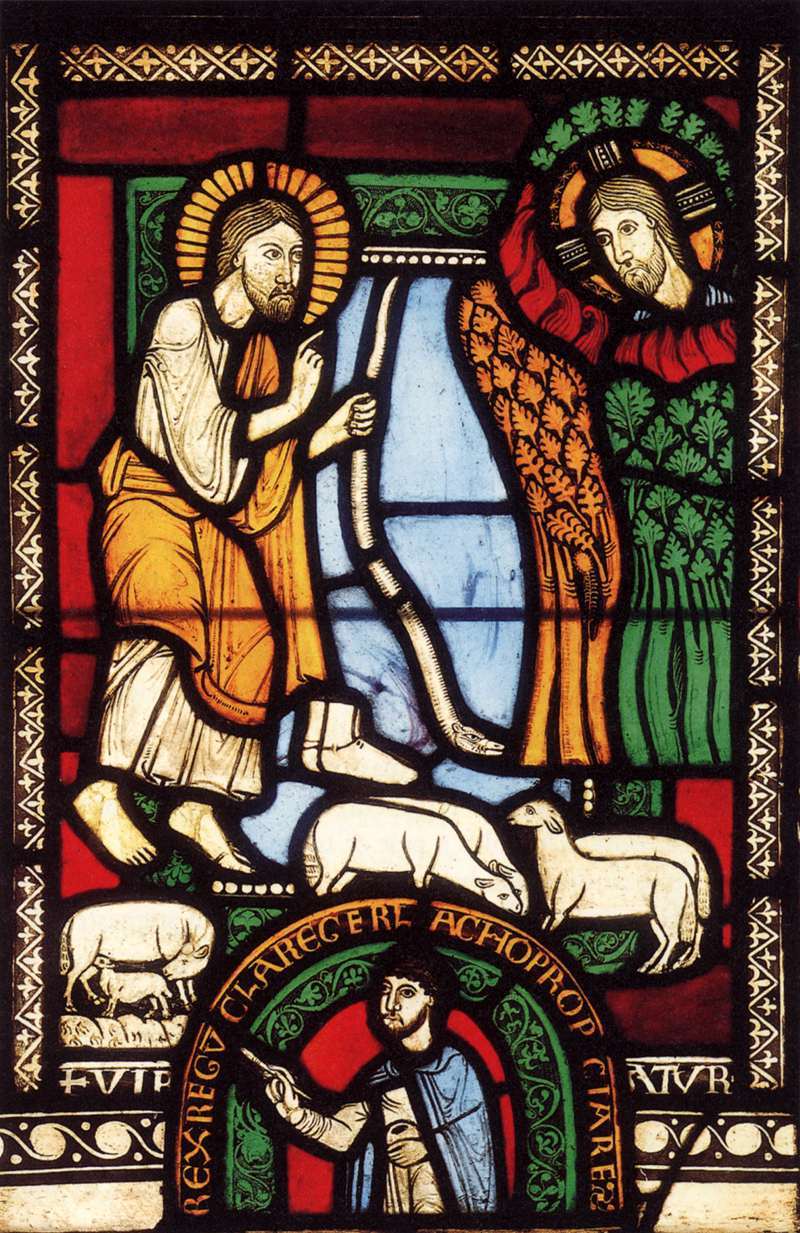
Exodus 3:1 Moses was keeping the flock of his father-in-law Jethro, the priest of Midian; he led his flock beyond the wilderness, and came to Horeb, the mountain of God. There the angel of the LORD appeared to him in a flame of fire out of a bush; he looked, and the bush was blazing, yet it was not consumed
2017-0903 17A 02g_1100

Moses and the Burning Bush (with the artist’s self-portrait), c. 1150,
Stained Glass, Master Gerlachus, 12th century

 ______________
Commentary by Hovak Najarian

Moses and the Burning Bush (with the artist’s self-portrait), c. 1150, Stained Glass, Master Gerlachus, 12th century

The basic ingredient of glass is silica which melts at a very high temperature (over 3,000 F). The melting point is lowered when a flux is added but for ancient artisans there was still a problem of how to control glass in its fluid state. In the first century BC, a minor industrial revolution occurred in the Near East when a person placed a blowpipe into molten glass, gathered a blob, blew into it, and formed a bubble (like blowing a soap bubble). Artisans learned to attach a pontel rod to where the base of a container would be and then cut the bubble from the blowpipe. While still fluid and workable, the open end (where it was cut from the blowpipe) was made wider to make a bowl or other usable form. The pontel then was snapped off and the glass was cooled slowly as it became a solid. During the late Romanesque period, artisans such as Gerlachus were heirs to a great deal of empirical knowledge which included how to make sheets of glass by cutting elongated bubbles lengthwise then opening and spreading them flat.

Today, the term “stained glass” is used interchangeably with “colored glass” but they are not technically the same. Colored glass contains coloring agents (oxides) within it, whereas staining is done by painting an oxide onto the surface to add details. After sections of glass are painted, they are returned to a furnace and the stain is fused. Then, H-shaped strips of lead called “came” are used to surround each section as a window is being assembled. The came is soldered where their ends touch to hold the glass in place.

“Moses and the Burning Bush” is one of a series of windows depicting the life of Moses; in it, the black, even-in-thickness came can be seen as outlines between the large sections of glass. Details such as the faces of Moses, God, the artist, their clothes, and the burning bush, are all stained by being painted with iron oxide and then fused to the glass. Instead of using many small pieces, Gerlachus’ windows were made from large sections of colored glass on which he painted clarifying details of his subject.

Note

While Master Gerlachus was working in Germany, Abbot Suger began rebuilding the Abbey Church of St. Denis in France. Abbot Suger called for stained glass to be used much more than it had been used previously. Light entering the church through stained glass not only displayed brilliant images that were related to a parishioner’s faith but also the colors were a sensual delight. In defense of its use, it was pointed out that light represented the divine and light coming through glass symbolized the Holy Spirit which was capable of passing through solid objects. The Abbey Church of St. Denis set in motion the direction that was taken by builders during the Gothic Period that followed; a time when there was even greater use of stained glass.

Hovak Najarian © 2013
The Story of Abraham | Art for Lent 2C

Genesis 15:1 The word of the LORD came to Abram in a vision, “Do not be afraid, Abram, I am your shield; your reward shall be very great.”

The Story of Abraham
1425-52
Gilded bronze, 79 x 79 cm
Baptistry, Florence
GHIBERTI, Lorenzo
(b. 1378, Firenze, d. 1455, Firenze)Click image for more information.

______________
Commentary by Hovak Najarian

The Story of Abraham, detail of the “Gates of Paradise,” 1425-52, Gilt Bronze, Lorenzo Ghiberti, 1378-1455

In 1401, the wool merchant’s guild of Florence announced a competition that would lead to a commission for a set of bronze doors for the Baptistery of San Giovanni (Saint John). Lorenzo Ghiberti won the competition and was given the commission. Upon completion, he was given a commission to design a second set of doors for the Baptistery. The doors and a few other pieces of sculpture would become his life’s work. “The Story of Abraham” is one of ten panels from the second set of doors which now is referred to as the “Gates of Paradise.” According to Giorgio Vasari, Michelangelo was looking at the doors when a companion asked his opinion. Michelangelo said allegedly the doors were so beautiful they were worthy to serve as the gates of paradise.

Ghiberti’s training as a goldsmith and metalworker was invaluable as he solved the technical problems of casting the bronze doors. Other sculptors were eager to learn from him. Also, he read widely, was a humanist, and was open to the changes during a time of cultural and artistic rebirth. Just as early Renaissance painters sought to create an illusion of depth, Ghiberti studied perspective and applied it to his relief sculpture. Rather than his reliefs being figures attached to a flat background, he sculpted the entire surface to create an illusion of pictorial depth. With regard to the “Gates of Paradise” he said “I sought to imitate nature as closely as possible.”

In the panel called “The Story of Abraham,” Ghiberti combined two accounts from the Book of Genesis. At the lower left is the story found in Genesis 18:2-10; a time when three men (Ghiberti interpreted them as heavenly beings with wings) came to Abraham. Sarah is at the doorway of their tent while Abraham is kneeling before the men with a pan of water with which they may wash their feet. The men tell him his wife, Sarah, will have a son. Ghiberti’s narrative composition continues with images from Genesis 22:3-13; the sacrifice of Isaac. At the lower center is a donkey and to its right are Abraham’s two servants who wait while he and Isaac go to a higher level of the mountain. Above them, Isaac is kneeling on an altar and Abraham has raised his knife. An angel has arrived just in time to hold back the knife and stop him from killing his son. Behind the feet of Abraham is a ram caught in a thicket; it will be sacrificed in place of Isaac.

Note

Because the rite of baptism was regarded to be a door to heaven, a baptistery was symbolically a “gateway to paradise.” Michelangelo’s alleged description of Ghiberti’s doors, if true, could have meant simply that the doors were worthy of the Baptistery of San Giovanni, not paradise itself.

Early scholars were interested in the many parallels found in the story of Abraham and the passion of Christ. Both stories deal with father, son, and sacrifice.

Hovak Najarian © 2013

Baptism and Temptation of Christ | Art for Lent 1C

Luke 4:1 Jesus, full of the Holy Spirit, returned from the Jordan and was led by the Spirit in the wilderness, where for forty days he was tempted by the devil

Baptism and Temptation of Christ
1580-82
Oil on canvas, 248 x 450 cm
Pinacoteca di Brera, Milan
VERONESE, Paolo
(b. 1528, Verona, d. 1588, Venezia)
Click image for more information.

______________
Commentary by Hovak Najarian

Baptism and Temptation of Christ, Oil on Canvas, 1580-1582, Paolo Veronese, 1528-1588

During the Italian Renaissance of the fifteenth and sixteenth century, the cities of Florence and Rome were major centers of art. Venetians also could boast of their art during this period; Titian, Tintoretto, and Veronese were among the finest artists in Europe. Being at the northern tip of the Adriatic Sea, the people of Venice were seafarers and their merchant ships sailed eastward to trade with ports throughout the region. Through trade, Venetians acquired great wealth and as was the practice (then and now), people of means acquired possessions to enrich their lives and serve as symbols of status. Inasmuch as expensive sports cars and private jets were not available, their possessions were sumptuous palaces and fine art. They also were generous in their support of public projects and the Church. Because of favorable working conditions and an opportunity to earn fine salaries, many painters, sculptors, and artisans made Venice their home. Veronese (given name Paolo Caliari), studied initially in the city of his birth, Verona, but soon was living and working in nearby Venice. In Venice, he became known simply as “Veronese,” a person from Verona.

As Renaissance art continued from the fifteenth century to the sixteenth there was a tendency toward mannerism and then from mannerism, art developed into the baroque style of the seventeenth century. “Baptism and Temptation of Christ,” painted by Veronese in the latter part of the mannerist period is baroque-like in its dramatic composition. As we enter the painting at the lower left, we see John the Baptist in shadow but we do not linger. Instead, we move past him immediately to the upper torso of Christ which is bathed in light emanating from a dove representing the Holy Spirit. Not only does Christ receive our immediate attention but also all figures in this section of the painting are focused on him. Included in this drama are a cherub and angels hovering excitedly. The dove illuminates the foreground figures while shadows of the trees close off pictorial depth.

The narrative continues as we leave the baptism and move to the right where after forty days and nights of fasting, Christ is with Satan in a clearing. A forest is in the middle ground and then in the background beyond the trees are buildings representing the kingdoms of the world and their splendor. Unlike the animated scene of the baptism, the temptation of Christ is calm. Satan is not depicted with horns or forked tail but appears as an old bearded and seemingly harmless figure in a gray robe.

Note

A visitor to Venice today may still feast visually on its art but they will not see evidence of shipping and trade. The city is supported financially now by tourists who dine at fine restaurants, ride the canals in gondolas, and feed pigeons after lunch at McDonalds in St. Mark’s Square.

Hovak Najarian © 2013

Transfiguration | Art for Last Epiphany C

Luke 9:28-29 Now about eight days after these sayings Jesus took with him Peter and John and James, and went up on the mountain to pray. And while he was praying, the appearance of his face changed, and his clothes became dazzling white.

Transfiguration
Transfiguration
Fresco
“Dark church” ( Karanlik kilise ) 11th century
Göreme district, Nevşehir Province, Turkey.
Click image for more information.
Click here for more Göreme district churches.

______________
Commentary by Hovak Najarian

Transfiguration, Fresco, 11th Century, Unknown artist of Cappadocia

“And after six days Jesus took with him Peter and James and John his brother, and led them up a high mountain apart. And he was transfigured before them, and his face shone like the sun, and his garments became white as light. And behold there appeared to them Moses and Elijah, talking to him.” (Matt. 17:1-3)

A large portion of the Eastern Roman Empire spoke Greek and by the seventh century it was the primary language used by the Byzantines. The Byzantine Empire extended eastward from Constantinople and included Asia Minor where Greek speaking Orthodox Christians often had to seek protection from invading tribes. In a region known as Cappadocia, the ash and lava of a volcanic eruption created rock formations that were soft and could be carved easily. By carving into the rock, Christians hollowed out spaces that would shelter them from the elements and offer protection from invaders. The soft rock also was carved out for churches.

In a monastic compound known as the “Dark Church,” The interior walls and the ceilings are covered with frescos and among the paintings is “The Transfiguration.” In it, Moses and Elijah are with Jesus in an event interpreted as a revelation that Christ is the fulfillment of the law and prophets. Moses represents the law and often he is shown holding the Torah or a stone tablet. Elijah represents the prophets. In this fresco, neither Moses nor Elijah has been given an identifying symbol but we can assume the gray-haired bearded man is Moses and the un-bearded figure is Elijah.

Mt. Tabor is the traditional site of the transfiguration but other places have been proposed. One of the suggested sites is Mt. Hermon which has three distinct peaks and in paintings of the event often three peaks are shown; Christ is always in the center. In the “Dark Church” fresco, Moses is standing on the right peak and Elijah is on the left. Below them are the disciples kneeling and crouching. At the bottom left is Peter with white hair and a beard. He is pointing upward toward Christ. The disciple John is depicted in the center as a beardless youth (his face is partially obscured by damage) and James is to the right with brown hair and a beard. Linear rays indicate a direct connection between Jesus and each of the figures.

Note

The “Dark Church” is so named because it has only a small opening (oculus) for light, thus the interior is dim.

Among the various people of ancient Cappadocia were the Armenians who were known at one time as being horse breeders. “Cappadocia,” the historic name for the region was derived likely from “Kapatuka,” an Old Persian term meaning, “Land of beautiful horses.” The Crusaders referred to the region as Terra Hermeniorum: “Land of the Armenians.”

Hovak Najarian © 2013

Elijah Increases the Oil of the Widow | Art for Epiphany 4C

Luke 4:25-26 But the truth is, there were many widows in Israel in the time of Elijah, when the heaven was shut up three years and six months, and there was a severe famine over all the land; yet Elijah was sent to none of them except to a widow at Zarephath in Sidon.

Elijah Increases the Oil of the Widow
1/69-70
Pewter-lead alloy, height 173 cm (without socle)
Liechtenstein Museum, Vienna
MESSERSCHMIDT, Franz Xaver
(b. 1736, Wiesensteig, d. 1783, Bratislava
Click image for more information.

______________
Commentary by Hovak Najarian

Elijah Increases the Oil of the Widow, Pewter, 1769-70, Franz Xaver Messerschmidt, 1736-1783

The title of Franz Messerschmidt’s, sculpture, “Elijah Increases the Oil of the Widow,” sets up an expectation of the biblical story (1 Kings, 17:7-16). The work only alludes to the story, however, and an occasional reference to it as the “so called Zarephath fountain” is fitting. It is primarily a fountain sculpture of a woman pouring water in the style of figures seen in courtyards and gardens throughout Europe.

The biblical account of Elijah and a poor widow tells of a time of famine. God told Elijah to go to the city of Zarephath to meet the widow. There he saw the widow gathering wood near the gate of the city. She was going to build a fire and use the last of her flour and oil to prepare bread. Then she and her son would have a final meal and it was likely they soon would die. Elijah, a stranger to the widow, asked her for water but then, as she was going to get some for him, he also asked for a piece of bread. She hesitated but Elijah promised that if she prepared bread for him she would never run out of oil and flour. The widow had faith and fed Elijah; thereafter provisions were miraculously provided for her.

Franz Messerschmidt, an Austrian, established a successful career sculpting busts of dignitaries in a fashionable baroque manner but in 1765 his studies in Rome brought him in direct contact with classical art. His visit to Italy coincided with a time when there was great interest in the excavations at Herculaneum, a Roman city covered and preserved by the ashes of Vesuvius. Upon his return to Austria, he completed several full-sized figures that were influenced clearly by classicism. Among these commissions was a courtyard fountain sculpture for a palace in Vienna. In its typical Roman niche setting, Elijah and the widow’s son are nowhere to be seen. The widow’s stance, clothing, hair style and the amphora from which she is pouring water are all from Greek and Roman sources. At the widow’s feet, Messerschmidt places two cherubs to do God’s work. One is lifting a food storage urn to the widow and another has his arms around an urn ready to offer it as well. The offering of storage urns by cherubs informs us that ongoing provisions from God are being supplied to the widow.

Note

In the eighteenth century, one of the metals alloyed with tin to make pewter was lead. Messerschmidt used pewter and as he became older he began exhibiting peculiar behavior; it is very likely this was due to lead poisoning.

In Christian art, plump rosy-cheeked cherubs were the counterparts to small Roman cupids. In appearance, cherubs often were not discernable from cupids and they were used in a similar manner. By the seventeenth century the question of whether a figure in art was a sacred cherub or a secular cupid depended on the theme of the work. As cupids, they were agents of secular love and as cherubs they represented the omnipresence of God.

Hovak Najarian © 2013

Prisoners Exercising | Art for Epiphany 3C

Luke 4:18-19
“The Spirit of the Lord is upon me,
because he has anointed me
to bring good news to the poor.
He has sent me to proclaim release to the captives
and recovery of sight to the blind,
to let the oppressed go free,
to proclaim the year of the Lord’s favor.”

Prisoners-Exercising (after-Doré)
Prisoners Exercising (after-Doré)
Vincent van Gogh
Painting, Oil on Canvas
Saint-Rémy: February 10 – 11, 1890
Pushkin Museum
Moscow, Russia, Europe
Click image for more information.

______________
Commentary by Hovak Najarian

Prisoners Exercising (after Gustave Doré), Oil on Canvas, 1890, Vincent van Gogh, 1853-1890

While he was a young man in the Netherlands, Vincent van Gogh worked for a gallery and seemed headed toward a career as an art dealer. A few years later, however, while working at the London branch of the dealership, an unrequited love turned his thoughts inward. He was a deeply spiritual person and his interest shifted toward becoming a minister, as was his father, in the Dutch Reform Church. Upon returning to the Netherlands, he tried to enroll in divinity school but was turned down. Vincent was turned down again when he wanted to be a missionary so he made the decision to take the Gospel to the coal miners in Belgium on his own. Miners there lived in great poverty and without hope but Vincent learned that nothing he could say or do would make a difference. As a result of his failures, he reasoned that painting might be a way he could give expression to his inner spirit without having to interact directly with people. He went about methodically to master the discipline of art and after three years of drawing and painting, he moved to Paris to be with his brother, Theo.

In Paris he became familiar with impressionism and started using bright colors but unstable conditions led him to seek a change of environment in the south of France. There, in Arles, he became immersed in his subjects as he painted the surrounding wheat fields and the orchards in bloom. He said “I feel like nature has spoken to me.” The artist, Paul Gauguin, joined him but soon their personalities clashed and after an argument, van Gogh went back to his apartment and in a state of intense frustration, severed the tip of his ear. City officials thought they had a madman in their midst and placed him in jail. His brother Theo arrived and Vincent volunteered to stay at an asylum in Saint-Remy until he felt better. It was agreed that while recovering he could go out into the surrounding countryside to paint when he felt like doing so. His masterpiece, “Starry Night” was painted during this period. At times when he became depressed, he stayed indoors and turned to his books. In them were paintings by artists he admired; he identified with aspects of some of their paintings and began to make copies. The reproductions, however, were not in color and, not having seen the originals, he painted them with colors of his own choice. He regarded this as being similar to a performer interpreting a musical score. Among the paintings he interpreted were Rembrandt’s “Raising of Lazarus,” and Delacroix’s “The Good Samaritan.” It is likely that his own confinement attracted him to Gustave Doré’s “Prisoners Exercising.” Because of his affliction it is likely also that he felt like a prisoner within himself.

Note

Medical science in the nineteenth century was in a primitive state and the cause of van Gogh’s illness is still unknown. In his time, it was thought it might have resulted from epilepsy, drinking too much absinthe, or even syphilis. Dr. Gachet thought it could have been caused by “…turpentine poisoning and the effects of too intense sunlight on a Nordic brain.”

Hovak Najarian © 2013

Miracle of Cana | Art for Epiphany 2C

John 2:1-11 On the third day there was a wedding in Cana of Galilee, and the mother of Jesus was there.

Miracle of Cana
Miracle of Cana
Ivory panel
Carolingian, AD 860-70
The British Museum
This panel once decorated the cover of a Gospel Book (now in the Hessisches Landesmuseum, Darmstadt) written and illuminated by a scribe named Liuthard. Liuthard is known to have produced three manuscripts for the French king, Charles II, ‘the Bald’ (AD 838-77) which helps us to date the panel.
Click image for more information.

______________
Commentary by Hovak Najarian

Miracle of Cana, Gospel Book Cover, Ivory, c. 860-870, Artist Unknown

Our sense of values is acquired partly through observations, direct experiences, and the process of enculturation. Among the materials of our natural world, we tend to be attracted visually to things that are rare and unusual. As we develop mentally, we construct a hierarchy based on experiences and the cultural values we have embraced. We learn that gold is valued more than clay; even though clay is more useful in many ways. Likewise, we respond to particular minerals and refer to them as “precious jewels.” We are attracted to ivory because of its pearly luster; it seems to welcome our touch. These materials have been treasured and used for thousands of years by people possessing power and wealth. During the middle ages, kings, popes and bishops built churches and private chapels. They also commissioned artists to enrich their surroundings with paintings, sculptures, and gospel books. Although art enhanced worship, it often served as a display of status as well.

Many gospel book covers were made of gold and embellished with jewels. Ivory’s whiteness symbolized purity and it was also a favorite material. The ivory relief carving of the Miracle of Cana, now in a museum in Darmstadt, Germany, was a cover for a manuscript that was likely made at the monastery at Reims during the time of Charles II, the grandson of Charlemagne. The cover depicts the well known story of Christ’s first miracle: Christ was with his mother, Mary, at a wedding banquet where there were many guests. When the wine vessels became empty, Mary asked her son for help. Water was poured into the empty vessels and Christ changed it into wine.

In this small relief sculpture, the story begins at the upper left side and proceeds in narrative form. The late O. M. Dalton of the British Museum described it as follows:

In the first scene, Christ and a disciple converse with the Virgin Mary while on the right, in a stacked perspective, servants wait upon guests seated at a table. In the bottom register two attendants pour water from vases on their shoulders into two of the six large amphorae. The story ends with the master of the feast in conversation with Christ.

Note

Today, the slaughter of elephants for their tusks has caused a sharp decrease in the size of herds in Africa. People with wealth and greed, however, continue to pay enormous prices for ivory and this has led to unconscionable poaching. There is a distinct possibility that within the present century elephants will no longer exist in the wild.

Painters are familiar with ivory black; a pigment with a name that seems to be a contradiction. It is made by heating ivory to a high temperature. The deep black pigment obtained from this process was used by Rembrandt for the dark background in many of his paintings.

Hovak Najarian © 2013

What poem speaks to you?

Is there a poem you most need as you step further into the new year? Is there a poem written on your heart—suddenly there when you most need it?

It’s that time of the year: the time when I need to carry my favorite poem in my pocket and read it frequently. I do this to inoculate myself against the fantasies that come up about now. Not Christmas fantasies of sugar plums dancing in my head—New Year’s fantasies.

As a new year approaches I begin to imagine that I will finally grab the reins of my life and get things under control. […]

I don’t actually have to put the poem in my pocket, for I carry it within me, recalling its images whenever I need them

What is the poem? The Avowal by Denise Levertov. Why does this work for Roger Owens? Why is it something to take with you as you follow the Way? Read Owens’ essay on The Christian Century and discover for yourself.

The Arian Baptistry | Art for Epiphany 1C

Luke 3:21-22 Now when all the people were baptized, and when Jesus also had been baptized and was praying, the heaven was opened, and the Holy Spirit descended upon him in bodily form like a dove. And a voice came from heaven, “You are my Son, the Beloved; with you I am well pleased.”

The Arian Baptistry
The Arian Baptistry
Ravenna, Italy
erected by the Ostrogothic King Theodoric the Great
5th & 6th century, (original building, now reconstructed)
Click image for more information.

______________
Commentary by Hovak Najarian

Baptism of Christ, Mosaic, Late 5th cent., Arian Baptistery, Ravenna, Italy

During the first several centuries of Christianity, the nature of Christ had not been resolved. The Roman and Eastern Churches believed Christ was one with God and the Holy Spirit, and was part of a trinity. Arius, an influential church elder in Alexandria, did not agree. He believed Christ was the Son of God but not of equal status. Roman Emperor Constantine regarded Arius a heretic and anyone spreading his teachings was threatened with death. An Ecumenical Council was called in AD 325 to meet in Nicaea for the purpose of repudiating Arianism and formulating a definitive statement about the nature of Christ. Out of this Council came the Nicene Creed. Arius, however, had a following among the Ostrogoths and they were out of Constantine’s jurisdiction. They remained Arian Christians.

Among the Arians was Theodoric the Great; a powerful Ostrogoth king who conquered Italy in AD 493 and set up his capital in Ravenna. Unlike Constantine in earlier times, Theodoric was tolerant of his subjects’ beliefs. Orthodox Catholic Christians were allowed to live under their own laws and to build and worship in separate churches. In Ravenna, there was a fifth century orthodox basilica with a baptistery (referred to here as the Orthodox Baptistery) that Theodoric could have appropriated for the Arians. Instead, he chose to build a new cathedral and baptistery. The new baptistery – known as the Arian Baptistery – was similar in design to the one built fifty years earlier at the orthodox basilica.

The ceiling mosaic of both baptisteries contains a central medallion surrounded by twelve apostles; each apostle is holding a crown placed on a veil. Both medallions show John baptizing a nude Christ standing in hip-deep water with arms hanging at his side. In the Orthodox Baptistery, John is at the left and a river god is in the water at the right with a cloth to cover Christ after the baptism. In Theodoric’s Arian Baptistery, Christ is again the central figure but John has been placed instead on the right side and the river god is on the left. The river god now is only an observer, not a participant. Uppermost in the medallion is a dove spewing water from its beak onto Christ’s head.

The two mosaics differ noticeably in the physical image of Christ. In the Orthodox Baptistery, Christ is shown to be bearded and physically fit but in the Arian Baptistery, Christ’s features are androgynous. His soft body, narrow shoulders, and face with feminine characteristics contrasts with the bearded and muscular river god nearby. A question facing early image makers was how should Christ be portrayed? How could an image of Christ project his physicality as a man and at the same time depict him as a person of tenderness, sensitivity, and spirituality?

Note

The Orthodox Baptistery also is called the Neon Baptistery. It was completed by Bishop Neon after mid fifth century.

River gods were minor Roman deities. They were said to stand watch over their domain and sometimes be of assistance.

Hovak Najarian © 2013