Statement of Becca Stevens after CNN Hero Awards

Becca Stevens at 2016 CNN Hear Awards Ceremony
Becca Stevens at the 2016 CNN Hero Awards Ceremony

It was a great honor to represent the women of Thistle Farms on the CNN Heroes Tribute last week in New York. The experience allowed us to make new friends and tell a wider community that love does heal. My favorite part of the weekend was becoming friends with the other honorees. I loved hearing about their work and laughing in the van on the way to interviews and the gala. From voting daily, to telling friends, I’m grateful for everything this community did to make such a big impact. We have a lot more work ahead and many women waiting for us to expand our reach. Love heals for sure–especially through the tireless efforts of everyone in the circle at Thistle Farms. Thank you, thank you, thank you.

Becca Stevens, Founder & President

Visit the Thistle Farms Website | Learn about the Mission of Thistle Farms

Ecce Ancilla Domini

The Annunciation by Rossetti

Ecce Ancilla Domini, oil on canvas, 1850, Dante Gabriel Rossetti, 1828 – 1882

The Biblical account of the Annunciation: Luke 1:26-38

Commentary by Hovak Najarian

At the time Dante Gabriel Rossetti painted, Ecce Ancilla Domini (Latin: “Behold the handmaiden of the Lord,” also called, The Annunciation), England was the most advanced industrialized nation in the world. In the following year, 1851, the Great Exhibition in London (the first “World’s Fair”) celebrated the advancements of industry and culture. Like leaders of industry, English artists of the day were looking toward the future. Unlike many artists of his generation, however, Rossetti and like-minded friends did not follow their contemporaries. Instead of looking toward new directions in art, they looked back to medieval times and called themselves the Pre-Raphaelite Brotherhood (the name is in reference to a time before Raphael and the fifteenth century Renaissance). Among their beliefs was that art lost its spiritual quality after the Renaissance.

In subject matter, paintings of the annunciation depict the angel Gabriel greeting Mary to tell her she would bear a son and call him Jesus. Fifteenth and sixteenth century artists often placed this event at an intimate indoor setting or on a porch. Mary is pensive usually with a dove, representing the Holy Spirit above her head.

In contrast to idealized settings – often with dramatic lighting – created typically by artists of the Renaissance and beyond, the Pre-Raphaelites depicted subjects as real people in natural surroundings. In Rossetti’s, The Annunciation, Gabriel does not have dazzling rainbow-hued wings and Mary is not sitting in a throne-like chair. Instead, she is on her bed in a loose white nightgown looking as though she was awakened just a few minutes earlier and is now sitting up trying to process the message that Gabriel brought. She seems somewhat bewildered. A wingless Gabriel is standing upright by the bed, looking like an ordinary man floating in air slightly above the floor with his feet in flames. [Rossetti’s brother posed for Gabriel and he was originally without a halo. His younger sister, Christina, posed for Mary.] As in traditional depictions, Gabriel is presenting a lily (symbolizing purity) to Mary; a small haloed-dove is nearby. Although the red rectangular shape in the right foreground may not be recognized immediately, it is a sewing stand with its work-surface folded down. The image on it is a long-stemmed lily that Mary has been embroidering.

When Rossetti’s Annunciation was exhibited initially it did not receive favorable reviews. Critics were not accustomed to biblical subjects being treated in this non-traditional manner.

Notes:

In addition to painting, Dante Gabriel Rossetti wrote poems. The poetry of his younger sister, Christina, however, received far more acclaim. Her, poem, “In the Bleak Midwinter,” was set to music by Gustav Holst and is a Christmas hymn of the Anglican Church. This poem also was set to music as an anthem by Harold Darke. Anglican Churches honor Christina Rossetti with a feast day on April 27th.

Hovak Najarian © 2016
Four Possible Paths for the Book of Common Prayer – Standing Commission on Liturgy and Music

Our Book of Common Prayer, of course, unites us as Episcopalians. It is not a static document anymore than we are static Christ-followers. God is always working within us, and within our collective worship. Here is an example of God’s constant call to us to renew our lives in Christ and our faithful response to that call.

The Standing Commission on Liturgy and Music (SCLM) will be sending to General Convention 2018 four different paths forward for its consideration in regards to the Book of Common Prayer and liturgical renewal.  It will request that General Convention 2018 select one of the four paths that will chart the SCLM’s course for the 2018-2021, and 2021-2024 triennia.

Source: Four Possible Paths for the Book of Common Prayer – Standing Commission on Liturgy and Music

But Grace Awaits – Bishop’s Blog

Bishop Prior is the Episcopal Bishop of Minnesota. I commend his Advent meditation to you.

The Advent season invites us, dare I say challenges us, to NOT fill our waiting space. I know that sounds incredibly inefficient at best and uncomfortable at worst. However, when we allow our waiting space to be an empty place, in my experience, God’s grace begins to seep into our souls.

Source: But Grace Awaits – Bishop’s Blog

Black clergy encouraged to reclaim Jesus and his movement

[Episcopal News Service – Houston, Texas] Black clergy from across the Episcopal Church and parts of the Anglican Communion are spending more than four days here exploring how to reclaim the Episco…

A call to, an inspiration for all Episcopalians.

Source: Black clergy encouraged to reclaim Jesus and his movement

Is Israel’s Big New Find for Real?

A look at the difficulties of assessing the authenticity of ancient artifacts.

A piece of recently found papyrus is said to prove that Jerusalem was the center of a kingdom thousands of years ago. But the timing of its discovery has cast some doubt on it.

Source: Is Israel’s Big New Find for Real? – The Daily Beast

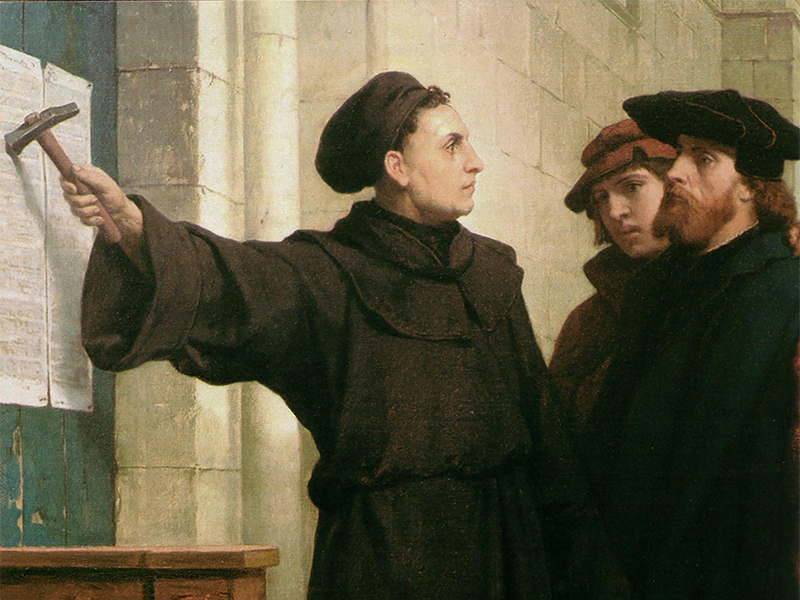
The ‘Splainer: What is ‘Reformation Day’? | Religion News Service

webrns-splainer-reformation-102816(RNS) Reformation Day is mainly marked by Lutherans and members of the Reformed Church, and in some churches it has developed into a holiday meant to rival Halloween. But does it? Let us ‘Splain . . .

Source: The ‘Splainer: What is ‘Reformation Day’? | Religion News Service

Mission to Seafarers

Screenshot 2016-08-08 13.40.31

Though Sea Sunday (July 10, 2016) has passed it is always the right time to reflect on the work others (like seafarers) do for the common good. Want to get an idea of how dependent we are on the sea, ships, and seafarers? Start with this article from Vox.com: This is an incredible visualization of the world’s shipping routes. The article features an interactive map that helps you visualize the extent of shipping traffic.

As a church we seek to minister to those who labor on ships and in ports throughout the world (including our own Port of San Diego). Here is more about the Mission to Seafarers (MtS):

A Bible Study Opportunity

Here is yet another way to join a group Bible Study

The Archbishop of Canterbury was joined by thousands of Christians around the world today [5/19/2016] for his first live Bible study on Facebook. Archbishop Justin Welby discussed John 1:35-42 with the Revd Chris Russell, the archbishop’s advisor for evengalism and witness, and answered questions from viewers.

Read the entire post on Anglican Communion News Service

Maybe this is just what you were looking for.

Image: ACNS


What do hear?

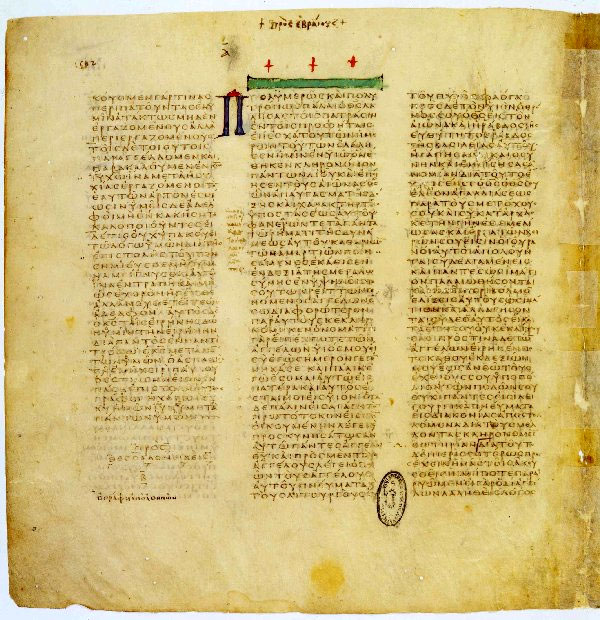
codex_vaticanus_b2c_2thess-_32c11-182c_hebr-_12c1-22c2

Catholic scholars drive a new wave on the New Testament (via Crux)

A new generation of scholars—many of them Catholic—are at last coming at the subject of New Testament scholarship with some humility and common sense.

The turning point in the scholarship has been the increased understanding of the relevance of the first century Jewish context  of the New Testament. As scholars and archeologists have uncovered an increasing amount of information about first century Jewish culture, beliefs and writings, they have come to understand more deeply the meaning and historicity of the gospels.

Put simply, a deeper understanding of first century Judaism has illuminated the New Testament, not only revealing new depths of meaning, but also affirming its early date and historical authenticity.

I encourage you to read the whole post on the Crux website. Let it inspire you to continue to do your own research and decision-making as you keep learning. ~Dan

Image: Page from Codex Vaticanus; ending of 2 Thes and beginning of Heb on Wikipedia