
Giving voice to our Baptismal Covenant

Baptized with water and the SpiritWe live by our Baptismal Covenant (Book of Common Prayer 304-305). Among the questions and promises:

Will you strive for justice and peace among all people, and respect the dignity of every human being? (Our Response): I will, with God’s help.

On April 26, 2016 the bishops of North Carolina responded to recent legislation in North Carolina (HB2) that “overtly discriminates against LGBT people and goes further by cutting back on protection against discrimination for anyone in the state.” Their response comes as they fulfill their responsibilities as baptized persons and as bishops of the church. Here is the introduction to their letter. I encourage you to read their entire letter as you consider how you are to live into the promises you’ve made as a baptized person.

Dear brothers and sisters in Christ,

In our baptismal covenant, we commit “to strive for justice and peace among all people, and respect the dignity of every human being.” For many, this is the most difficult promise in the covenant, as it calls us to move beyond our differences, expectations, fears, prejudices and misunderstandings about other people and meet them where they are. At times, it means standing up in the world and speaking truth to power, knowing that there will be resistance. This promise takes us out of our comfort zone and into the uncharted territory of God’s grace.

In the highly polarized and political environment in which we live, we may be tempted to take sides on an issue or to back off entirely and be silent. But the issue of discrimination is not partisan, nor is it secular. The practice of discrimination by a state or institution limits, even prohibits, us from respecting the dignity of another human being. It inhibits our very capacity to care for one another and to work for the common good. This affects all people.

Read the entire letter here: North Carolina bishops issue statement regarding HB2 as reported by Episcopal News Service (ENS).
Remember

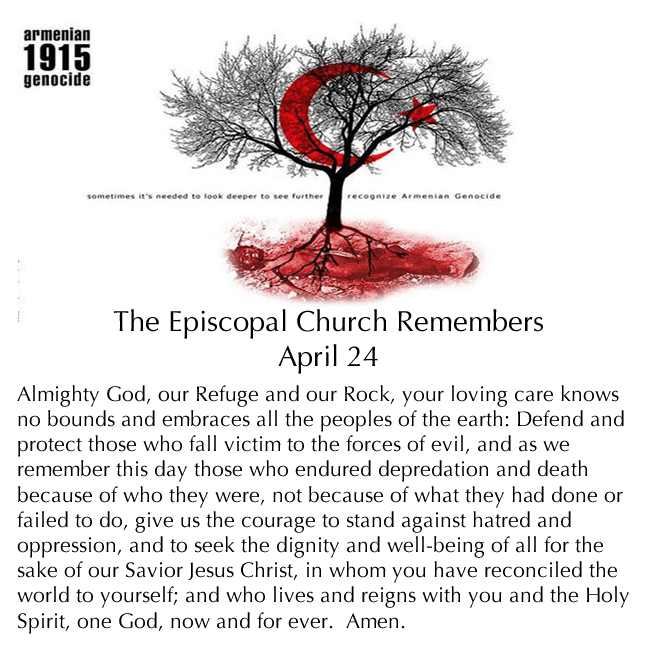
Remembering the Armenian Genocide

As you remember we direct you to a previous post: One Million Bones. Beyond remembering, the Spirit urges us to actions of healing and reconciliation and the promoting of a just peace throughout our world.

Prayers to begin, but what is to follow?

2016-04 Lahore

April 4, 2016 [ACNS, by Gavin Drake] Around 200 Christians, Muslims and Hindus gathered yesterday (Sunday) at the site of last weekend’s horrific Easter Day bomb attack for a united act of solidarity and sympathy for the victims of the attack.

This weekend’s gathering at the Gulshan-e Iqbal Park began with a peaceful demonstration at 5.40 pm – the exact moment that last week’s blast occurred.

[…] Candles were lit and Christian, Muslim and Hindu religious leaders – including the Moderator of the Church of Pakistan, Bishop Samuel Azariah, joined hands as they prayed for the victims and their families.

Amongst the 200 people present were representatives from the Episcopal Church’s Diocese of Louisiana and the presbyterian Church of Scotland. The Church of Pakistan is a United Church. In addition to being a province of the Anglican Communion it is also a member of the World Council of Reformed Churches and the World Methodist Council. See: http://www.anglicannews.org/news/2016/04/multi-faith-vigil-for-lahore-easter-bomb-victims.aspx on Anglican News Service

As the article goes on read how the Archbishop of Canterbury was confronted with words asking for more than platitudes, no matter how compassionate. The Archbishop’s unnamed friend was asking for involvement.

What do you hear the Spirit saying?

Photo Credit: Diocese of Raiwind on Anglican News Service

Head of Judas | Art for Lent 5C

At the heart of the matter

John 12:4-6
But Judas Iscariot, one of his disciples (the one who was about to betray him), said, “Why was this perfume not sold for three hundred denarii and the money given to the poor?” 
(He said this not because he cared about the poor, but because he was a thief; he kept the common purse and used to steal what was put into it.)
Head of Judas
Head of Judas
Pencil, black chalk, paste, and watercolour, 562 x 435 mm
Musées de Strasbourg, Strasbourg
Westfälisches Landesmuseum, Münster
LEONARDO da Vinci
(b. 1452, Vinci, d. 1519, Cloux, near Amboise)
Click image for more information.

______________
Commentary by Hovak Najarian

Head of Judas, c.1495, Mixed Media, Leonardo da Vinci, 1452-1519

“The Last Supper” – a large mural in the refectory (dining hall) of the Convent of Santa Maria delle Grazie, Milan – took Leonardo three years to complete. Leonardo had in mind a physical likeness of each disciple and was known to leave his work to seek the image he wanted. Upon finding a face with the right characteristics, he would follow them unnoticed, observe them closely, and later make multiple sketches. The prior of the convent complained at length about these delays. On many days Leonardo would come to the refectory just to sit, observe, and think without picking up a brush; yet other days he would paint all day without a break.

Some of the sketches Leonardo made for the face of Judas have been lost and the one presented here (from the Strasbourg Museum, Germany) and others like it, is very likely to be a tracing made by one of Leonardo’s pupils. The “Judas” portion of a sketch of “Judas and Peter,” at the Ackland Museum at Chapel Hill, North Carolina is virtually identical to the Judas at the Strasbourg Museum. It is likely it also is a tracing made directly from Leonardo’s cartoon for “The Last Supper.”

When it is not known if a work is from the direct hand of a particular artist, historians and authenticators seek clues from sources such as notebooks, correspondence, sales records, materials (pigments, paper, etc), as well as an analysis of stylistic similarities to known works. Museums enjoy the prestige associated with possessing the work of a renowned artist and when authenticity has not been established fully, museums may connect a work to an artist by using terms such as, “Attributed to…” or, “Pupil of…”

In the facial expression and body language of each disciple, Leonardo sought to convey the very moment Jesus announced that one among them would betray him. In “The Last Supper,” Judas, in profile, is the fourth figure from the left. He is looking toward Jesus and was taken aback when he heard Jesus’ words. He is seated in shadow, his elbow is on the table, and he is clutching a money purse. Salt has spilled from a tipped shaker that is near Judas’ hand. The salt makes a symbolic connection to the Near-Eastern saying, “betray the salt,” meaning to betray one’s master.

Note

No…the man selected by Leonardo to be the face of Judas in “The Last Supper” was not the same person whose face was used to portray Jesus. This contrived story tells of an innocent young man who was selected to represent Jesus but later became a degenerate criminal with a face that personified evil. According to the legend, Leonardo did not recognize the man and used his face again; this time to portray the face of Judas. Like e-mail misinformation that is forwarded repeatedly as “fact,” this fabricated story continues to be told.

Because of the prior’s incessant complaints, Leonardo joked with the Duke of Milan, that if he couldn’t find a face for Judas, he might use the prior’s face. The duke mentioned this to the prior who did no more complaining.

Hovak Najarian © 2013

March 8th: International Women’s Day


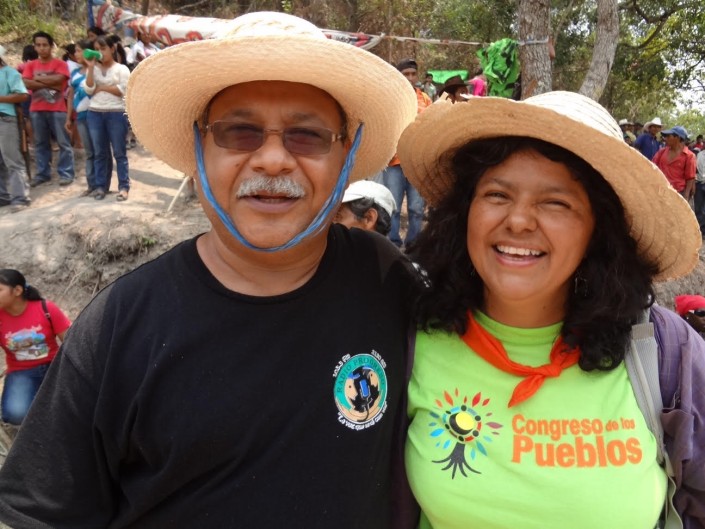
berta-y-melo-705x529
Ismael Moreno Coto, S.J. and Berta Caceres, 2013

On Thursday, March 3, 2016 Berta Caceres was murdered in Honduras.

Honduran indigenous leader Berta Caceres, who won the 2015 Goldman Environmental Prize for her role in fighting a dam project, was shot to death Thursday by attackers who broke into her home, authorities said.

Caceres, a 40-year-old Lenca Indian activist, had complained of receiving death threats from police, soldiers and local landowners because of her work.

Tomas Membreno, a member of her group, the Indian Council of People’s Organizations of Honduras, said at least two assailants broke into the home and shot Caceres in the town of La Esperanza. http://wapo.st/21jlQvj

As we consider the role of girls and women in the Global Goals established by the United Nations, let us remember the courage and the work of Berta Caceres.

For further consideration

Pain and Rage for the Loss of Berta Cáceres  by Ismael Moreno Coto, S.J. on the Ignatian Solidarity Network, 3/7/16

A killing in Honduras shows that it may be the world’s deadliest country for environmentalists in the Washington Post 3/3/16

Image: Ignatian Solidarity Net

Look again

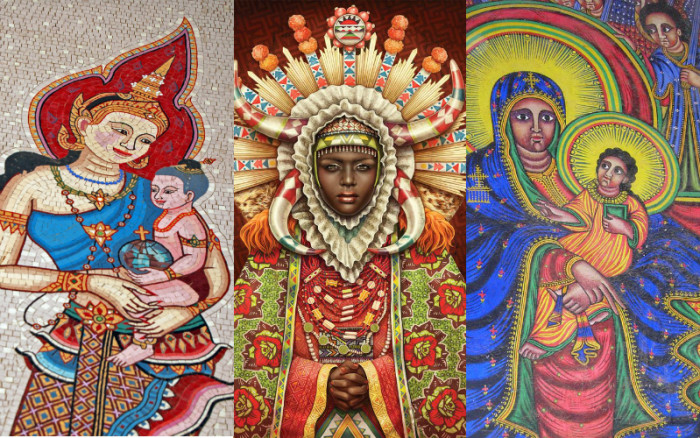
mary-700x438

How would you picture Mary?

The Blessed Virgin Mary was thoroughly Jewish. Different cultures and ethnicities have often portrayed her, Jesus, and others from the Bible as being from their group.

Since Christianity for many centuries was based largely in Europe, these important characters of salvation history have often been depicted as white Europeans. Which is fine! But other cultures have also depicted them according to their own appearances.

Take a look at how others have pictured Mary: 13 Beautiful Non-White Depictions of the Blessed Virgin Mary a post on ChurchPop by the Editor

Image: via ChurchPop

Work at being ordinary

Paul Kowalewski publishes a daily essay on his blog Desert Retreat House. In the post for Monday, February 22nd he writes:

On this ordinary Monday, plenty of people are off to work or school or off to the market or perhaps off to the gym, off to accomplish the everyday tasks of their routine lives. This sure doesn’t sound very exciting, but in fact if we just pay attention to the seemingly uneventful moments in life and work at being ordinary, a whole world of miracles unfolds without end.

The essay is an extended invitation and a meditation to “pay attention” as we move along the Way into our week. Read the entire post.

What do you hear the Spirit saying?

Speaking for the Victim – inward/outward

Refugees coming ashore. Reuters image.

From Reuters (1/29/16) Deadliest January on record for refugees raises alarm

Consider:

To speak for the victim, for the forgotten and killed, requires not only the Spirit’s truthfulness, to give us the awareness of this ‘memory of suffering’ but also an opening of our mouths….

Read more: Speaking for the Victim – inward/outward

The ‘Splainer: Can the Anglican-Episcopalian marriage be saved?

This is a good introduction from Religion News Service (RNS) to the recent decision of the leading bishops of the Anglican Communion (“the primates”) to remain together but in a divided way. Confusing? Yes. This helps set the foundation and offers some history. I encourage you to read more on your own, pray, speak, study, and decide for yourself what the Spirit is saying. ~Daniel Rondeau

The Anglican Communion has voted to suspend the Episcopal Church, its American branch, from participating in decision-making and governance for three years. The move came in a private meeting of Anglican leaders in Canterbury, England and is designed to send a message — Anglicans feel the decisions Episcopalians have made regarding gay clergy (they got ’em), same-sex marriage (they do ’em) are out of line with what the the majority of Anglicans consider Christian doctrine. Read more on Religion News Service http://bit.ly/1KnxLjJ

What poem speaks to you?

Is there a poem you most need as you step further into the new year? Is there a poem written on your heart—suddenly there when you most need it?

It’s that time of the year: the time when I need to carry my favorite poem in my pocket and read it frequently. I do this to inoculate myself against the fantasies that come up about now. Not Christmas fantasies of sugar plums dancing in my head—New Year’s fantasies.

As a new year approaches I begin to imagine that I will finally grab the reins of my life and get things under control. […]

I don’t actually have to put the poem in my pocket, for I carry it within me, recalling its images whenever I need them

What is the poem? The Avowal by Denise Levertov. Why does this work for Roger Owens? Why is it something to take with you as you follow the Way? Read Owens’ essay on The Christian Century and discover for yourself.