Art and wonder

An insight into why we post art and music and why art and music are an important part of our Sunday Morning Forum:

The purpose of art is the gradual, lifelong construction
of a state of wonder and serenity.

Glenn Gould, pianist

From the Word for the Day (5/7/13) posted by Gratefulness.org

What do you hear? What do you see? How does the ‘Seer’ speak to you?

In the Sunday Morning Forum (5/5/13) we looked at the Book of Revelation (in a general way) and the appointed reading, Revelation 21:10, 22-22:5 (in a specific way).

In general: What we are hearing (reading, if we must) is a book [Revelation] that is (a) prophetic in content, (b) apocalyptic in form, and (c) pastoral in intent.

Prophetic: the function of the prophet is to interpret history as reflecting the action of God. What we see is what is happening on the human scale; what is really going on is the work of God.

Apocalyptic in form: the word apocalypse is the Greek equivalent of revelatio in Latin. It means to unveil or disclose. What is really going on in history is not evident until the prophet draws back the curtain to show what he has seen.

Pastoral in intent: John writes to strengthen and encourage his fellow Christians in a time of peril. Horrors he knows: he has witnessed (or heard about) the execution of Christians in Rome under Nero in 64, the fall of Jerusalem at the end of the Jewish War in 70, the civil war after the death of Nero in 69, a vast destruction resulting from the eruption of Vesuvius in 80.

Revelation by Holt H. Graham on Bible Briefs from VTS

Another Resource for your Bible study

If the pastoral intent long ago was “to strengthen and encourage … fellow Christians in a time of peril” let us assume the intent is the same today. What ‘perils’ do you hear about? What perils do you see? What does the ‘Seer‘ speak to you as you process what you hear and see? The conversation on Sunday was lively. There is much around us to cause fear, dismay, despair. More importantly, as we looked more closely at the text of Revelation (a text we’ve been reading for a while now) we did indeed find encouragement.

Share your thoughts in the Comment section. We want to continue the conversation.

Sarah Josepha Buell Hale

Sarah Josepha Buell Hale as pictured in Godey's Lady BookOn our “Wednesday Morning Spiritual Day Hike” we walked with Sarah Josepha Buell Hale yesterday (5/1/13). Sarah Hale is commemorated in the Episcopal Church’s (trial) Calendar, Holy Women, Holy Men on April 30th.

Sarah, a woman ahead of her time in some ways, was a woman of her time in others. Shining through it all: her love of God and neighbor. She continues to inspire folks she never met living some 200 years later in a part of her country she never visited. The Communion of Saints is an amazing thing.

Watch, Sarah Hale: The Mother of Thanksgiving, an Audio Slide Show posted by BackStory with the American History Guys

The Collect of Day as we commemorate Sarah Hale:

Gracious God, we bless your Name for the vision and witness of Sarah Hale, whose advocacy for the ministry of women helped to support the deaconess movement. Make us grateful for your many blessings, that we may come closer to Christ in our own families; through Jesus Christ our Savior, who lives and reigns with you and the Holy Spirit, one God, for ever and ever. Amen..

“My Shepherd Will Supply My Need”

I was reminded of this adaptation of the 23rd Psalm the other day and wanted to share. What a beautiful thing to remember.

(arranged by Mack Wilberg)

My Shepherd will supply my need:
Jehovah is His Name;
In pastures fresh He makes me feed,
Beside the living stream.
He brings my wandering spirit back
When I forsake His ways,
And leads me, for His mercy’s sake,
In paths of truth and grace.

When I walk through the shades of death
Thy presence is my stay;
One word of Thy supporting breath
Drives all my fears away.
Thy hand, in sight of all my foes,
Doth still my table spread;
My cup with blessings overflows,
Thine oil anoints my head.

The sure provisions of my God
Attend me all my days;
O may Thy house be my abode,
And all my work be praise.
There would I find a settled rest,
While others go and come;
No more a stranger, nor a guest,
But like a child at home.
–Isaac Watts (1674-1748)

Wind Chimes: 28 Apr 2013

“I give you a new commandment,
that you love one another.
Just as I have loved you,
you also should love one another.”

John 13:34

Today (4/28/13) we listened to these words of Jesus from the Gospel of John. Getting home I found this post by Brian McLaren:

I compiled this list of “one-anothers” in the New Testament, a primer on a basic social practices. Not a bad curriculum!

  • “…be at peace with each other.” (Mk. 9:50, 1 Thes. 5:13, 1 Pet. 3:8)
  • “wash one another’s feet…. serve one another in love.” (Jn. 13:14, Gal. 5:13)
  • “Love one another. As I have loved you, so you must love one another.” (John 13:34; 15:12; 15:17; Romans 13:8, 1 Thes. 4:9, Heb. 13:1, 1 Pet. 1:22, 1 Pet. 3:8, 1 Pet. 4:8, 1 Jn. 3:11, 23; 1Jn. 4:7, 11; 2 Jn. 1:5)
  • “Be devoted to one another with mutual affection.” (Romans 12:10)

Brian has quite a list of ‘one-anothers.’ See for yourself. Then comes the challenge: to live (act) like we understand, believe, and cherish these words.

DivLine360x12

It sounds like the chimes have heard the Good News and are singing, “Love one another,” over and over (until we have the melody), “Love one another.”

What do you hear?

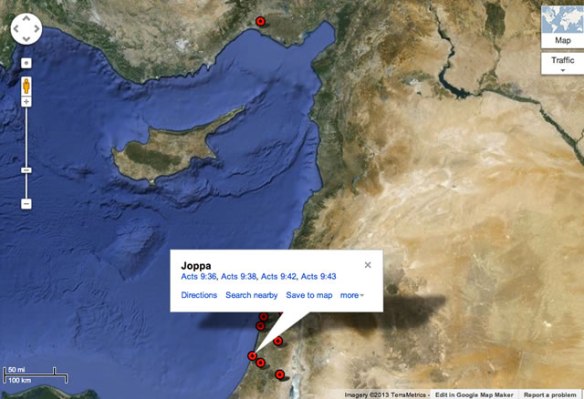
Where is Joppa? Well, we have an app for that.

Preview Map from Bible Geocoding for Acts 9On Sunday (4/21/13) we listened to a reading from Acts 9 (verses 36-43). In the reading we learned that Peter was in Lydda when he was summoned to Joppa. In Joppa he raised Tabitha (Dorcas) from the dead and restored her to the community.

Setting aside the discussion about the historical accuracy of this account (or of Acts in general) and setting aside the discussion of miracles (for now), a 21st century American studying this account may wonder where these two towns were/are located. Fortunately, we live in an age where we “have an app for that.”

In this case we have a website and an app to help us locate Lydda and Joppa (well, modern cities overlaying an ancient landscape really).

If you already have Google Earth try out Bible Geocoding. If you do not have Google Earth, no problem: click on “preview” when seeking to locate a place named in the Bible and you will get plenty of information. For example, here is the “preview” of all the places listed in Acts 9.

We (the authors and editors of this blog) are working to build a Resources Page for your use. Our goal is to have the page active by the end of April. If you have an internet resource you would like to share, please share it via the Comments section. Let us help each other.

Wind Chimes: 23 Apr 2013

“The spirit of Christ must be the soul of all real social reconstruction.”

Toyohiko Kagawa (1888 – 1960)

Since 2009 the Episcopal Church has been exploring a revised Liturgical Calendar titled Holy Women, Holy Men. Stories of women and men living exemplary lives are finding a wider audience. The stories call forth the best in us and pose questions for us who continue our journey on the Way. Today, April 23rd, the church remembers Toyohiko Kagawa a “Prophetic Witness in Japan.”

Toyohiko Kagawa was a

Image of Toyohiko Kagawa on Holy Women, Holy Men“Japanese Christian social reformer. He came of a wealthy family and received his early education in a Buddhist monastery. After conversion to Christianity and disinheritance by his family, he studied at the *Presbyterian seminary at Kobe from 1905 to 1908. Here he became acutely conscious of Christian responsibility in the face of existing social evils and spent several years among the poor in the bad slums of Shinkawa. In 1914 he went to Princeton, USA, to study modern social techniques, and after returning to Japan in 1917 devoted himself entirely to the improvement of social conditions.”

Oxford Dictionary of the Christian Church

Within the political rhetoric of our country today, we who follow Christ, who follow the Way (of Love) can best love our neighbor if we can hold fast to that ancient truth discovered and lived by Toyohiko Kagawa: “The spirit of Christ must be the soul of all real social reconstruction.”

DivLine360x12There’s a peaceful rhythm to sounds in the chimes today. The melody is simple:
have the Spirit of Christ … have the Spirit of Christ …have the Spirit of Christ
What do you hear?

How does ‘the Way’ go for you?

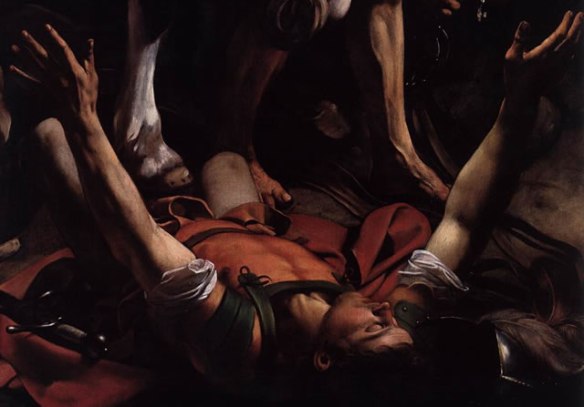
We talked about Saul’s conversion (Acts 9:1ff) on Sunday. As always, Forum members voiced a number of questions, expressed their wisdom learned by experience, and each of us left a little fuller and richer for the fellowship and conversation.

detail-conversion

Some random observations and questions from Sunday:

  • Though much of our art and poetry have God knocking Saul off his horse, the text makes no mention of horses
  • Saul is on his way to round up (and punish) any who “belonged to the Way” (v. 2) This is one of the earliest appellations used for those later called “Christian” (See also: Acts 18:23-26; Acts 19:23; Acts 24:14, 22)
  • The term “Christian” was first used in Antioch (c.40-44 CE) according to Acts:
    • 25 Then Barnabas went to Tarsus to look for Saul, 26 and when he had found him, he brought him to Antioch. So it was that for an entire year they met with the church and taught a great many people, and it was in Antioch that the disciples were first called “Christians.” Acts 11:25-26 NRSV
  • When one of our members suggested that there is often “conversion” (or recommitment in trust) as a response to trial, darkness, dryness, or the ‘Valley of the shadow of death,’ there were many nods and affirming comments.
  • Does conversion come best, deepest, profoundly, only through a ‘dark moment,’ a trial, a letting-go? A question for the week. A question for you.

Come back, as the week progresses we’ll work through some of the other comments from Sunday. Please continue the Sunday conversation by commenting here.

Wind Chimes: 13 Apr 2013

Diana Butler Bass is a favorite author, writer, speaker, and teacher. In early March she posted this to her Facebook Page:

Was asked by an evangelical friend who has found his way to an Episcopal Church WHY the congregation likes scholars like Dom Crossan. Here’s part of my answer:

“Since I wasn’t at Dom’s presentations at the church you mention, I can’t speak directly to them. But I can speak to the ethos of the Episcopal Church. The Episcopal Church understands itself as a big room, a community bound together by prayer and enacting justice, not a particular way of understanding scripture or theology. It is a comprehensive church, one that prides itself on holding a wide variety of views, and always open to new ways of engaging the ancient stories. Thus, as a denomination, everyone is really, truly welcome—and that includes Dom Crossan to Rowan Williams and Marcus Borg to NT Wright! But, of course, not everyone is comfortable with such an ethos. But it does mean that we listen to a wide swath of Christian thinkers — it is NOT unusual at all for a single Episcopal congregation to read books ranging from Crossan to CS Lewis. Or to hear Mary Daly and Phil Yancey quoted in a sermon.”

Every Sunday (at 9 am) we gather at St. Margaret’s in our Sunday Morning Forum. We definitely represent “a wide swath” of Christian thinking and believing. Either before (8 am) or after (10 am) the Forum we worship together and take communion together. Come join us for a wide-ranging discussion, prayers, and communion.

DivLine360x12It is a beautiful spectrum of sounds and rhythms from the chimes today.
What do you hear?

Wind Chimes: 1 Apr 2013

Sister Joan Chittister is one of my favorite authors. Here is her “Easter Prayer.” You can find an index to all of her “Ideas in Passing” here. I encourage you to subscribe to her weekly email.

To say “I believe in Jesus Christ . . . who rose from the dead,” is to say I believe that the Resurrection goes on and on and on forever. Every time Jesus rises in our own hearts in new ways, the Resurrection happens again. Every time we see Jesus where we did not recognize him before—in the faces of the poor, in the love of the unloved, in the revelatory moments of life, Jesus rises anew. The real proof of the Resurrection lies not in the transformation of Jesus alone but in the transformation awaiting us who accept it.

To say, “I believe in Jesus Christ . . . who rose from the dead,” is to say something about myself at the same time. It says that I myself am ready to be transformed. Once the Christ-life rises in me, I rise to new life as well. “Christ is risen, we are risen,” we sing at Easter. But it has a great deal more to do with life than with death. If I know that Jesus has been transformed, then I am transformed myself, and as a result, everything around me.

Until we find ourselves with new hearts, more penetrating insights, fewer compulsions, less need for the transient, greater awareness of the spiritual pulse of life, resurrection has not really happened for us. Jesus has risen but we have not. Resurrection is change at the root of the soul. It marks a whole new way of being in life.

Prayer

Jesus, help me to understand that in every life, something good fails, something great ends, something righteous is taken unjustly away, something looms like an abandonment by God. Give me the wisdom to know that You rose from the dead as a sign to us that every one of these “little deaths” is life become new all over again. Be with me in living Your Resurrection over and over again.

Joan Chittister in: Vision and Viewpoint e-newsletter dated 1 April 2013

DivLine360x12The chimes are fairly shouting praises as they sound today. What do you hear?