Anglican Women gather in New York to consider Communion’s advocacy efforts

Posted On : January 19, 2012 1:40 PM | Posted By : Anglican News Service
By Rachel Chardon, at the Anglican United Nations Office

Quote . . .Twenty Anglican women from countries1 including Australia, Bangladesh, Uganda and India are visiting the Anglican United Nations Office AUNO next month to engage with the UN’s 56th Commission on the Status of Women, which this year has ‘empowerment of rural women’ as its priority theme2.


Read the entire post: Anglican Communion News Service: Anglican Women gather in New York to consider Communions advocacy efforts.

I offer this as an invitation to continue in study, prayer, and action. During Advent and Christmas our Sunday Morning Forum offered several windows into the important work being done on behalf of women.

The article (I encourage you to read the whole post) mentions the need for clean water as a way to empower rural women. Again, our Opportunity Calendar can lead you to more information and your prayers will lead you to action.

Let’s keep learning, praying, and working to extend God’s reign and share God’s Peace, God’s Shalom. ~dan

Beloved! Can you believe it?

This past Sunday we heard the story of Jesus’ baptism. The story has an ending filled with good news: “…a voice came from heaven, ‘You are my Son, the Beloved; with you I am well pleased.'” Mark 1:11

In the Forum discussion we shared our own stories of baptism and the faith within us. In the sharing  we wondered about the mystery of being “in Christ” and if we are in Christ then we, too, are “beloved.” It is almost too good to be true. It certainly is a grace, unmerited, but greatly needed. Several in the group remembered that “being the beloved” was at the center of the writing and teaching of Henri J.M. Nouwen (1932-1996).

To further the Sunday conversation here is Nouwen in his own words:

  • Note: the YouTube video (you will discover) has 8 parts. You will be able to find and select Parts 2-7 in the right hand panel of the YouTube screen when viewing Part 1. Alternatively you can search YouTube using “Nouwen” as your search term.
  • Visit the website Henri Nouwen Society for a wealth of resources
  • Beloved: Henri Nouwen in Conversation was a book read and recommended by some of our members

B Epiphany 2, Art for Readings for January 15, 2012

El GRECO
(b. 1541, Candia, d. 1614, Toledo)
Click to open Web Gallery of Art Artist Biography and to explore other works by this artist.

Apostle St Philip
1610-14
Oil on canvas, 97 x 77 cm
Museo de El Greco, Toledo

Click to open Web Gallery of Art display page. Click on their image to enlarge/fit page etc.


Click to explore El Greco’s Apostolados: the Series of Christ and the Apostles.

Come into an unforgettable Epiphany sermon

Awesome

Laughing Bird Liturgical Resources is “a gift to the wider Church from the South Yarra Community Baptist Church in Melbourne, Australia.” It is one of my favorite places on the net. As the sun rises on this Feast of the Epiphany I invite you to come into the sermon shared by Pastor Nathan Nettleton on 6 January 2005—just 11 days after the worst tsunami in history ended more than 230,000 lives and displaced almost 2 million people in 15 countries. The South Asia Tsunami of December 26, 2004 | Images from the tsunami.

Invitation to the sermon: An Epiphany Tsunami. Here’s how it begins:

Epiphany
An appearance
A revelation
Deep truth suddenly becomes visible
The lights go on

Tsunami
A massive wave
A wave of destruction
An all-powerful surge of chaos and death
But perhaps too, an event where truth suddenly becomes visible
Perhaps too, this can bring light to bear

Epiphany
An appearance
A revelation
A star rises in the West
Who’d even notice
A million stars come out every night
throwing their light in all directions
But they notice these things, those magi
those mystics from the East
from Iraq
To them it’s a sign
A revelation
The lights go on
Deep truth beckons them from the western sky
The plan of mystery hidden for ages in God is emerging
The chosen one is born
The one for whom all the world has been longing
The one before whom the rulers of the earth will bow
The light beckons from the western sky
A journey begins

Tsunami
A wave of power and death
Totally unexpected
Spreading out
East and West, North and South
Awesome, unstoppable, all-conquering
One before whom all bow
or flee
or fall
And after whom all are changed
all are weeping
all are grieving

Finish reading this sermon. YES, it is well worth reading on this Feast of the Epiphany.

Though these words of blessing were composed by Nathan I pray them for you, asking God to bless you, dear reader:

Go now, seek out the Christ wherever he may be found,
and share the good news with all who bear him no ill will.
Bring light to those in thick darkness,
a voice to those no one speaks for,
and hope to those no one cares for.

And may God make you a sharer in the promised light.
May Christ Jesus fill you with his sense of what is right.
And may the Holy Spirit be to you like rain
that gives life to the fertile earth.

A blessing for the Feast of the Epiphany on Laughing Bird Liturgical Resources

More importantly, what does it mean to you?

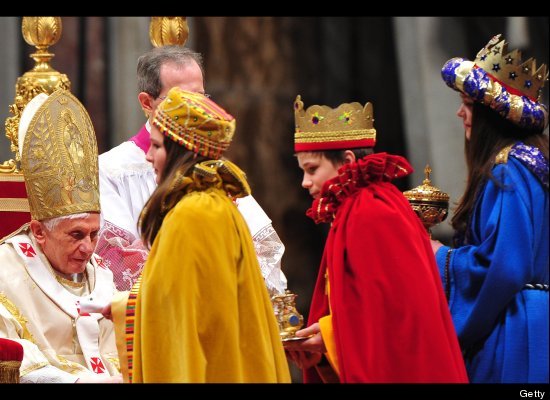
Youths dressed as the three Kings greet Pope Benedict XVI as celebrates the solemnity of Mary the Mother of God mass and the 45th World Day of Peace on Jan. 1, 2012 at the Vatican basilica.

Epiphany. Well, what does it mean to you? What’s the big deal about Epiphany? Decide for yourself.

Here is the “official” description of Epiphany shared by our Episcopal Church in its book Holy Women, Holy Men:

The name “Epiphany” is derived from a Greek word meaning “manifestation” or “appearing.” Anglican Prayer Books interpret the word with an alternative title, “The Manifestation of Christ to the Gentiles.” The last phrase, of course, is a reference to the story of the Wise Men from the East.

A Christian observance on January 6 is found as early as the end of the second century in Egypt. The feast combined commemorations of the visit of the Magi, led by the star of Bethlehem; the Baptism of Jesus in the waters of the River Jordan; and Jesus’ first recorded miracle, the changing of water into wine at the marriage of Cana of Galilee—all thought of as manifestations of the incarnate Lord.

The Epiphany is still the primary Feast of the Incarnation in Eastern Churches, and the three-fold emphasis is still prominent. In the West, however, including Anglican Churches, the story of the Wise Men has tended to overshadow the other two events. Modern lectionary reform, reflected in the 1979 Prayer Book, has recovered the primitive trilogy, by setting the event of the Baptism as the theme of the First Sunday after the Epiphany in all three years, and by providing the story of the Miracle at Cana as the Gospel for the Second Sunday after the Epiphany in Year C.  Page 158

Here is another write up that we can discuss in the Sunday Morning Forum. As you will see, I/we might dispute some of what is written here:

Epiphany — which is variously known as Theophany, Three Kings Day and El Dia de los Tres Reyes — is a Christian celebration of the revelation of the birth of Jesus to the wider world. This is embodied most in the story of three wise men visiting a newborn Jesus with gifts, found in the Gospel of Matthew 2:1-12. Read the article and view more images of Epiphany.

I encourage you to view the pictures that accompany the article (above) about Epiphany. There is no disputing that the Feast is observed and celebrated these thousand of years later in ways to capture the imagination and the heart.

Are you ready for another timely word?

Words are important. We use a lot of words in the Sunday Morning Forum. We hear a lot of words—from scripture and from each other. In Sunday’s Gospel account (12/4/11) we heard that John “appeared in the wilderness, proclaiming a baptism of repentance for the forgiveness of sins.” Mark 1:4. Once again the SSJE brothers give us a word:

REPENTANCE

“Repentance is one of the essential words of the Scriptures. It’s found on the lips of the prophets, it’s found on the lips of John the Baptist, and it’s found on the lips of Jesus himself…. We’re almost programmed to expect words like hellfire and brimstone to follow, and sometimes they do, but we can’t avoid it or do without because it is one of our essential words—and practices.”

-Br. Kevin Hackett via Brother, Give Us A Word a ministry of the Society of St. John the Evangelist (SSJE) in Boston, MA (members are also known as “The Cowley Fathers”)

More on the word:

Repentance: A change of mind or behaviour; this may be attributed even to God in OT (1 Sam. 15: 11). It was demanded of the people whose repentance was often merely formalized in cultic actions and as such condemned by prophets as inadequate and empty (Amos 4: 6; Hosea 6: 4; Isa. 1: 10–17) and without the radical change demanded by the Law. The hope lay in the possibility that one day God would give his people a new heart (Ezek. 36: 26–31) and there would be forgiveness to all who repented (Isa. 1: 18–19). In the NT repentance is called for by John the Baptist (Matt. 3: 9–10) and is to be validated by baptism. The call is repeated by Jesus (Luke 5: 32) and sometimes Paul (e.g. Rom. 2: 4) and in Rev. (2: 5).

“repentance.” In A Dictionary of the Bible. , edited by W. R. F. BROWNING. Oxford Biblical Studies Online http://www.oxfordbiblicalstudies.com/article/opr/t94/e1610 (accessed 07-Dec-2011).

Wilderness is the word. Ever been there?

Wilderness is a word that marks the Second Week of Advent 2011. In Sunday’s Gospel selection we heard that “John the baptizer appeared in the wilderness” (Mark 1:4).

In your meditations this week consider the word, WILDERNESS. From the timely meditations offered by Suzanne Guthrie let these words help you:

Meditation One (introit)
the inner desert

There is a physical desert, inhabited by a few exceptional men and women who are called to live there; but more importantly, there is an inner desert, into which each one of us must one day venture. It is a void; an empty space for solitude and testing.

-Frere Ivan The Desert and the City quoted from The Desert, An Anthology for Lent

He [John the Baptist] is in the wilderness. Obviously because he finds these surroundings appropriate to his life- the parched solitude, the endless spaces, where no one can feel at home. Inevitably we keep discovering that we too are in the wilderness, the wilderness of a great city, the wilderness of isolation, a wilderness that seems to have no center, a wilderness we cannot feel at home in. And we are also men and women who would live in a wilderness if we have to give our outward environment the shape of that which is within us.

-Karl Rahner 1904-1984 sermon for Advent 3(B) from The Great Church Year

From Soulwork Toward Sunday: self-guided retreat Advent 2 (Year B) | At the Edge of Adventure blog

Have you ever been in the wilderness? Physically? What did you learn? Spiritually? What did you learn? Are you there now? What are you learning?

What we are doing on earth—a bishop speaks

The Rev. Dr. Mariann Budde was consecrated as the ninth bishop of the Diocese of Washington on 12 Nov 2011 and was “seated” in her cathedral and preached her first “episcopal sermon” on 13 Nov 2011 in the National Cathedral. You can read her entire sermon here: What we are doing on earth.

To whet your appetite for reading, I offer this tidbit from the midst of her remarks. It is a remeinder to all of us of the unique character of our Episcopal Church (firmly in the “Anglican Tradition”). Enjoy.

My friends of the Episcopal Diocese of this Washington, you have called me to serve as your bishop at a decisive moment of opportunity and challenge for us all. The opportunity is all around us. We of the Episcopal Church have been entrusted with a particular expression of Christ’s gospel that is priceless. Think of what it means to you to have a spiritual home with such an appreciation of mystery and all that is beyond our knowing and curiosity about the world as we can know it through the rigorous inquiry of science.

Think of what it means to you to have a spiritual home that lives the Via Media, the middle way among all expressions of Christianity, affirming the wholeness of faith that can only be fully experienced in the creative tension of polarities — heart and mind, Catholic and Protestant, word and sacrament, mysticism and service, contemplation and social engagement. Think of what it means to you to be part of a Church that does not ask its members to agree on matters of politics or theology or biblical interpretation, but rather to allow the grace of God to unite us at the altar of Christ in full appreciation of our differences and the God-given right of everyone to be welcome at God’s table.

Come back and leave a comment or two. Share your reaction to her sermon. What is stirred up within you? What did you learn? What did you relearn? Let us know by leaving a comment.

Photo: Episcopal News Service

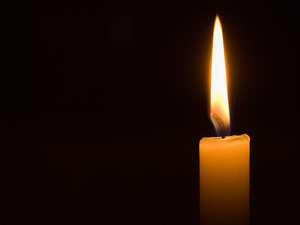
It is better to light one candle, than to curse the darkness

Lighting a candle is a way to let Christ, the Light, into our lives; it is a way to let our light (of care, concern, hope, love, compassion, interconnectedness, peace) shine into the world;  it is an invitation to warmth; the fire of a candle ascends, like our prayer; it can be an offering of self, “our souls and bodies” to  God’s glory. … The lit candle can be our continuing prayer, even when our conscious praying is interrupted or distracted into oblivion.

The lit candle, especially in the darkest part of the night, is a symbol of an unquenchable hope; it is a symbol of a life-giving trust (in God).

I encourage you to light a candle, offer a prayer, give light (no, give the Light you know) to the world.

For further reading and reflection

In many different traditions lighting candles is a sacred action. It expresses more than words can express. It has to do with gratefulness. From time immemorial, people have lit candles in sacred places. Why should cyberspace not be sacred? From the website of Gratefulness.org as an introduction to a sacred space in which you can light a candle.

I have started a Group for us on Gratefulness.org. The Group initials are 4 letters: a-m-e-n. Our group is “amen” (without the quotes). As you complete the guided process to light your candle in cyberspace you will have the opportunity to enter a set of Group initials. Use “amen” (without the quote marks). All candles with the Group initials amen will appear together. If you want to find your candle, use your initials in the space provided.

“Amen.” Of course, this is a common ending to our prayers. To say Amen to a prayer is to say to all who hear “Let it be so, even more than I can say, or more than I can ask or imagine, let it be so.”

Click the image or click here: Light A Candle and go to Gratefulness.org I will greet you there and you will be guided in your candle lighting effort; God will do the rest.

Light a candle in your home or other sacred space and spend time with the light before leaving and then, take that light into the world.

Note: The headline is borrowed from The Christophers and was a frequent mantra while i was hospitalized in 2008-09.

Hymn History: “All Hail the Power”

Church music has such a rich history, but we often know very little about the brave men and women who wrote our beloved hymns. As we transition into Fall, I’m hoping to write a bit more about some of these people–what their lives were like, what they did, and why they might have been inspired to write such powerful music. Today’s focus is on Edward Perronet, who wrote the text to “All Hail the Power (of Jesus’ Name).”

Edward Perronet (1726-1792) was born in Kent, England to a family that had fled France due to religious persecution. His father, an Anglican minister, was strongly supportive of the teachings of John and Charles Wesley and of George Whitefield. Edward also grew up to be an Anglican minister, though he disagreed with many practices of the Anglican church. In the 1740s and ’50s, he spent a great deal of time traveling and evangelizing with the Wesleys. Their group suffered frequent persecution and violence because of their teachings. John Wesley often encouraged Perronet to preach, but Perronet found preaching in front of the Wesleys to be far too intimidating, so he always found ways to avoid preaching in their presence. During one service, John Wesley decided that he had had enough, and, in front of the entire congregation, he called Perronet up to preach. Perronet, realizing that he had no way out, strode behind the podium and said, “I will now deliver the greatest sermon ever preached on earth.” He proceeded to read “The Sermon on the Mount” and quietly sat down.

After several years of ministering with the Wesleys, Perronet decided to part ways. The three felt that they had too many disagreements (and that Perronet was too opinionated) to effectively minister together. It was at that time that Perronet began serving at an independent church in Canterbury, where he worked until his death in 1792. Perronet’s last words were, “Glory to God in the height of His divinity! Glory to God in the depth of His humanity! Glory to God in His all-sufficiency! Into His hands I commend my spirit!”

Perronet wrote most of his hymns and poems anonymously, but “All Hail the Power of Jesus’ Name” was published in 1779, and it has been a standard in most Christian hymnals ever since. It is the only work in his name that is well-known. The song has been referred to as the “National Anthem of Christendom,” and it has been translated into nearly every language. Of it, one writer wrote, “So long as there are Christians on earth, it will continue to be sung; and after that, in heaven.”

All hail the power of Jesus’ Name!
 Let angels prostrate fall;
Bring forth the royal diadem, 
and crown Him Lord of all!

 Ye chosen seed of Israel’s race,
 ye ransomed from the fall,
Hail Him Who saves you by His grace,
 and crown Him Lord of all!

 Let every kindred, every tribe on this terrestrial ball,
To Him all majesty ascribe, 
and crown Him Lord of all!

 Oh, that with yonder sacred throng 
we at His feet may fall!
We’ll join the everlasting song, 
and crown Him Lord of all!

Resources: http://www.theeffectivetruth.info/testep.html, http://www.cyberhymnal.org/bio/p/e/perronet_e.htm