
An Easter Blessing for you

Items of General Interest about liturgy, the liturgical calendar, church customs and culture, our unique “Episcopal vocabulary,” the intersection of faith and culture, and all other items not fitting into the other categories (or fitting into multiple categories).
Behold the Lord’s Servant.
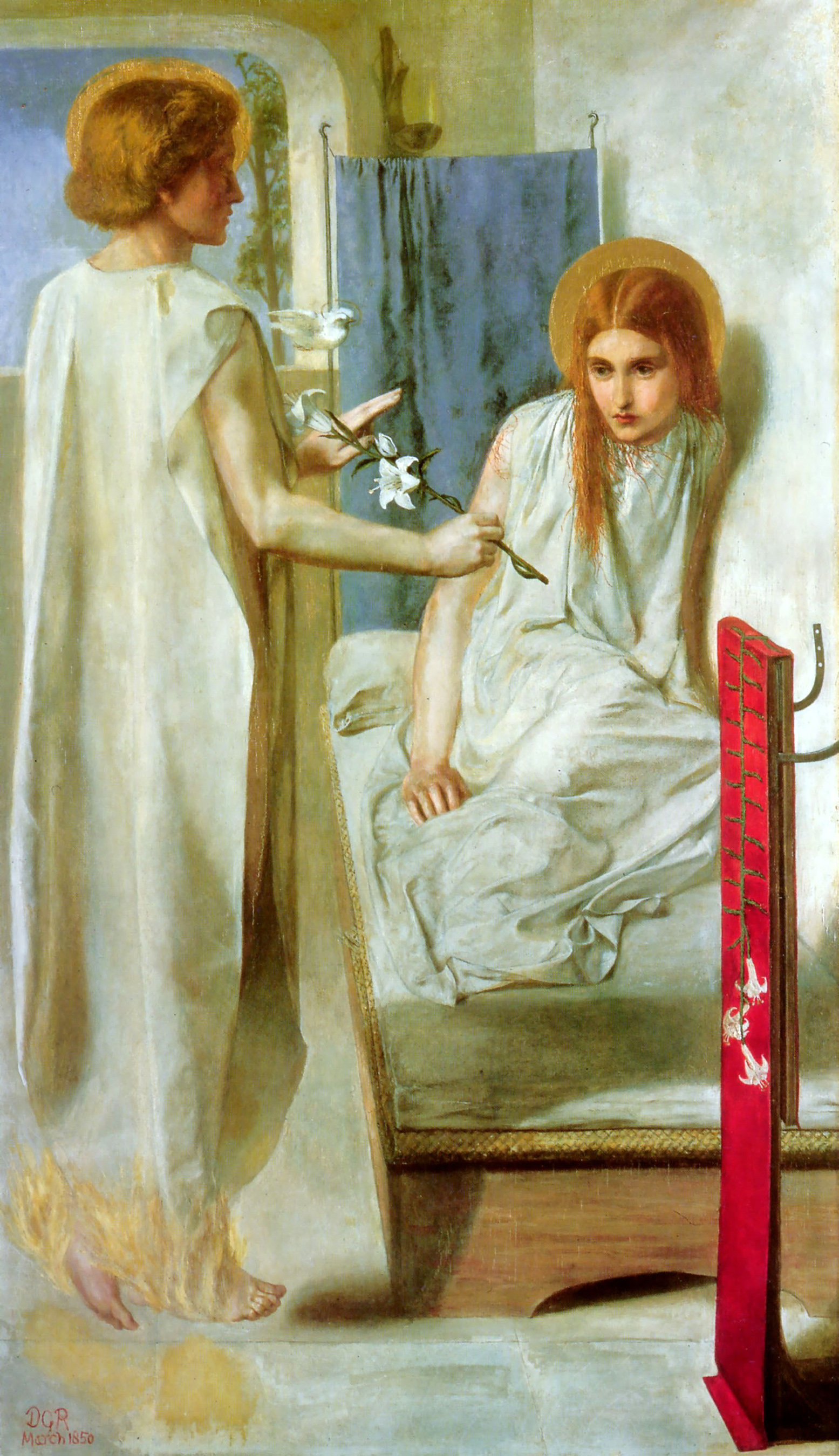
Ecce Ancilla Domini! (Behold the Lord’s Servant)
Painting, 1849-1850
Rossetti, Dante Gabriel, 1828-1882
Pour your grace into our hearts, O Lord, that we who have known the incarnation of your Son Jesus Christ, announced by an angel to the Virgin Mary, may by his cross and passion be brought to the glory of his resurrection; who lives and reigns with you, in the unity of the Holy Spirit, one God, now and for ever. Amen.
The Book of Common Prayer, 240
As this Collect makes clear: it’s all connected. In the life of Jesus—and ours—their is birth, the cross and passion, death, and “the glory of … resurrection.” Let us live life fully. ~Fr. Dan

The Annunciation (pp. 188 and 240)
In the Gregorian sacramentary this collect is used as a postcommunion prayer for the feast of the Annunciation [….] Cranmer translated it:
We beseech thee, Lord, pour thy grace into our hearts; that, as we have known Christ thy Son’s incarnation by the message of an angel; so by his cross and passion we may be brought into the glory of his resurrection; Through the same Christ our Lord
Both the 1662 revision and this [1979] Book made changes for the sake of clarification, though the substance of the original remains. In an admirable way the collect links the Annunciation and the Incarnation with the themes associated with the time of the year [Lent] in which the feast occurs.
Marion J. Hatchett, Commentary on the American Prayer Book, (New York: The Seabury Press, 1981), p. 200
Image: Art in the Christian Tradition (Vanderbilt Divinity Library)
Jesus’ home in Nazareth
This essay originally appeared on Bible History Daily from the Biblical Archeology Society on March 17, 2017. It is an updated version of a 2015 posting.
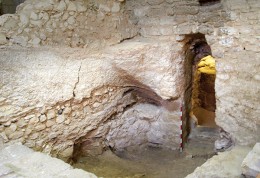
The childhood home of Jesus may have been found underneath the Sisters of Nazareth Convent in Nazareth, Israel, according to archaeologist Ken Dark.
The excavation site located beneath the convent has been known since 1880, but it was never professionally excavated until the Nazareth Archaeological Project began its work in 2006. In “Has Jesus’ Nazareth House Been Found?” in the March/April 2015 issue of BAR, Ken Dark, the director of the Nazareth Archaeological Project, not only describes the remains of the home itself, but explores the evidence that suggests that this is the place where Jesus spent his formative years—or at least the place regarded in the Byzantine period as the childhood home of Jesus.
The excavation revealed a first-century “courtyard house” that was partially hewn from naturally occurring rock and partially constructed with rock-built walls. Many of the home’s original features are still intact, including doors and windows. Also found at the site were tombs, a cistern and, later, a Byzantine church.
The remains combined with the description found in the seventh-century pilgrim account De Locus Sanctis point to the courtyard house found beneath the convent as what may have been regarded as Jesus’ home in Nazareth. Archaeological and geographical evidence from the Church of the Annunciation, the International Marion Center and Mary’s Well come together to suggest that this location may be where Jesus transitioned from boy to man.
Ken Dark also discusses the relationship between the childhood home of Jesus, Nazareth and the important site of Sepphoris. It has been thought that Sepphoris would have provided Joseph with work and Jesus many important cultural experiences. However, Ken Dark believes that Nazareth was a larger town than traditionally understood and was particularly Jewish in its identity—as opposed to the Roman-influenced Sepphoris. This is partially based on the result of his survey of the Nahal Zippori region that separates Sepphoris and Nazareth geographically.
For more on the childhood home of Jesus, read the full article “Has Jesus’ Nazareth House Been Found?” by Ken Dark in the March/April 2015 issue of Biblical Archaeology Review.

Image: Bible History Daily. Description: “This very well could be the childhood home of Jesus. It doesn’t look inviting, but this rock-hewn courtyard house was quite likely Jesus’ home in Nazareth. The recent excavation by Ken Dark and the Nazareth Archaeological Project revealed evidence suggesting this is where Jesus was raised—or at the least the place venerated as such by the Byzantine period. Photo: Ken Dark.”
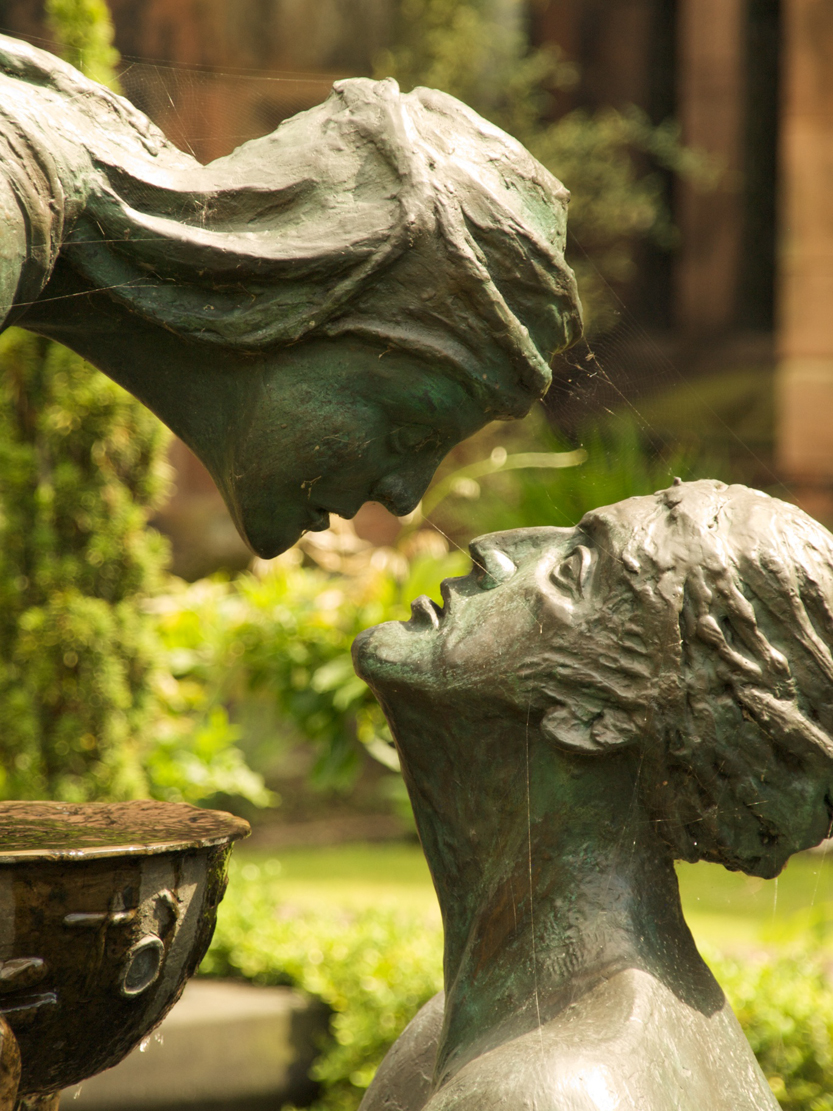
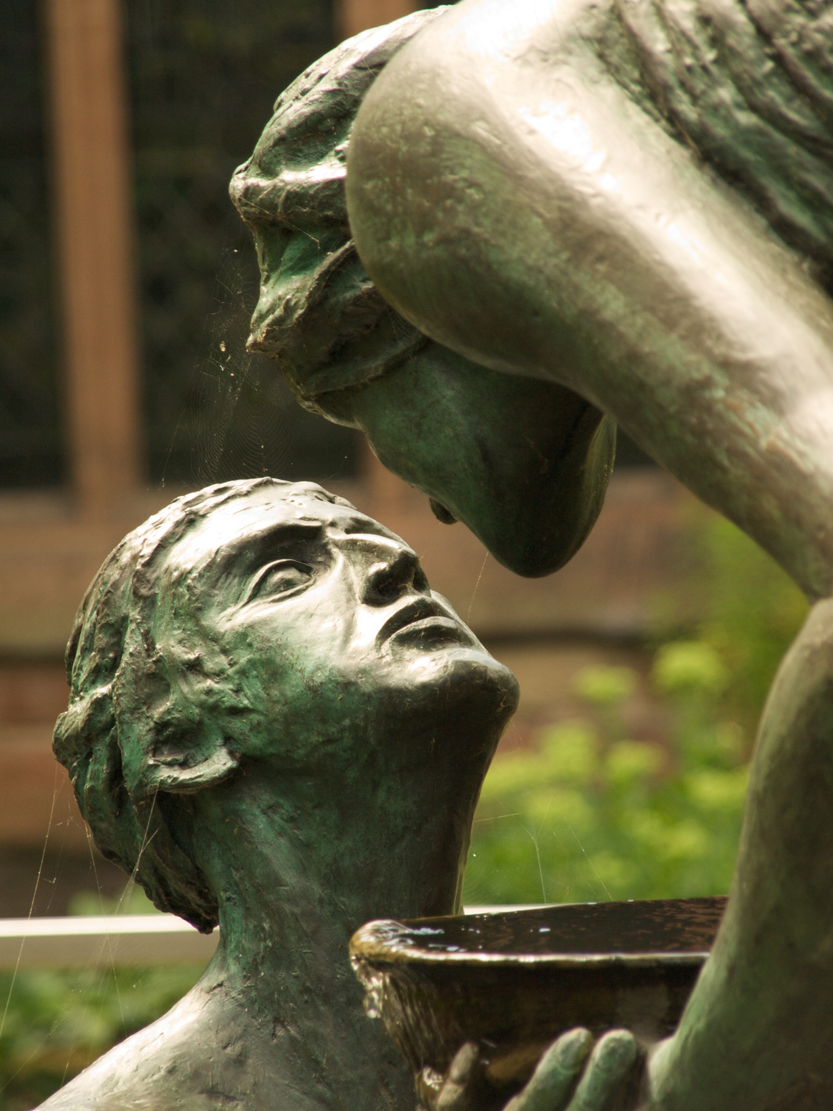
A visual exploration of John 4:14
“Jesus said, ‘ the water that I shall give will be an inner spring always welling up for eternal life” John 4:14

Broadbent, Stephen, 1961-
The Water of Life
Sculpture, freestanding, metal
Chester Cathedral
Chester GB
Click image for more information.
Detail Views
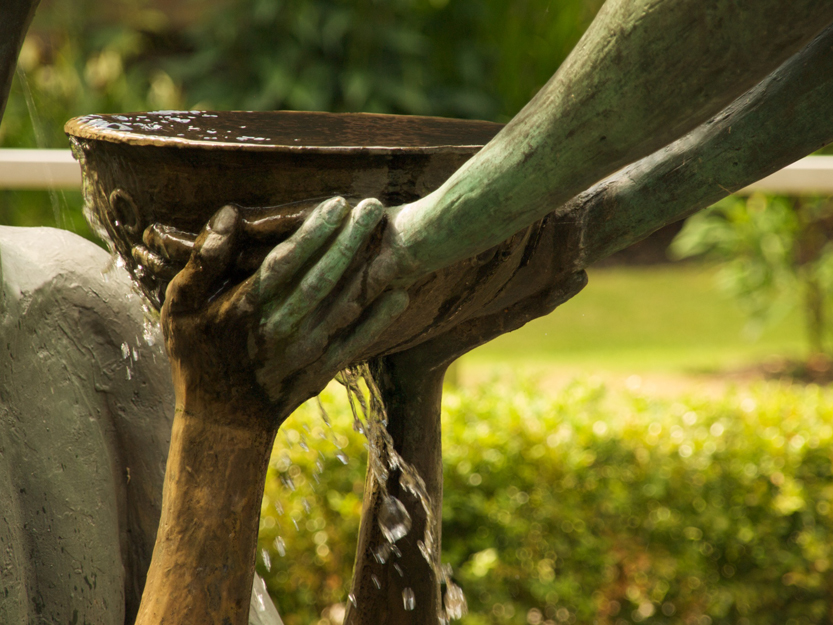
A short introduction to John 4:5-42, the Gospel Lesson appointed for Lent 3A in the Revised Common Lectionary:
Our gospel tells the story of Jesus’ meeting with the Samaritan woman by Jacob’s well. The narrative is rich with themes. Jesus is willing to break with custom in order to talk with one who is both a woman and a foreigner. True worship of God is tied to no particular place. He himself offers living water which wells up to eternal life. The woman learns that Jesus is the expected Messiah, and later others from the town come to believe that he is the world’s Savior. During an interval in the story, Jesus speaks with his disciples concerning his true food and drink, and tells them that the time of harvesting for eternal life is at hand. Introducing the Lessons of the Church Year
Please follow the Case Study link (below) to learn more about this sculpture in the Garden of the Chester Cathedral. ~Fr. Dan
This is the introduction to work of Episcopal Relief & Development (ERD) to promote gender equality, to empower women, and to oppose and heal gender-based violence. The ERD page contains links to specific programs, data about gender-based violence, and an invitation to help heal a hurting world. Read more
Gender equality, women’s empowerment and gender-based violence (GBV) prevention and response are cross-cutting themes that shape and inform all of Episcopal Relief & Development’s integrated programs worldwide. In order to sustainably and equitably address hunger, poverty, disease and post-disaster relief and recovery, local attitudes and customs around gender, power and gender-based violence must also be taken into account.
Gender roles and other social norms impact every area of Episcopal Relief & Development’s work, and addressing gender-based violence (GBV) is a major area of focus. GBV affects the health and well-being of women in every country, regardless of socioeconomic or ‘development’ status, and almost all of our partners identify violence against women and girls as a major obstacle to healthy and prosperous families and communities. There is a great need for the voice and action of faith leaders, communities and institutions to prevent and respond to GBV, and to restore the health, dignity and livelihoods of women and girls affected by violence.
Although GBV is often associated with countries experiencing conflict, it is present everywhere, in various forms such as domestic violence, rape and the marginalization of girls and women across cultures and nations. Stemming from attitudes and practices around gender and power that are deeply ingrained in society and culture, GBV is a sensitive issue and often falls by the wayside of community dialogues and interventions. Change must come from within those communities to be lasting and effective, and faith leaders have a unique position of trust and influence at both the individual and community levels to enable and encourage such change. Our programs aim to empower these leaders and to leverage their roles in their communities to become champions for the support, protection and empowerment of survivors of violence, and of women and girls in general. Read more about this on the ERD website.
Commission on the Status of Women 61 in 2017 (UN Women)
UN Women (Homepage)
Gender Equality, Women’s Empowerment, & GBV (Episcopal Relief & Development)
How women are leading the way to peace and reconciliation.

[L-R] Harriet Baka Nathan & Joy Kwaje Eluzai
Photo Credit: ACNS
Originally Posted on: March 16, 2017 3:28 PM by Anglican Communion News Service (ACNS)
Related Categories on ACNS: apjn, iawn, Other News, South Sudan, Sudan, UN, UNCSW
Key Anglican campaigners for peace and justice in war-torn South Sudan have told a meeting at the United Nations in New York about the vital role women and the church have been playing in peace building and supporting the victims of conflict.
Harriet Baka Nathan, from the Episcopal Church of South Sudan and Mothers’ Union, and Joy Kwaje Eluzai, a member of the country’s national assembly, were speaking to a packed meeting at the UN Commission on the Status of Women.
“Women have become an example to the community,” Harriet told them. “The church has become a role model as we wait for a bigger peace – reconciliation. The women never waited, the Mothers’ Union never waited, the Church never waited. We are donors of ourselves – when the conflict comes, we call a meeting and we give whatever we have.”
Harriet described how the conflict had devastated the country, displacing hundreds of thousands of people. The absence of people to work the land had led to widespread hunger and now there was a famine. She told the meeting how on one occasion, she had been part of a convoy taking aid to displaced people who had fled into the bush.
“God gave me courage to escort 25 tons (of aid) into a camp which was in the bush. This was very dangerous – I could have been raped or killed. But I did not have that fear at all because I was dressed with a spirit of boldness.
“She described how extreme hunger had left many women in the camp bedridden. But once a distribution centre was set up, the atmosphere began to change.
“In a short time there was smoke (around the camp) – people began to make porridge on small fires. Hope came back and then life came back.”
Harriet gave the meeting snapshots of various projects where women were working to bring peace to South Sudan. She said they had initially been left out of negotiations but were now monitoring the implementation of peace agreements and lobbying hard for the agreements to be honoured.
In one example, she explained the vital role women had played in the diocese of Bor, the scene of some of the fiercest fighting. She had realised that bringing peace – and food – among the women would be a uniting factor.
“Because once you unite the women… where are the husbands who will not follow their wives and their children? So as the women (from different tribes) got united – their families began to benefit and slowly these fighting men, who were not coming together, slowly they came in too.
“So the project provided food and united these fighting tribes. Now Bor is a role model for the Church. It has really created hope and it has created peace.”
Harriet also described how thousands of women had benefited from projects in literacy, numeracy and income generation and how better education had given them confidence to participate more fully in society. She said they felt inspired and economically empowered.
She thanked Christians around the world for their ongoing support.
“We are not alone with the Anglican Communion behind us,” she said. “If we were all alone, I don’t think we could make it”.Joy Kwaje Eluzai urged the audience to do more.“We are looking for shoulders to help us,” she said. “How can we reach your governments to make sure that peace is reached in South Sudan? How do we get your support and your strength to tell your governments that we are tired of the war?”
Noting that the theme of UNCSW61 is the economic empowerment of women, she said this had been eroded by the conflict in South Sudan. But she said the country had the desire, energy and the capacity to achieve the goals that had been set out by the UNCSW on the opening day.“t is only with peace that we can put the economic empowerment of women into perspective,” she said. “Economic empowerment of women benefits society. If a woman is empowered, that family is empowered… and her children will never go uneducated.”
The meeting had to be hastily rescheduled by the Anglican Communion team at the UN after a snowstorm hit New York. The UN building was one of many in the city which was forced to stay closed because of the bad weather. Transport was also badly hit. But despite the difficulties, around 60 delegates attended the briefing by Harriet and Joy.
Source: Women ‘donate themselves’ to help find peace in South Sudan campaigner tells UN meeting
Did a plague influence the spread of Christianity?

This post originally appeared in the “Classical Corner” column of the Bible History Daily
 The year was 166 C.E., and the Roman Empire was at the zenith of its power. The triumphant Roman legions, under the command of Emperor Lucius Verrus, returned to Rome victorious after having defeated their Parthian enemies on the eastern border of the Roman Empire. As they marched west toward Rome, they carried with them more than the spoils of plundered Parthian temples; they also carried an epidemic that would ravage the Roman Empire over the course of the next two decades, an event that would inexorably alter the landscape of the Roman world. The Antonine Plague, as it came to be known, would reach every corner of the empire and is what most likely claimed the life of Lucius Verrus himself in 169—and possibly that of his co-emperor Marcus Aurelius in 180. Read the entire post on Bible History Daily
How would you portray the face of Jesus?
Once again we find the intersection of art and faith to be both interesting and challenging. Watch this short video of one priest’s quest over the years to seek the face of Jesus:
The video is part of a story on Religion News Service: The Many Faces of Jesus. What do you think?
A 50 year work of love to restore art for generations to come,.
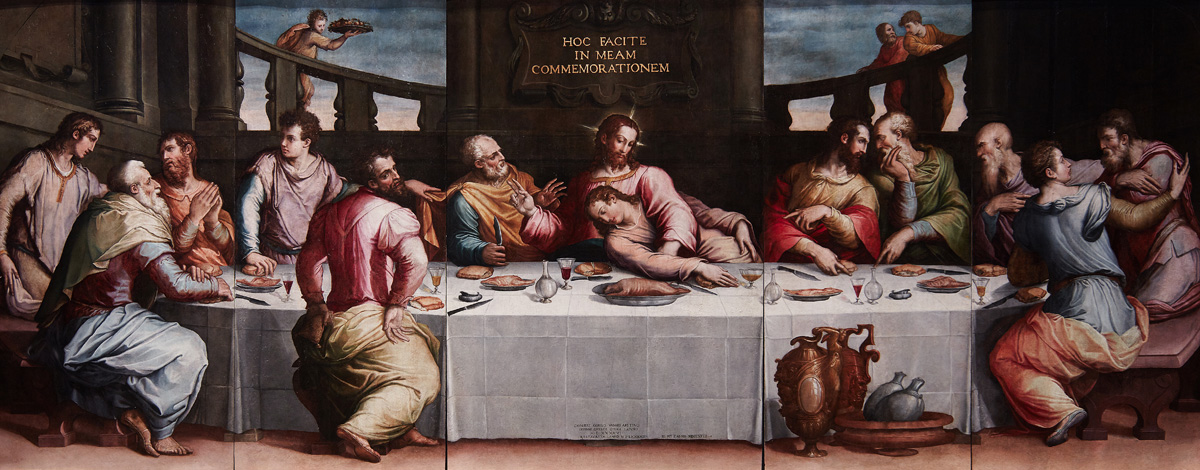
This originally appeared in the March/April edition of Biblical Archeology Review, p. 12
After 50 years, The Last Supper is back on display at the Santa Croce Basilica in Florence.
In 1966, a massive flood filled Florence with water, mud, sewage and debris. The flood wreaked havoc on many of the city’s structures and works of art, including The Last Supper by the Italian Renaissance artist Giorgio Vasari. Measuring 21 by 8 feet, The Last Supper is composed of five panels and dates to 1546. It portrays Jesus’ final Passover meal with his disciples before his arrest and crucifixion. During the flood, the painting—then displayed at the Santa Croce Basilica— was covered with water and mud for more than 12 hours.
When rescuers were finally able to reach the painting, they did their best to stabilize and preserve it, but the damage had already been done. Without the proper technology to restore the painting at that time, they packed up its panels and put them in storage. The painting waited there for 44 years until finally the Opificio delle Pietre Dure (Workshop of Semi-precious Stones), a conservation laboratory in Florence, undertook the feat of restoring it in 2010. The cracked, broken and damaged painting was slowly returned to its original state with the help of a three-year grant from the Getty Foundation as well as with the aid of Prada and the Protezione Civile (Italy’s Department of Civil Protection).
After several years, their work is complete, and The Last Supper can be seen once again at Santa Croce Basilica. Further, to prevent damage from future flooding, a new safety system has been put in place. If the structure should flood again, two winches will lift the painting above the flood line. The system is activated by pushing a button and requires no electricity, so the painting will be secure even if there is a power outage.

Timothy Beal, Case Western Reserve University
For many women, people of color, LGBTQ people, Muslims and immigrants, the victory of Donald Trump seems to have endorsed discrimination against them. Acts of hatred against minorities are surfacing even more brazenly.
College campuses are reporting increasing numbers of incidents of election-related harassment and intimidation. Three days after the election, I saw a “Black Lives Matter” banner on a church wall in Denver splattered with bright red paint.
Many of us feel tremendous grief over what appears to be the end of a certain idea of American democracy. Amidst such pain and loss, many are also desperate for healing. Politicians on all sides are declaring, as Trump himself did on Nov. 9, that “it is time for America to bind the wounds of division.”
The desire to begin healing is certainly understandable. But before we can even begin to hope for healing, we need to grieve. As a scholar and teacher, I explore the many fascinating ways in which biblical images, words and even the idea of the Bible help people make meaning in their lives.
To be sure, there is a lot in the Bible about healing. But there is at least as much about grieving. The biblical tradition emphasizes the importance of grieving before moving toward healing.
To grieve is to embrace the reality of pain and loss.
For many, following the elections, faith in the idea of American democracy has died. Cultural historian Neil Gabler’s “Farewell, America,” published two days after the election, expresses powerfully this sense of the end of faith in America:
“America died on Nov. 8, 2016, not with a bang or a whimper, but at its own hand via electoral suicide…Whatever place we now live in is not the same place it was on Nov. 7. No matter how the rest of the world looked at us on Nov. 7, they will now look at us differently.”
Indeed, irrespective of who got elected, the presidential race itself exposed mortal wounds on our body politic. We are not who we thought we were.
As the way to healing, pastors and religious leaders, including Anne Graham Lotz, daughter of evangelists Billy and Ruth Graham, are calling for prayer and repentance:
“When God’s people will pray with a humble heart, repenting of our sins, then God promises He will hear our prayer; He will forgive our sin and the third element is that He will heal our land.”
Healing is not possible without grieving. The biblical tradition offers an invitation to sit with sadness before reaching for hope and healing. It does not simply allow for grief – it privileges it.
It dwells uncomfortably long in the valleys of loss and despair, refusing to ascend too quickly onto horizons of hope.
The Hebrew Scriptures, in fact, possess a rich vocabulary of grief. Behind the words “grief” and “grieve,” as I found in my research, there are 13 different Hebrew words with connotations ranging from physical injury, to sickness, to mourning, to rage, to agitation, to sighing, to tottering unsteadily to and fro. The most common expressions involve a mix of emotional and physical pain in the face of loss.

This privileging of grief over and before any hope of healing is powerfully expressed in the words of the Hebrew biblical prophets. As theologian Walter Brueggemann shows in his book “Reality, Grief, Hope,” the biblical prophets were not, as we often assume, predictors of the future.
Rather they were poets who, like poets today, offered alternative ways of seeing things – that is, to the way the empire (in their case ancient Israel or Judah) wanted people to see things. The prophet confronted ancient Israel’s imperial ideology of special blessing and national exceptionalism with the realities of exploitation and violence upon which its prosperity was gotten.
Addressing an audience that was in total denial that there were any serious problems in their society, the prophet gave voice to the realities of injustice, and grieved the pain and loss that was the result. They confronted the people’s denial with grief.
Consider these words from the prophet Amos, who addressed the prosperous of northern Israel during the eighth century B.C.:
   Alas for those who are at ease in Zion,
   and for those who feel secure on Mount Samaria,
   the notables of the first of the nations ...
   Alas for those who lie on beds of ivory,
   and lounge on their couches ...
   but are not grieved over the ruin of Joseph!
   Therefore they shall now be the first to go into exile,
   and the revelry of the loungers shall pass away.
Simultaneously pronouncing judgment for their exploitation of the poor and grief over their imminent downfall, the prophet cries out in horror for those who recline in denial of their ill-gotten prosperity and “are not grieved” (from the Hebrew word “chalah,” “made sick”) at the ruin all around.
Though they are guilty, Amos nonetheless laments that they “shall now be the first to go into exile” as a result. The prophet pronounces judgment from the inside, inviting “us” to look at ourselves, to stare at the wounds, to live into the pain, not as a path to healing but as reality in and of itself.
The crux of this “prophetic imagination” is grief. Then, and only then, is it even possible for the prophet to confront the despair of the empire in ruins with hope for the possibility of healing and restoration.
I am sympathetic with those who feel driven to do something, indeed to resist despair and renew the struggle for justice. As the black feminist lawyer Florynce Kennedy famously said,
“Don’t agonize. Organize.”

But what if grief is a kind of activism? What if one of the most subversive acts right now is to give voice to our grief? To refuse to “move on”? Such grief denies denial its power to look away in desperate pursuit of healing. Just as there is no peace without justice, there is no healing without grief.
The day of Donald Trump’s election was also the anniversary of both Kristallnacht – the pogrom in 1938, when Nazi soldiers and German citizens attacked and killed many Jews and destroyed Jewish businesses, schools, and hospitals – and the fall of the Berlin Wall in 1989.
This coincidence reminds us that we together have the capacity for both atrocious horror and miraculous liberation. Even now. The difference may lie as much in how we grieve as in how we heal.

Timothy Beal, Professor of Religion and Chair of the Department of Religious Studies, Case Western Reserve University
This article was originally published on The Conversation. Read the original article.
 Hear what the Spirit is saying