O Antiphons (Dec 17-23)

The exact origin of the “O Antiphons” is not known. Boethius (c. 480-524) made a slight reference to them, thereby suggesting their presence at that time. At the Benedictine abbey of Fleury (now Saint-Benoit-sur-Loire), these antiphons were recited by the abbot and other abbey leaders in descending rank, and then a gift was given to each member of the community. By the eighth century, they are in use in the liturgical celebrations in Rome. The usage of the “O Antiphons” was so prevalent in monasteries that the phrases, “Keep your O” and “The Great O Antiphons” were common parlance. One may thereby conclude that in some fashion the “O Antiphons” have been part of our liturgical tradition since the very early Church. Read more: What are the O Antiphons from Catholic Education Resource Center

Sr. Joan Chittister has provided an entire page to help you pray the O Antiphons (from December 17th through December 23rd). Each meditation is accompanied by a women’s choir chanting the Antiphon in English. Use this online meditation to deepen your prayers as Advent comes to a close and the Nativity arrives.

In the digital age …

… we sometimes lose sight of the passion, dedication, sacrifices, and practical challenges of information sharing in previous ages. Here is a reminder: Let Bidding Begin for the Bay Psalm Book From 1640 (Religion in the New York Times).

Detail. Title Page of the Bay Psalm Book, 1640

From the article:

David N. Redden recited the opening of the 23rd Psalm the way he had memorized it as a child: “The Lord is my shepherd; I shall not want. He maketh me to lie down in green pastures.”

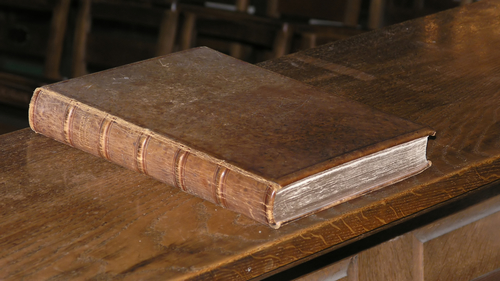
Then he opened a weathered little book and read the version it contained: “The Lord to mee a shepheard is, want therefore shall not I. Hee in the folds of tender-grasse, doth cause mee downe to lie.”

Those lines were in a volume published in Massachusetts in 1640 that amounted to the Puritans’ religious and cultural manifesto. It was the first book printed in the colonies, and the first book printed in English in the New World. The locksmith who ran the hand-operated press turned out roughly 1,700 copies. The one in Mr. Redden’s hands is one of only 11 known to exist.

Read the article online

Read more about the Bay Psalm Book on Wikipedia

Image: Janneman on Wikipedia

The Cross

Mosaic."Transfiguration Cross" in St Apolinare in Ravenna, ItalyIn the last two days Marcus Borg, teacher and scholar, posted a two-part essay on the Meaning of the Cross for Christians. Part 1 described the understanding of the cross held by many (most?) 21st century Christians in the United States (Jesus “paid” for our sins). Part 2 described ancient understandings of the Cross (understandings lost when the currently dominant theme of payment ascended in the 12th century). How is the Spirit speaking to the Church through this scholar? How is the meaning of the Cross (and Resurrection)  expanded or narrowed for you? I commend the two essays to you:
Part 1. Christianity Divided by the Cross

For Christianity from its beginning, the cross has always mattered. The crucial question is: what does it mean? Why does it matter? What is its significance?

Part 2. The Real Meanings of the Cross

In earliest Christianity, the cross of Jesus (always also including his resurrection) was utterly central. Central as revelation of God’s passion and Jesus’s passion for the transformation of this world; and as revelation of the way, the path, of personal transformation.

I invite your comments as we continue the conversation.

Look again/anew at Paul

2013-1014-paul-amongWhat’s the connection between St. Paul’s First Letter to the Corinthians and the second-century Roman novelist Apuleius’s comedy The Golden Ass? More than you might think, says classicist Sarah Ruden in her book Paul Among the People (Image). Ruden, who specializes in ancient Greek and Roman literature, became interested in the preconceptions modern readers bring to Paul’s writing when she began studying the apostle herself. –

Read the interview in US Catholic

We shared the link to the interview on our Facebook Page. Now we share it here. Read the article. Share what you think. Keep the conversation going.

A short note on the Book of Common Prayer

The Book of Common Prayer (1662)

“Ashes to ashes, dust to dust.”
“All the deceits of the world, the flesh and the devil.”
“Read, mark, learn, and inwardly digest.”

Shakespeare? The King James Bible? Close — the Anglican Book of Common Prayer, the liturgical and literary masterpiece that along with the playwright and the landmark Bible helped shape the English language, [marked its 350th anniversary in 2012].

Anglicans Celebrate Book of Common Prayer’s 350th Anniversary by Trevor Grundy for Ecumenical News International and posted by Sojourners on May 2, 2012

From the same article:

The anniversary actually refers to the revised edition that still stands as the official doctrinal standard of the Church of England and most other churches in the worldwide Anglican Communion. After Henry VIII’s break with the Roman Catholic Church, Archbishop of Canterbury Thomas Cranmer set out to replace the Latin missal with a book of liturgical services and prayers in English that would also incorporate theological changes, such as less prominence for saints.

The Prayer Book now appears in many variants in the 77 million-member Anglican Communion and has influenced the liturgical texts of other denominations.

The book’s language — another phrase is “till death us do part” from the marriage service — resonates even today, said Bishop Stephen Platten, chair of the Church of England’s Liturgical Commission. “Even in an apparently secular world, large numbers come to have their children christened or baptized. The cadences of the Prayer Book have become part of a treasury of prayers and reflections that have helped to fashion people’s lives,”

Read the entire post by Trevor Grundy.

Do you have some favorites from the Book of Common Prayer? Share them in the Comments section here. Keep the conversation going …

Divider

Photo from the article by Trevor Grundy via Shutterstock

Wind Chimes: 12 August 2013

“Jesus said, ‘Recognize what is in your sight, and that which is hidden from you will become plain to you. For there is nothing hidden which will not become manifest.’” 

The Gospel of Thomas (c. 60-175 A.D.)
in A New New Testament

The Four Evangelists by Jordaens Lovre
Four Evangelists, Jordaens Louvre (c. 1625-1630)

Are you ready to be stretched a little? A lot? Is it possible that other ancient texts can lead to a deeper understanding of the ‘official’ biblical texts used by Christians of various denominations? A council of scholars and teachers came together under the leadership of Hal Taussig to produce A New New Testament:

Is the New Testament missing a few books? In a move that may seem heretical to some Christians, a group of scholars and religious leaders has added 10 new texts to the Christian canon.

The work, A New New Testament, was released nationwide in March in an attempt to add a different historical and spiritual context to the Christian scripture.

Some of the 10 additional texts—which have come to light over the past century—date back to the earliest days of Christianity and include some works that were rejected by the early church.

The 19-member council that compiled the texts consisted of biblical scholars, leaders in several Christian denominations—Episcopal, Roman Catholic, United Methodist, United Church of Christ and Lutheran—two rabbis and an expert in Eastern religions and yoga.

Read the Religion News Service introduction to this effort. The article (dated March 28, 2013) includes the names of those who helped in the project.

The article points out that “not surprisingly not everyone admires the project.” Read the article, read all (or parts) of A New New Testament and let us know what you think. Continue the conversation here.

DivLine360x12There’s a restless, searching, rhythm in the chimes today.
What do you hear?

The Trinity

We’re now a Sunday past Trinity Sunday (2013). However, finding this YouTube video warrants a revisit to the doctrine of the Trinity. Thanks to the folks at The Lutheran Satire for this short course on the Trinity:

Pentecost in 2 minutes

Yesterday (5/19/13) we shared this video in the Sunday Morning Forum. For those of you unable to join us, please enjoy this 2 minute look at Pentecost offered by the folks at Busted Halo.

Have other questions? Please use our Comment section to continue the conversation.

Grateful for scholars

Geza Vermes
Geza Vermes was known for his skillful translations of the Dead Sea Scrolls, which were first discovered in 1947 and contain the earliest known versions of the Hebrew Bible. (David Levenson / Getty Images / April 22, 1992)

Most of us who study the Bible depend on scholars like Geza Vermes.

All of us who have taken up Bible Study after 1947 (the discovery of the Dead Sea Scrolls) have benefitted from the scholarship (and advocacy) of Dr. Vermes.

Geza Vermes died on May 15, 2013. You can read more about the man in the LA Times: Geza Vermes.

Throughout his life’s work Vermes advocated for wider access to the Dead Sea Scrolls. And this has come about in the ‘digital age.’

The Digital Dead Sea Scrolls Project allows “users to examine and explore these most ancient manuscripts from Second Temple times at a level of detail never before possible.”

Go to The Digital Dead Sea Scrolls Project

A new* study resource introduced

In the Sunday Forum I introduced folks to a new (to us) study resource: The New English Translation of the Bible (NET Bible or NET in abbreviation) was begun in 1995 and published in 2005.

The NET Bible on bible.org

From the Preface to the NET Bible:

The NET Bible (New English Translation) is a completely new translation of the Bible, not a revision or an update of a previous English version. It is being completed by more than twenty biblical scholars who are working directly from the best currently available Hebrew, Aramaic, and Greek texts. The translation project originally started as an attempt to provide an electronic version of a modern translation for electronic distribution over the Internet and on CD-Rom. Anyone anywhere in the world with an Internet connection will be able to use and print out the NET Bible without cost for personal study. In addition, anyone who wants to share the Bible with others can print unlimited copies and give them away free to others.

You can find this resource on bible.org. You can choose to become a registered user or not. The process to become a registered uset is Free and easily done. Registering opens up other ways to use this resource. Even if you don’t become a registered user the NET Bible will be a useful addition for your personal study. I agree with Wikipedia: “The translation is most notable for an immense number of lengthy footnotes (which often explain its textual translation decision), its open translation process, [and] its availability on the Internet ….” Good stuff. ~dan

Check out this resource for yourself:

*That is, new to us in the Sunday Morning Forum (the NET Bible has been online since 2005).