Bulletin Insert: Epiphany 1(A)

Every week the Episcopal Church offers a Bulletin Insert (online and as a PDF). This is from the Bulletin Insert for Sunday, January 8, 2017 (The Baptism of our Lord). ~Fr. Dan

The Feast of the Baptism of Our Lord is celebrated each year on the Sunday following the Feast of the Epiphany on January 6. The event of Christ’s baptism is recorded in all four gospel accounts:

  • Mark 1:9-11
  • Luke 3:21-22
  • John 1:29-34
  • Matthew 3:13-17

Read more here: Bulletin Insert: Epiphany 1(A)

For further reading


Some Epiphany Customs

A man dressed as one of the Three Kings greets people during the Epiphany parade in Gijon, Spain, on Jan. 5, 2017. Photo courtesy of Reuters/Eloy Alonso

A baby in the cake, shoes left out for candy (or coal), a polar bear dip to retrieve a cross: these are a few of the customs explained in a Religion News Service (RNS) “‘Splainer.” Epiphany was celebrated on January 6th, but the RNS post “What is Epiphany?” is still timely. Enjoy the read.

You thought the holidays were over. Technically, no — not until Jan. 6, when Christians all over the world celebrate Epiphany. In some places, the day is known as “Three Kings Day” after the wise men, or Magi, who, the Bible says, brought the infant gifts and proclaimed him the Son of God. In other places, the day is known for giving gifts, for extremely cold baths and for biting into babies. Let us ’splain …

Read “What is Epiphany?” on RNS

Photo from the RNS article

Why Did the Magi Bring Gold, Frankincense and Myrrh?

January 6th is the Feast of the Epiphany in the Episcopal Church. Often we read the account of the Magi offering the baby Jesus gold, frankincense, and myrrh. There is a long history of exploring the meaning of these gifts. The link (below) will give you one insight.

“Were the gifts of the magi meant to save Jesus from the pain of arthritis? It’s possible, according to researchers at Cardiff University in Wales who have been studying the medical uses of frankincense.”

Find out. Read more:  Why Did the Magi Bring Gold, Frankincense and Myrrh? – Biblical Archaeology Society

Creating a Covenant Resolution

Mosaic of the Baptism of the LordThe Episcopal Diocese of Minnesota (Bishop’s Blog) posted a short meditation on entering the new year with the Season of Epiphany on our hearts and shaping our determination to be a follower (and a revealer) of Christ.

… what it would be like to merge our New Year’s resolutions with the Season of Epiphany. What if our New Year’s resolutions were to know and make known Christ in all things? Here’s what I think it would look like: Read the resolutions put forward for consideration

Source: Creating a Covenant Resolution – Bishop’s Blog

Image: Art in the Christian Tradition (Vanderbilt Library)

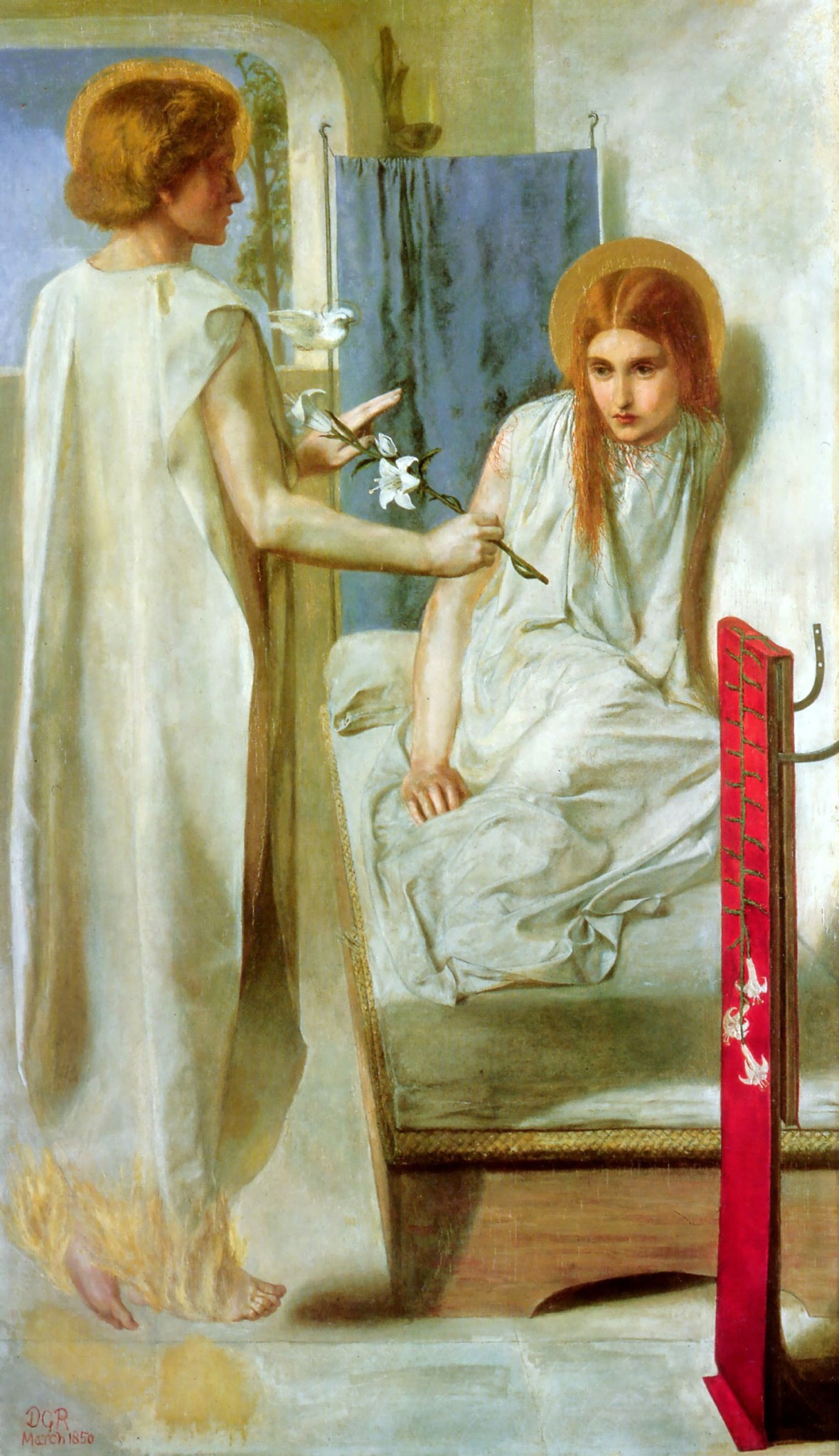
Ecce Ancilla Domini

The Annunciation by Rossetti

Ecce Ancilla Domini, oil on canvas, 1850, Dante Gabriel Rossetti, 1828 – 1882

The Biblical account of the Annunciation: Luke 1:26-38

Commentary by Hovak Najarian

At the time Dante Gabriel Rossetti painted, Ecce Ancilla Domini (Latin: “Behold the handmaiden of the Lord,” also called, The Annunciation), England was the most advanced industrialized nation in the world. In the following year, 1851, the Great Exhibition in London (the first “World’s Fair”) celebrated the advancements of industry and culture. Like leaders of industry, English artists of the day were looking toward the future. Unlike many artists of his generation, however, Rossetti and like-minded friends did not follow their contemporaries. Instead of looking toward new directions in art, they looked back to medieval times and called themselves the Pre-Raphaelite Brotherhood (the name is in reference to a time before Raphael and the fifteenth century Renaissance). Among their beliefs was that art lost its spiritual quality after the Renaissance.

In subject matter, paintings of the annunciation depict the angel Gabriel greeting Mary to tell her she would bear a son and call him Jesus. Fifteenth and sixteenth century artists often placed this event at an intimate indoor setting or on a porch. Mary is pensive usually with a dove, representing the Holy Spirit above her head.

In contrast to idealized settings – often with dramatic lighting – created typically by artists of the Renaissance and beyond, the Pre-Raphaelites depicted subjects as real people in natural surroundings. In Rossetti’s, The Annunciation, Gabriel does not have dazzling rainbow-hued wings and Mary is not sitting in a throne-like chair. Instead, she is on her bed in a loose white nightgown looking as though she was awakened just a few minutes earlier and is now sitting up trying to process the message that Gabriel brought. She seems somewhat bewildered. A wingless Gabriel is standing upright by the bed, looking like an ordinary man floating in air slightly above the floor with his feet in flames. [Rossetti’s brother posed for Gabriel and he was originally without a halo. His younger sister, Christina, posed for Mary.] As in traditional depictions, Gabriel is presenting a lily (symbolizing purity) to Mary; a small haloed-dove is nearby. Although the red rectangular shape in the right foreground may not be recognized immediately, it is a sewing stand with its work-surface folded down. The image on it is a long-stemmed lily that Mary has been embroidering.

When Rossetti’s Annunciation was exhibited initially it did not receive favorable reviews. Critics were not accustomed to biblical subjects being treated in this non-traditional manner.

Notes:

In addition to painting, Dante Gabriel Rossetti wrote poems. The poetry of his younger sister, Christina, however, received far more acclaim. Her, poem, “In the Bleak Midwinter,” was set to music by Gustav Holst and is a Christmas hymn of the Anglican Church. This poem also was set to music as an anthem by Harold Darke. Anglican Churches honor Christina Rossetti with a feast day on April 27th.

Hovak Najarian © 2016
But Grace Awaits – Bishop’s Blog

Bishop Prior is the Episcopal Bishop of Minnesota. I commend his Advent meditation to you.

The Advent season invites us, dare I say challenges us, to NOT fill our waiting space. I know that sounds incredibly inefficient at best and uncomfortable at worst. However, when we allow our waiting space to be an empty place, in my experience, God’s grace begins to seep into our souls.

Source: But Grace Awaits – Bishop’s Blog

#Adventword

Here’s a wonderful opportunity to participate with Christ-followers throughout the world in the Season of Advent: http://bit.ly/1l2y51G

Sign up. Partici[ate. Keep learning.

Remembering St. Andrew, November 30th

Every November 30th the Episcopal Church remembers Saint Andrew, Apostle. Here’s a fun look at the history that has made Saint Andrew important to the Scottish people:

Prayers and readings we use on this day


Last Judgment | Art for A Christ the King

Matthew 25:44-46 “Then they also will answer, ‘Lord, when was it that we saw you hungry or thirsty or a stranger or naked or sick or in prison, and did not take care of you?’ Then he will answer them, ‘Truly I tell you, just as you did not do it to one of the least of these, you did not do it to me.’ And these will go away into eternal punishment, but the righteous into eternal life.”

Last Judgment
GIOTTO di Bondone
Last Judgment
1306
Fresco, 1000 x 840 cm
Cappella Scrovegni (Arena Chapel), Padua
Click image for more information.
Click here to explore the Cappella Scrovegni.

Jael, Deborah and Barak | Art for A Proper 28

Judges 4:4 At that time Deborah, a prophetess, wife of Lappidoth, was judging Israel.

Jael, Deborah and Barak
BRAY, Salomon de
Jael, Deborah and Barak
1635
Oil on panel, 87 x 72 cm
Museum Catharijneconvent, Utrecht
Click image for more information.