But Grace Awaits – Bishop’s Blog

Bishop Prior is the Episcopal Bishop of Minnesota. I commend his Advent meditation to you.

The Advent season invites us, dare I say challenges us, to NOT fill our waiting space. I know that sounds incredibly inefficient at best and uncomfortable at worst. However, when we allow our waiting space to be an empty place, in my experience, God’s grace begins to seep into our souls.

Source: But Grace Awaits – Bishop’s Blog

Black clergy encouraged to reclaim Jesus and his movement

[Episcopal News Service – Houston, Texas] Black clergy from across the Episcopal Church and parts of the Anglican Communion are spending more than four days here exploring how to reclaim the Episco…

A call to, an inspiration for all Episcopalians.

Source: Black clergy encouraged to reclaim Jesus and his movement

The Crucifixion of Christ and the Two Thieves | Art for Proper 29

Luke 23:33 “When they came to the place that is called The Skull, they crucified Jesus there with the criminals, one on his right and one on his left.”

The Crucifixion of Christ and the Two Thieves
MICHELANGELO Buonarroti
(b. 1475, Caprese, d. 1564, Roma)
The Crucifixion of Christ and the Two Thieves
1522-24
Red chalk, 394 x 281 mm
British Museum, London
Click image for more information.

Commentary by Hovak Najarian

The Crucifixion of Christ and the Two Thieves, c. 1522-24, Red Chalk, Michelangelo Buonarroti, 1475-1564

When early Christian artists began creating visual images of their faith they were faced with questions such as what did Jesus look like? Could or should God be portrayed – if so, how? How would the crucifixion be depicted and what would be the shape of the cross?

Although there were fervent associations with the crucifixion, it was not depicted in art for several hundred years after the event. Then, when it began to be shown, artists did not attempt to give a realistic interpretation. Instead, the crucifixion was used as a symbol. It was in the sixth century that scenes familiar to us today began to appear; in the years that followed, details of the event were reconstructed as artists followed biblical descriptions and used their imaginations. Jesus and the thieves were shown on crosses; Jesus in the center and the thieves on each side. At first, only a few people were present but as compositions became more complex, figures were added; among them were disciples, the three Marys, bystanders, and soldiers (one with a spear and others throwing dice for Christ’s cloak). Some artists placed angels above the cross of Jesus and often a skull was placed at the foot of his cross to indicate this was “the place of the skull.”

Michelangelo’s chalk drawing, “Crucifixion with Two Thieves,” was sketched possibly as a study for a painting and was not intended to be a complete or permanent work. Because chalk does not have within it a binding agent such as egg yolk or linseed oil, it can be rubbed off a surface easily. Some details in this drawing are not clear and almost lost.

Michelangelo depicts the crucifixion as it is taking place. A man on the top of the central cross is making an adjustment to Jesus’ arm while a figure is on a ladder at his feet. Another person is on a ladder at the feet of the thief on the right and an additional ladder is being brought to the site; it is presumed this is to reach the feet of the thief on the left whose unsupported legs are dangling loosely. [It also may be interpreted that this ladder is being removed from the scene] Under the cross on the left are two horses (their images are very light and barely distinguishable). Below the central cross, Mary has fainted and is being assisted. Others are consumed with grief.

The familiar Latin cross has a horizontal section approximately one third down from the top but many other forms have been made. In this drawing the thieves are attached to crossbeams at the very top of the vertical posts, whereas the cross on which Christ is placed is “Y” shaped. This was not a Michelangelo innovation; the “Y” shaped cross was among the earliest depicted in scenes of the crucifixion.

Hovak Najarian © 2013

Fall into Ruin of the House of God | Art for Proper 28

Luke21:6 Jesus said, “As for these things that you see, the days will come when not one stone will be left upon another; all will be thrown down.”

Fall into Ruin of the House of God
Click image for more information.
Click to find Haggai among the Amiens Cathedral 44 Prophet Quatrefoils
The Lord shows Haggai his vision of the ruined Temple
Quatrefoils on the western exterior, depicting the Temple which the people have allowed to fall into ruin
1220-1240
Cathédrale d’Amiens
Relief sculpture
Amiens, France
Click image for more information.

Commentary by Hovak Najarian

The Fall into Ruin of the House of God and The Lord Shows Haggai the Ruined Temple, Stone, c. 1220-1240, Western exterior, Cathedral of Amiens, France

In the year AD 1220 when the construction of the Cathedral of Amiens began, the invention of the printing press was still more than two centuries away. Books were handmade and not available usually to the general public; a majority of people were unable to read. For them, subjects in the Bible were learned through the spoken word and the visual arts. Illustrations in mosaics, stained glass, paintings, and sculptures, re-enforced visually the biblical stories they heard. These arts were an integral part of their churches.

The three recessed arched entrances of the Cathedral of Amiens are covered completely with relief sculpture. The walls are flanked by biblical figures carved in high relief and the space above the central doors – the tympanum – depicts the Last Judgment. From eye level to ground level, a base with two rows of relief sculpture framed in quatrefoils continues around the interior of all the buttresses of the façade. The figures in the base of the central portal depict virtues with their corresponding vices. From there, the rows continue with scenes of the Major and Minor Prophets. The images depicted in the top row show significant events in a prophet’s life; other important events associated with him are placed directly below it.

The prophet Haggai (HAG-eye) is represented by four scenes but he is not pictured on the upper row and he appears in only one of the quatrefoils. The Temple in ruins shown above is in the upper row and God is standing in the quatrefoil directly beneath it; Haggai is seated to his left. God is pointing to the Temple above him and calling Haggai’s attention to the fact that it has been left in ruins by the people. The scenes representing most of the prophets are self-contained; the subjects are complete in themselves. The ruined Temple differs, however, in that it is linked to the scene of God and Haggai below it. The two images support each other to complete a visual message.

In ancient times, people and animals in distant lands tended to be a mystery; often the descriptions of them were a result of the imagination. A host of animals and creatures – sometimes with frightening powers – were imagined and became part of the lore that was passed down through the ages. Bestiaries compiled during the Middle Ages included special attributes and symbolic associations with creatures such as unicorns, basilisks, and griffins. These and other imagined animals often appeared in medieval art. At Amiens, the ruined Temple of God is being inhabited by reptile-like creatures crawling among the fallen stones and rubble.

Hovak Najarian © 2013

Is Israel’s Big New Find for Real?

A look at the difficulties of assessing the authenticity of ancient artifacts.

A piece of recently found papyrus is said to prove that Jerusalem was the center of a kingdom thousands of years ago. But the timing of its discovery has cast some doubt on it.

Source: Is Israel’s Big New Find for Real? – The Daily Beast

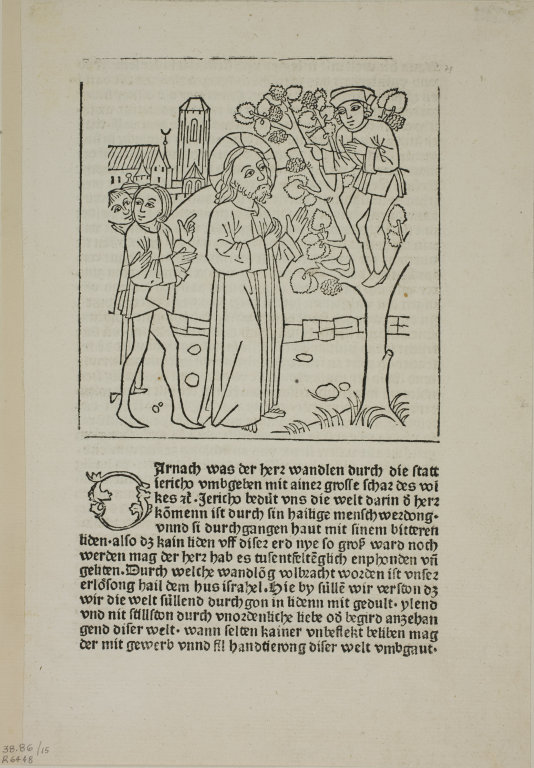
Jesus calling Zacchaeus | Art for Proper 26C

Luke 19:5 When Jesus came to the place, he looked up and said to him, “Zacchaeus, hurry and come down; for I must stay at your house today.”
 

2016-1030-prop-26c-jesus-zacchaeus

Jesus Calling Zacchaeus
a woodcut made by and unknown artist

Click the image for more information

Commentary by Hovak Najarian

In the early 1450s, Johannes Gutenberg of Mainz, Germany, developed a successful printing press with moveable type. The technology spread rapidly and within a few decades Gutenberg’s invention was being used at other cities in Europe. In Ulm, (about 135 miles from Mainz), Johann Zainer set up a press to publish both sacred and secular books. Among them was, The Spiritual Interpretation of the Life of Christ, c. 1485.

With the invention of moveable type, it was no longer necessary to hand-letter a text but readers of the day were accustomed to seeing illustrations in a book. Publishers met this expectation with woodcuts. An image, carved in relief on a block of wood and set in place, could be inked and printed together with the text. The time of hand-painted illustrations, as in a codex, had passed. For special editions, however, woodcuts often were colored by hand after being printed.

Included in Zainer’s illustrated book about Christ’s life is, Jesus Calling Zacchaeus. It is a composition that may have been based on a contour drawing made originally as a study for stained glass. This image depicts an occurrence at the time Jesus was passing through Jericho while on his way to Jerusalem. Because of the crowd, Zacchaeus, a wealthy tax collector and a man of short stature, was unable to see Jesus. In order to have a higher vantage point he climbed a nearby sycamore tree. Jesus saw Zacchaeus and spoke to him by name.

In this woodcut, Christ is the central figure and is greater in size in keeping with the practice of depicting important people to be larger than others in a composition. Two people follow Jesus but the crowd that is noted in the Bible, is not shown. Instead, attention is on Jesus at the moment he arrives at the tree where Zacchaeus is perched. One of the figures behind Jesus spots Zacchaeus and turns to a person next to him and points, perhaps saying, “Look, there is a man in that tree!” Jesus’ left hand is raised to greet Zacchaeus, while his right hand motions for him to come down. “Zacchaeus, come down immediately,” Jesus said, “I must stay at your house today.” Zacchaeus welcomed Jesus to his home but the crowd was dismayed that Christ would choose to stay with a tax collector.

While with Jesus, Zacchaeus was repentant and offered to give half his possessions to the poor. If he had cheated anyone, he said, he would repay them four times the amount. Jesus responded, “Today salvation has come to this house…”

Note: The sycamore tree mentioned in the Bible is related botanically to fig trees. It is not of the same specie as the familiar sycamore in America or the maple-related tree in England. This tree, often called, “sycamore fig,” has edible fruit and has been cultivated in the Holy Land since ancient times. The above woodcut is unusual in that clusters of figs have been included among the leaves of the tree.

Hovak Najarian © 2016
 

Resurrection of the Flesh | Art for Proper 27

Luke 20: 33 “In the resurrection, therefore, whose wife will the woman be? For the seven had married her.”

Resurrection of the Flesh
SIGNORELLI, Luca
(b. ca. 1450, Cortona, d. 1523, Cortona)
Resurrection of the Flesh
1499-1502
Fresco, width 700 cm
Chapel of San Brizio, Duomo, Orvieto
Click image for more information.

Commentary by Hovak Najarian

Resurrection of the Flesh, fresco, 1499-1502, Luca Signorelli, 1441-1523

Art created in Italy during the turn of the century from the 1490s to the 1520s elicits a sense of awe in us even today. During those years, Michelangelo painted the ceiling of the Sistine Chapel, Leonardo painted the “Last Supper,” Raphael painted “The School of Athens,” and Luca Signorelli painted his fresco cycle in Orvieto Cathedral. Artists of the High Renaissance achieved their remarkable results because problems that dogged earlier artists for many centuries had been resolved.

The problem of creating pictorial space was resolved in the early fifteenth century but creating a convincing likeness of a human figure from any point of view was another major challenge. Figures in early paintings were depicted usually in a front or side view with little or no sense of movement; they often were ill-proportioned, stiff in appearance, and in sculpture-like poses. Signorelli’s mastery of anatomy, perspective, and foreshortening gave him the skills and freedom to paint the human form in every conceivable position. He seemed to delight in doing so.

At the Cappella Nova (the “New Chapel” – now called the Chapel of San Brizio) in the Cathedral at Orvieto, Signorelli was commissioned first to complete ceiling frescos that were begun by Fra Angelico. Signorelli’s work impressed his patrons (also, his fee was less than that of other artists and he worked faster) and this led to a commission to paint seven side walls. Among the frescos of the side walls are scenes depicting the end of time. The painting, “Resurrection of the Flesh,” illustrates the text found in the First Letter of Paul to the Corinthians: “We shall not all sleep, but we shall all be changed, in a moment…. For the trumpet will sound, and the dead will be raised imperishable, and we shall be changed.” (1 Cor. 15:51-52, RSV)

In this painting, two larger than life angels are in the sky. They have sounded their trumpets (with Crusader flags attached) and the dead are emerging from the earth; many have risen in full flesh. Others are only partially above the surface and are in the process of lifting themselves out. Some are still in skeleton form; here and there only a skull has popped up. In the central foreground, two men are assisting full-fleshed figures that are emerging and on the far right a man is having a conversation with a group of standing skeletons. Signorelli’s skills matched his fertile imagination and his ability to depict freely the human figure impressed and influenced many of his contemporaries; Michelangelo was among his admirers.

[Signorelli did not seem to have an interest in the accuracy of a skeleton’s form. His rendering of the pelvis is quite inaccurate.]

Hovak Najarian © 2013

The ‘Splainer: What is ‘Reformation Day’? | Religion News Service

webrns-splainer-reformation-102816(RNS) Reformation Day is mainly marked by Lutherans and members of the Reformed Church, and in some churches it has developed into a holiday meant to rival Halloween. But does it? Let us ‘Splain . . .

Source: The ‘Splainer: What is ‘Reformation Day’? | Religion News Service

The Pharisee and the Publican | Art for Proper 25C

Luke 18:13 “…the tax collector, standing far off, would not even look up to heaven, but was beating his breast and saying, ‘God, be merciful to me, a sinner!'”

The Pharisee and the Publican, wood engraving, 1864, John Everett Millais, 1829 – 1896
Click the image for more information

In mid nineteenth century France, Neoclassicism continued to be the style taught in academies, and Romanticism was receiving a great deal of attention. Realism (paintings of everyday activities of common folks) also had followers, and other artists were painting landscapes in the open air. To varying degrees, English artists were influenced by these styles but they tended to remain independent.

Three young English artists – John Everett Millais, William Holman Hunt, and Dante Gabriel Rossetti – were not enamored with French styles or with contemporary painting in England. They also were not pleased with the direction art had taken in the centuries following the Renaissance. In 1848, they formed a brotherhood and called themselves, “Pre-Raphaelites.” Other artists joined them. As a group, they found inspiration in nature and in the art of the middle ages – a time before the painter Raphael and the Renaissance – hence the name, “Pre-Raphaelites.”

Within a few years, Millais’ outlook expanded and he moved away from Pre-Raphaelite principles. He did, however, continue his interest in the spiritual aspects of art. Among his many works are drawings that illustrate parables found in the Bible; these were reproduced as wood engravings by the noted Dalziel Brothers and published in 1864 under the title, “The Parables of Our Lord.” The Pharisee and the Publican is an illustration from this book.

In a typical illustration of this parable, the Pharisee is at a temple, standing in the foreground with arms raised pretentiously in prayer. The publican is often on his knees in the background. In Millais’ composition, the positions have been reversed and the contrast between the two is made even greater by the use of light and shadow. The tax collector is standing in the dark area of the foreground and is the immediate focus of our attention. It is the Pharisee who is now in the background. He and the other men are secondary figures and light in value.

There are differences in body language as well. The publican’s weight is on one leg as he slumps over and leans against a Solomon’s column for support. There is a sense that his mind in burdened and even the twist of the column suggests swirling thoughts. His hands are “beating his breast” and his head is downcast as he is saying, “God be merciful to me, a sinner.” By contrast, the self-satisfied Pharisee is standing among other worshipers and is leaning back in pride. His chin is thrust forward as he strokes his beard.

Note: “Solomon’s column,” is one of the terms given to pillars that have a corkscrew-like shaft. Constantine brought a set of these columns to Rome (for St. Peter’s Basilica) and it was said they were from Solomon’s Temple. This source is unlikely but the descriptive term, “Solomon’s column,” continues to be used.

Hovak Najarian © 2016

Très Riches Heures du Duc de Berry | Art for Proper 26

Luke 19:5 When Jesus came to the place, he looked up and said to him, “Zacchaeus, hurry and come down; for I must stay at your house today.”

Très Riches Heures du Duc de Berry
The Limbourg Brothers
Très Riches Heures du Duc de Berry
French Gothic manuscript illumination
book of hours
1412 – 1416
Click image for more information.

Commentary by Hovak Najarian

Christ’s Entry into Jerusalem (with Zacchaeus), illumination, 1412-1416, Limbourg brothers (active early 15th century)

In the early fifteenth century, painting on wood panels had gained popularity among artists in Europe but exceptional book illuminators were still in demand; among the finest were the Limbourg brothers (Paul, Jean, and Herman) of Flemish origin. Their book of hours, commissioned by the Duke de Berry of France, is regarded a masterpiece of the International Gothic style. “Christ’s Entry into Jerusalem” (with Zacchaeus) is from the Lenten cycle of, “Les Tres Riches Heures du Duc de Berry.”

Paintings of Christ entering Jerusalem are well known; they show typically a crowd waving palm fronds as Christ nears the gate of the city. He is on a donkey and is followed by Peter leading the disciples; a fine cloth is spread before him as he approaches the gate. Paintings of the story of Jesus and Zacchaeus also are familiar. They show crowds in Jericho standing by the roadside to see Jesus who is on his way to Jerusalem. Zacchaeus, being short in stature is sitting in a sycamore tree in order to see him. [Jesus spoke to him, stayed at his house, and Zacchaeus was converted.] In art, these two events are treated usually as separate subjects but in, “Christ’s Entry into Jerusalem,” Zacchaeus makes an unexpected cameo appearance. Perhaps the Limbourgs reasoned he followed Jesus and the disciples to Jerusalem and climbed a tree to gather branches and have a better view of this event.

Zacchaeus seems unnoticed by others in this painting. Christ is focused on the people in front of him and is offering them a blessing. Unlike the usual paintings of “Christ’s Entry into Jerusalem,” there is no crowd with palms; instead, Zacchaeus is alone dropping branches from a flowering tree. [Palm Sunday also is known as “Flower’s Sunday” or by the name of the tree from which branches are taken. The general term “Branch Sunday” also is used.]

While the Limbourgs were working in France, Brunelleschi, in Italy, was working on details of linear perspective; a means by which an illusion of space can be created on a flat surface. Its use had not spread to France at the time the Limbourgs were active, thus the perspective of the architecture throughout the painting is awkward. The city gate is not in proportion to the size of the people and its entrance is too narrow to accommodate Christ on a donkey. Despite flaws, the human aspects of this painting are foremost. As Christ is entering Jerusalem, he bears a sense of authority and dignity. There is warmth and awe in the faces of the people who are there to welcome him.

[The three Limbourg brothers and the Duke de Berry died in 1416. It is likely they were all victims of the devastating bubonic plague.]

Hovak Najarian © 2013