Head of Judas | Art for Lent 5C

At the heart of the matter

John 12:4-6
But Judas Iscariot, one of his disciples (the one who was about to betray him), said, “Why was this perfume not sold for three hundred denarii and the money given to the poor?” 
(He said this not because he cared about the poor, but because he was a thief; he kept the common purse and used to steal what was put into it.)
Head of Judas
Head of Judas
Pencil, black chalk, paste, and watercolour, 562 x 435 mm
Musées de Strasbourg, Strasbourg
Westfälisches Landesmuseum, Münster
LEONARDO da Vinci
(b. 1452, Vinci, d. 1519, Cloux, near Amboise)
Click image for more information.

______________
Commentary by Hovak Najarian

Head of Judas, c.1495, Mixed Media, Leonardo da Vinci, 1452-1519

“The Last Supper” – a large mural in the refectory (dining hall) of the Convent of Santa Maria delle Grazie, Milan – took Leonardo three years to complete. Leonardo had in mind a physical likeness of each disciple and was known to leave his work to seek the image he wanted. Upon finding a face with the right characteristics, he would follow them unnoticed, observe them closely, and later make multiple sketches. The prior of the convent complained at length about these delays. On many days Leonardo would come to the refectory just to sit, observe, and think without picking up a brush; yet other days he would paint all day without a break.

Some of the sketches Leonardo made for the face of Judas have been lost and the one presented here (from the Strasbourg Museum, Germany) and others like it, is very likely to be a tracing made by one of Leonardo’s pupils. The “Judas” portion of a sketch of “Judas and Peter,” at the Ackland Museum at Chapel Hill, North Carolina is virtually identical to the Judas at the Strasbourg Museum. It is likely it also is a tracing made directly from Leonardo’s cartoon for “The Last Supper.”

When it is not known if a work is from the direct hand of a particular artist, historians and authenticators seek clues from sources such as notebooks, correspondence, sales records, materials (pigments, paper, etc), as well as an analysis of stylistic similarities to known works. Museums enjoy the prestige associated with possessing the work of a renowned artist and when authenticity has not been established fully, museums may connect a work to an artist by using terms such as, “Attributed to…” or, “Pupil of…”

In the facial expression and body language of each disciple, Leonardo sought to convey the very moment Jesus announced that one among them would betray him. In “The Last Supper,” Judas, in profile, is the fourth figure from the left. He is looking toward Jesus and was taken aback when he heard Jesus’ words. He is seated in shadow, his elbow is on the table, and he is clutching a money purse. Salt has spilled from a tipped shaker that is near Judas’ hand. The salt makes a symbolic connection to the Near-Eastern saying, “betray the salt,” meaning to betray one’s master.

Note

No…the man selected by Leonardo to be the face of Judas in “The Last Supper” was not the same person whose face was used to portray Jesus. This contrived story tells of an innocent young man who was selected to represent Jesus but later became a degenerate criminal with a face that personified evil. According to the legend, Leonardo did not recognize the man and used his face again; this time to portray the face of Judas. Like e-mail misinformation that is forwarded repeatedly as “fact,” this fabricated story continues to be told.

Because of the prior’s incessant complaints, Leonardo joked with the Duke of Milan, that if he couldn’t find a face for Judas, he might use the prior’s face. The duke mentioned this to the prior who did no more complaining.

Hovak Najarian © 2013

March 8th: International Women’s Day


berta-y-melo-705x529
Ismael Moreno Coto, S.J. and Berta Caceres, 2013

On Thursday, March 3, 2016 Berta Caceres was murdered in Honduras.

Honduran indigenous leader Berta Caceres, who won the 2015 Goldman Environmental Prize for her role in fighting a dam project, was shot to death Thursday by attackers who broke into her home, authorities said.

Caceres, a 40-year-old Lenca Indian activist, had complained of receiving death threats from police, soldiers and local landowners because of her work.

Tomas Membreno, a member of her group, the Indian Council of People’s Organizations of Honduras, said at least two assailants broke into the home and shot Caceres in the town of La Esperanza. http://wapo.st/21jlQvj

As we consider the role of girls and women in the Global Goals established by the United Nations, let us remember the courage and the work of Berta Caceres.

For further consideration

Pain and Rage for the Loss of Berta Cáceres  by Ismael Moreno Coto, S.J. on the Ignatian Solidarity Network, 3/7/16

A killing in Honduras shows that it may be the world’s deadliest country for environmentalists in the Washington Post 3/3/16

Image: Ignatian Solidarity Net

Prodigal Son in the Tavern | Art for Lent 4C

Luke 15:11 Then Jesus said, “There was a man who had two sons.

Prodigal Son in the Tavern

Rembrandt and Saskia in the Scene of the Prodigal Son in the Tavern
c. 1635
Oil on canvas, 161 x 131 cm
Gemäldegalerie, DresdenREMBRANDT Harmenszoon van Rijn
(b. 1606, Leiden, d. 1669, Amsterdam) Click image for more information.

______________
Commentary by Hovak Najarian

Rembrandt and Saskia in the Scene of the Prodigal Son in the Tavern, 1635, Oil on Canvas, Rembrandt van Rijn, 1606-1669

Like other young men in Holland during the early seventeenth century, Rembrandt’s formal education consisted of studying Latin and Religion but when his skills in drawing became apparent, he was guided toward a formal study of art. After an apprenticeship in the studio of Pieter Lastman in Amsterdam, Rembrandt opened a studio in Leyden and was recognized for his exceptional work. His success led him back to Amsterdam which was the most prosperous city in Europe at that time. People of wealth liked having their portraits painted and Rembrandt excelled in portraiture. This brought fame and wealth but he did not manage money well. Soon he was in debt and personal tragedies as well became an ongoing part of his life.

Before financial and personal problems developed, Rembrandt married Saskia. He idolized her and painted her as the Roman goddess, Flora. A person not knowing anything about this painting might regard it simply as a portrait of a woman with flowers but symbolic content and subtexts are often found in an artist’s work. In this portrait, Rembrandt’s admiration and love for Saskia is revealed in his portrayal of her as Flora, the goddess of flowers and springtime. Soon after painting Flora, Rembrandt painted a double portrait representing a blissful time in their recent marriage; the two were young and happy. This painting’s subject, like the “Flora,” also may be appreciated for its subject; in it we see a celebration that does not seem to represent anything other than what it appears to be. Yet a tavern is part of this painting’s subtext and there are similarities between Rembrandt’s drawings of the prodigal son in the tavern and this double portrait.

In 1925, German scholar Wilhem Valentiner concluded that Rembrandt and Saskia are playing roles. Just as an actor may direct a movie as well as play a leading role in it, Rembrandt has cast himself in the role of the wastrel prodigal son; his wife, Saskia, is acting as a carefree prostitute. Valentiner’s conclusion has been supported by an x-ray analysis that indicates the composition once contained a woman playing a lute as well as objects that are associated with a tavern. Rembrandt painted over them as the two principal figures became the object of his attention.

Note
Rembrandt’s penchant for casting family members and people from his community as subjects in scenes continued throughout his life. His study of Latin was likely the source of an early interest in Roman subjects such as Saskia in the role of Flora. As he became older, his interest in biblical themes increased greatly.

Unlike almost every other artist in Europe, Rembrandt did not go to Italy to study the classics. Elements of classicism and its tendency toward formality are not found in his work. Whereas classicism tends to guide a viewer to an intellectual appreciation, the works of Rembrandt contain a sense of emotional warmth and psychological insight.

Hovak Najarian © 2013

Speaking the Truth in Love

From the Episcopal Bishop of Minnesota a timely reminder and invitation to speak the truth with love

Unknown's avatarBrian Prior

It was a casual conversation, yet as it went on, it became more and more difficult to listen to. Now I like a good story, but when a story is being spun in a way that suggests it is verifiably factual, but it’s not, my inner skeptic alarm goes off. Again, tell me a tall tale, entertain me with wit and embellishment, share something that leads to a deeper meaning or truth, I’m good. Yet to suggest something is unequivocal truth, when you know it’s not, is challenging.

I am working with a great group of people on an upcoming retreat which will focus on The Word and words. The daily themes of the retreat will include: the stories we have been told, the stories we tell others, the stories we tell ourselves, and the stories we will tell. As such, I have been thinking a lot about the stories…

View original post 337 more words

Look again

mary-700x438

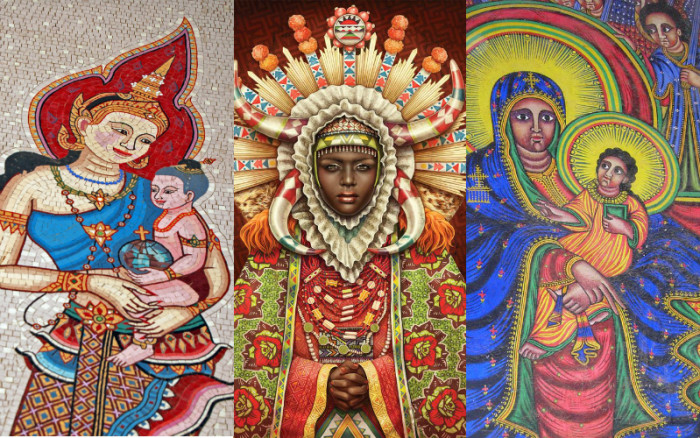
How would you picture Mary?

The Blessed Virgin Mary was thoroughly Jewish. Different cultures and ethnicities have often portrayed her, Jesus, and others from the Bible as being from their group.

Since Christianity for many centuries was based largely in Europe, these important characters of salvation history have often been depicted as white Europeans. Which is fine! But other cultures have also depicted them according to their own appearances.

Take a look at how others have pictured Mary: 13 Beautiful Non-White Depictions of the Blessed Virgin Mary a post on ChurchPop by the Editor

Image: via ChurchPop

Moses and the Burning Bush | Art for Lent 3C

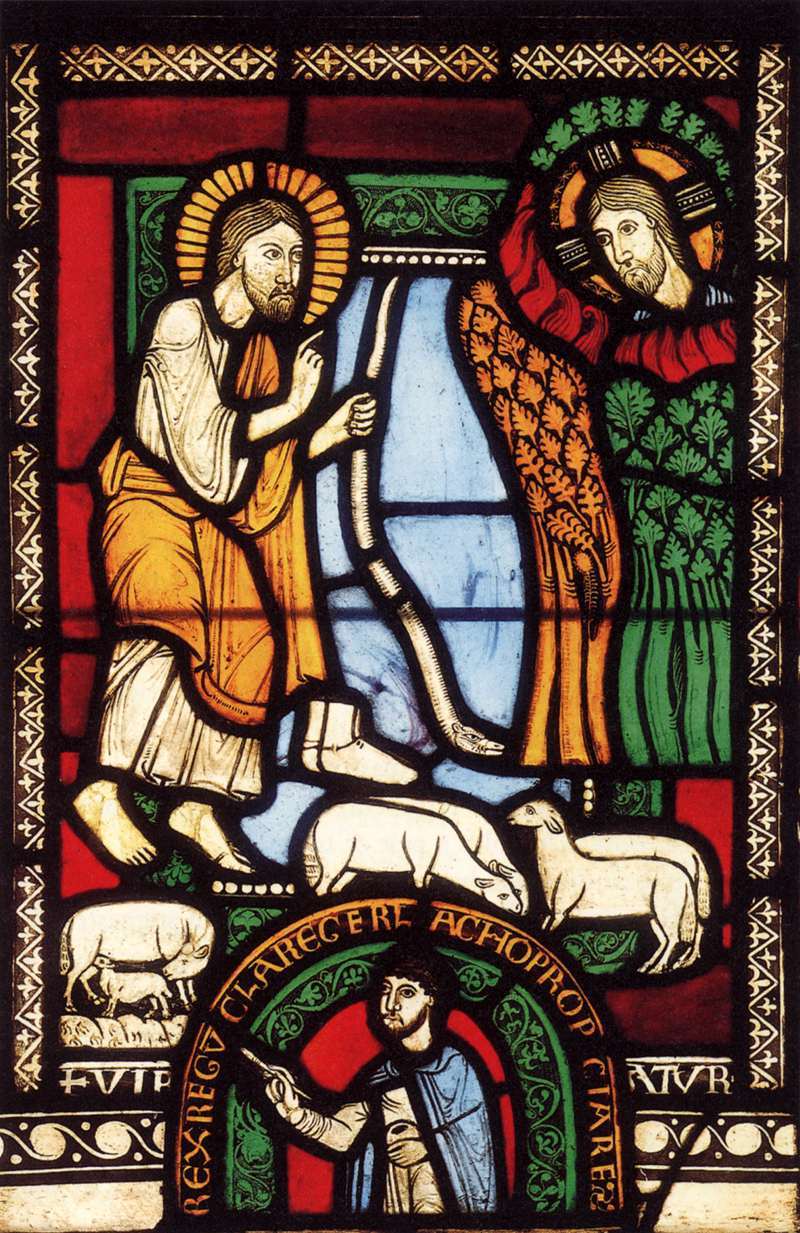
Exodus 3:1 Moses was keeping the flock of his father-in-law Jethro, the priest of Midian; he led his flock beyond the wilderness, and came to Horeb, the mountain of God. There the angel of the LORD appeared to him in a flame of fire out of a bush; he looked, and the bush was blazing, yet it was not consumed

2017-0903 17A 02g_1100

Moses and the Burning Bush (with the artist’s self-portrait), c. 1150,
Stained Glass, Master Gerlachus, 12th century

 ______________
Commentary by Hovak Najarian

Moses and the Burning Bush (with the artist’s self-portrait), c. 1150, Stained Glass, Master Gerlachus, 12th century

The basic ingredient of glass is silica which melts at a very high temperature (over 3,000 F). The melting point is lowered when a flux is added but for ancient artisans there was still a problem of how to control glass in its fluid state. In the first century BC, a minor industrial revolution occurred in the Near East when a person placed a blowpipe into molten glass, gathered a blob, blew into it, and formed a bubble (like blowing a soap bubble). Artisans learned to attach a pontel rod to where the base of a container would be and then cut the bubble from the blowpipe. While still fluid and workable, the open end (where it was cut from the blowpipe) was made wider to make a bowl or other usable form. The pontel then was snapped off and the glass was cooled slowly as it became a solid. During the late Romanesque period, artisans such as Gerlachus were heirs to a great deal of empirical knowledge which included how to make sheets of glass by cutting elongated bubbles lengthwise then opening and spreading them flat.

Today, the term “stained glass” is used interchangeably with “colored glass” but they are not technically the same. Colored glass contains coloring agents (oxides) within it, whereas staining is done by painting an oxide onto the surface to add details. After sections of glass are painted, they are returned to a furnace and the stain is fused. Then, H-shaped strips of lead called “came” are used to surround each section as a window is being assembled. The came is soldered where their ends touch to hold the glass in place.

“Moses and the Burning Bush” is one of a series of windows depicting the life of Moses; in it, the black, even-in-thickness came can be seen as outlines between the large sections of glass. Details such as the faces of Moses, God, the artist, their clothes, and the burning bush, are all stained by being painted with iron oxide and then fused to the glass. Instead of using many small pieces, Gerlachus’ windows were made from large sections of colored glass on which he painted clarifying details of his subject.

Note

While Master Gerlachus was working in Germany, Abbot Suger began rebuilding the Abbey Church of St. Denis in France. Abbot Suger called for stained glass to be used much more than it had been used previously. Light entering the church through stained glass not only displayed brilliant images that were related to a parishioner’s faith but also the colors were a sensual delight. In defense of its use, it was pointed out that light represented the divine and light coming through glass symbolized the Holy Spirit which was capable of passing through solid objects. The Abbey Church of St. Denis set in motion the direction that was taken by builders during the Gothic Period that followed; a time when there was even greater use of stained glass.

Hovak Najarian © 2013

Work at being ordinary

Paul Kowalewski publishes a daily essay on his blog Desert Retreat House. In the post for Monday, February 22nd he writes:

On this ordinary Monday, plenty of people are off to work or school or off to the market or perhaps off to the gym, off to accomplish the everyday tasks of their routine lives. This sure doesn’t sound very exciting, but in fact if we just pay attention to the seemingly uneventful moments in life and work at being ordinary, a whole world of miracles unfolds without end.

The essay is an extended invitation and a meditation to “pay attention” as we move along the Way into our week. Read the entire post.

What do you hear the Spirit saying?

The Story of Abraham | Art for Lent 2C

Genesis 15:1 The word of the LORD came to Abram in a vision, “Do not be afraid, Abram, I am your shield; your reward shall be very great.”

The Story of Abraham
1425-52
Gilded bronze, 79 x 79 cm
Baptistry, Florence
GHIBERTI, Lorenzo
(b. 1378, Firenze, d. 1455, Firenze)Click image for more information.

______________
Commentary by Hovak Najarian

The Story of Abraham, detail of the “Gates of Paradise,” 1425-52, Gilt Bronze, Lorenzo Ghiberti, 1378-1455

In 1401, the wool merchant’s guild of Florence announced a competition that would lead to a commission for a set of bronze doors for the Baptistery of San Giovanni (Saint John). Lorenzo Ghiberti won the competition and was given the commission. Upon completion, he was given a commission to design a second set of doors for the Baptistery. The doors and a few other pieces of sculpture would become his life’s work. “The Story of Abraham” is one of ten panels from the second set of doors which now is referred to as the “Gates of Paradise.” According to Giorgio Vasari, Michelangelo was looking at the doors when a companion asked his opinion. Michelangelo said allegedly the doors were so beautiful they were worthy to serve as the gates of paradise.

Ghiberti’s training as a goldsmith and metalworker was invaluable as he solved the technical problems of casting the bronze doors. Other sculptors were eager to learn from him. Also, he read widely, was a humanist, and was open to the changes during a time of cultural and artistic rebirth. Just as early Renaissance painters sought to create an illusion of depth, Ghiberti studied perspective and applied it to his relief sculpture. Rather than his reliefs being figures attached to a flat background, he sculpted the entire surface to create an illusion of pictorial depth. With regard to the “Gates of Paradise” he said “I sought to imitate nature as closely as possible.”

In the panel called “The Story of Abraham,” Ghiberti combined two accounts from the Book of Genesis. At the lower left is the story found in Genesis 18:2-10; a time when three men (Ghiberti interpreted them as heavenly beings with wings) came to Abraham. Sarah is at the doorway of their tent while Abraham is kneeling before the men with a pan of water with which they may wash their feet. The men tell him his wife, Sarah, will have a son. Ghiberti’s narrative composition continues with images from Genesis 22:3-13; the sacrifice of Isaac. At the lower center is a donkey and to its right are Abraham’s two servants who wait while he and Isaac go to a higher level of the mountain. Above them, Isaac is kneeling on an altar and Abraham has raised his knife. An angel has arrived just in time to hold back the knife and stop him from killing his son. Behind the feet of Abraham is a ram caught in a thicket; it will be sacrificed in place of Isaac.

Note

Because the rite of baptism was regarded to be a door to heaven, a baptistery was symbolically a “gateway to paradise.” Michelangelo’s alleged description of Ghiberti’s doors, if true, could have meant simply that the doors were worthy of the Baptistery of San Giovanni, not paradise itself.

Early scholars were interested in the many parallels found in the story of Abraham and the passion of Christ. Both stories deal with father, son, and sacrifice.

Hovak Najarian © 2013

Baptism and Temptation of Christ | Art for Lent 1C

Luke 4:1 Jesus, full of the Holy Spirit, returned from the Jordan and was led by the Spirit in the wilderness, where for forty days he was tempted by the devil

Baptism and Temptation of Christ
1580-82
Oil on canvas, 248 x 450 cm
Pinacoteca di Brera, Milan
VERONESE, Paolo
(b. 1528, Verona, d. 1588, Venezia)
Click image for more information.

______________
Commentary by Hovak Najarian

Baptism and Temptation of Christ, Oil on Canvas, 1580-1582, Paolo Veronese, 1528-1588

During the Italian Renaissance of the fifteenth and sixteenth century, the cities of Florence and Rome were major centers of art. Venetians also could boast of their art during this period; Titian, Tintoretto, and Veronese were among the finest artists in Europe. Being at the northern tip of the Adriatic Sea, the people of Venice were seafarers and their merchant ships sailed eastward to trade with ports throughout the region. Through trade, Venetians acquired great wealth and as was the practice (then and now), people of means acquired possessions to enrich their lives and serve as symbols of status. Inasmuch as expensive sports cars and private jets were not available, their possessions were sumptuous palaces and fine art. They also were generous in their support of public projects and the Church. Because of favorable working conditions and an opportunity to earn fine salaries, many painters, sculptors, and artisans made Venice their home. Veronese (given name Paolo Caliari), studied initially in the city of his birth, Verona, but soon was living and working in nearby Venice. In Venice, he became known simply as “Veronese,” a person from Verona.

As Renaissance art continued from the fifteenth century to the sixteenth there was a tendency toward mannerism and then from mannerism, art developed into the baroque style of the seventeenth century. “Baptism and Temptation of Christ,” painted by Veronese in the latter part of the mannerist period is baroque-like in its dramatic composition. As we enter the painting at the lower left, we see John the Baptist in shadow but we do not linger. Instead, we move past him immediately to the upper torso of Christ which is bathed in light emanating from a dove representing the Holy Spirit. Not only does Christ receive our immediate attention but also all figures in this section of the painting are focused on him. Included in this drama are a cherub and angels hovering excitedly. The dove illuminates the foreground figures while shadows of the trees close off pictorial depth.

The narrative continues as we leave the baptism and move to the right where after forty days and nights of fasting, Christ is with Satan in a clearing. A forest is in the middle ground and then in the background beyond the trees are buildings representing the kingdoms of the world and their splendor. Unlike the animated scene of the baptism, the temptation of Christ is calm. Satan is not depicted with horns or forked tail but appears as an old bearded and seemingly harmless figure in a gray robe.

Note

A visitor to Venice today may still feast visually on its art but they will not see evidence of shipping and trade. The city is supported financially now by tourists who dine at fine restaurants, ride the canals in gondolas, and feed pigeons after lunch at McDonalds in St. Mark’s Square.

Hovak Najarian © 2013

Transfiguration | Art for Last Epiphany C

Luke 9:28-29 Now about eight days after these sayings Jesus took with him Peter and John and James, and went up on the mountain to pray. And while he was praying, the appearance of his face changed, and his clothes became dazzling white.

Transfiguration
Transfiguration
Fresco
“Dark church” ( Karanlik kilise ) 11th century
Göreme district, Nevşehir Province, Turkey.
Click image for more information.
Click here for more Göreme district churches.

______________
Commentary by Hovak Najarian

Transfiguration, Fresco, 11th Century, Unknown artist of Cappadocia

“And after six days Jesus took with him Peter and James and John his brother, and led them up a high mountain apart. And he was transfigured before them, and his face shone like the sun, and his garments became white as light. And behold there appeared to them Moses and Elijah, talking to him.” (Matt. 17:1-3)

A large portion of the Eastern Roman Empire spoke Greek and by the seventh century it was the primary language used by the Byzantines. The Byzantine Empire extended eastward from Constantinople and included Asia Minor where Greek speaking Orthodox Christians often had to seek protection from invading tribes. In a region known as Cappadocia, the ash and lava of a volcanic eruption created rock formations that were soft and could be carved easily. By carving into the rock, Christians hollowed out spaces that would shelter them from the elements and offer protection from invaders. The soft rock also was carved out for churches.

In a monastic compound known as the “Dark Church,” The interior walls and the ceilings are covered with frescos and among the paintings is “The Transfiguration.” In it, Moses and Elijah are with Jesus in an event interpreted as a revelation that Christ is the fulfillment of the law and prophets. Moses represents the law and often he is shown holding the Torah or a stone tablet. Elijah represents the prophets. In this fresco, neither Moses nor Elijah has been given an identifying symbol but we can assume the gray-haired bearded man is Moses and the un-bearded figure is Elijah.

Mt. Tabor is the traditional site of the transfiguration but other places have been proposed. One of the suggested sites is Mt. Hermon which has three distinct peaks and in paintings of the event often three peaks are shown; Christ is always in the center. In the “Dark Church” fresco, Moses is standing on the right peak and Elijah is on the left. Below them are the disciples kneeling and crouching. At the bottom left is Peter with white hair and a beard. He is pointing upward toward Christ. The disciple John is depicted in the center as a beardless youth (his face is partially obscured by damage) and James is to the right with brown hair and a beard. Linear rays indicate a direct connection between Jesus and each of the figures.

Note

The “Dark Church” is so named because it has only a small opening (oculus) for light, thus the interior is dim.

Among the various people of ancient Cappadocia were the Armenians who were known at one time as being horse breeders. “Cappadocia,” the historic name for the region was derived likely from “Kapatuka,” an Old Persian term meaning, “Land of beautiful horses.” The Crusaders referred to the region as Terra Hermeniorum: “Land of the Armenians.”

Hovak Najarian © 2013