John baptizes Jesus | Art for A Epiphany 1

Matthew 3:13 Jesus came from Galilee to John at the Jordan, to be baptized by him.

John baptizes Jesus
Jesus Mafa Community
Camerron
John baptizes Jesus
1973
Click image for more information.

Commentary by Hovak Najarian

John Baptizes Jesus, oil on canvas, 1973, Bénédicte de la Ronciére, (20th
Century)

Artists made objects that supported the physical and spiritual needs of people throughout history and their work carried an imprint of the culture from which it came. When churches were established, art became a means by which biblical stories could be taught and worship enhanced.

In the Western division of the Church during the Middle Ages, artists painted images of the world they knew and thus biblical figures tended to be depicted as Europeans; the architecture and natural world in their paintings were their local surroundings. During the Renaissance of the fifteenth century, as painters were becoming highly skilled, the Italian heritage of Greek and Roman art brought in a classical overlay to Christian subjects and “art” evolved to exist in a realm of its own; it tended to be separate from the reality of the everyday world. The Renaissance spread throughout Europe and the art, music, literature, science, and technology that grew out of it influenced cultures of non-Europeans as well.

In recent years, a perceived need to make the arts accessible to a broader range of people led to Shakespeare’s plays being offered in a form they believed to be more palatable. Today, his plays may be seen in modern day settings with its language changed to the vernacular; the same has occurred in performances of opera. Fr. Francois Vidil of France was mindful of racial and cultural differences in people and he believed native Africans could not identify easily with biblical figures that were portrayed as white Europeans. In 1973, he worked with the Mafa Christian Communities in Africa as they staged scenes such as, “John Baptizes Jesus,” (shown here) with villagers in the roles of biblical figures. These re-enactments were recorded and illustrator Bénédicte de la Ronciére was selected to make paintings from the photographs of native Africans in these scenes.

These paintings fulfilled Fr. Vidil’s vision of casting Africans in the role of the people in biblical stories. Yet, just as the portrayal of biblical figures as Europeans in local settings was not accurate, neither was it accurate to depict biblical figures as African villagers. These paintings did not develop naturally out of the Mafa culture and although the scenes are in Africa, they are painted in a style common to European and American magazine illustrations. The subject matter of these paintings will receive attention undoubtedly from non-art sources and discussions about them will deal with social and cultural issues; not about aesthetics. It is unlikely they will receive attention from art critics and historians.

Hovak Najarian © 2013

The Nativity between Prophets Isaiah and Ezekiel | Art for A Christmas 1

John 1:14 And the Word became flesh and lived among us….

The Nativity between Prophets Isaiah and Ezekiel
DUCCIO di Buoninsegna
(b. ca. 1255, Siena, d. 1319, Siena)
The Nativity between Prophets Isaiah and Ezekiel
1308-11
Tempera on wood
National Gallery of Art, WashingtonClick image for more information.

Commentary by Hovak Najarian
(Previously Hovak has commented on works from the Maesta:
Christ’s Appearance to the Apostles and Solomon)

The Nativity (with the Prophets Isaiah and Ezekiel), 1308-1311, egg tempera, Duccio di Buoninsegna, c. 1255-1319

Duccio’s “Nativity” was once part of the Maesta (Majesty) which served as an altarpiece for the Cathedral of Siena, Italy. When the painting was completed in 1311, it was composed of a very large panel of the Madonna and Child surrounded by saints and angels. Its base – called a “predella” (Italian for “foot stool” which it resembled) – was below the main panel. It served physically to support the altarpiece and visually to depict seven scenes of the birth and early life of Christ. In its original form, an Old Testament prophet stood to the right of each event holding a scroll on which a passage written by him pertained to the scene.

Duccio’s “Nativity,” the second scene in the predella, takes place in a grotto with Mary reclining on a red cushion in a royal robe of blue. In keeping with the practice of increasing a person’s size in accordance with their importance, she is much larger than the other figures. In the manger, the baby Jesus is being watched over by an ox and an ass and many angels have gathered above them; some are looking heavenward in praise and others are leaning over for an adoring glance at the baby. A small star is at the peak of the cave entrance with its rays shining onto the face of Jesus. Below the figure of Mary are two related scenes. On the left, two midwives are bathing the new born Jesus and on the right, angels are announcing Jesus’ birth to the shepherds as they stand with a sheepdog and their flock. On the left side, Joseph is sitting outside of the grotto in a pink robe, To the right of this scene is a painting of Ezekiel holding a scroll with his words; “This gate shall be kept shut: it shall not be opened, and no man may pass through it.”

In the early eighteenth century, the Maesta altarpiece was taken apart in order to divide it between the two altars of the Cathedral of Siena. During this process, damage was caused and some parts of the painting became separated and lost. Other sections were purchased and placed in museums. One of the results is Isaiah now is not with the scene to which he and his words belong. The scroll he is holding states; “Behold a young woman shall conceive and bear a son and shall call his name Immanuel” and he was placed originally at the immediate right of the “Annunciation,” (the first scene of the predella). He was separated from it and is now at the National Gallery of Art, Washington, DC standing next to the “Nativity.” Isaiah is not looking toward the birth of Jesus because in the original he was looking toward the archangel Gabriel’s visit to Mary. The painting of the “Annunciation,” to which his words of prophecy apply is an ocean away in the National Gallery of London without its accompanying prophet, Isaiah.

Hovak Najarian © 2013

Marriage of Sts Mary and Joseph | Art for Advent 4A

Matthew 1:20…an angel of the Lord appeared to him in a dream and said, “Joseph, son of David, do not be afraid to take Mary as your wife”…

Marriage of Sts Mary and Joseph
TORRETTI, Giuseppe
(b. 1664, Asolo, d. 1743, Venezia)
Marriage of Sts Mary and Joseph
Marble
Basilica dei Santi Giovanni e Paolo, Venice
Click image for more information.

Commentary by Hovak Najarian

Marriage of Sts. Mary and Joseph, marble, 18th century, Giuseppe Torretti, 1664-1743

At the beginning of the eighteenth century the Baroque period in art was ebbing as patrons favored lighter surroundings. From this a decorative trend emerged in a style that is called Rococo; a name derived from ornamental sea shells used as embellishments in architecture. Giuseppe Torretti (also spelled Torretto), from a family of artists, was active during this period but while working with other sculptors in Rome, classicism influenced his work. In the “Marriage of Sts. Mary and Joseph” shown here, Torretti presents relief figures in a Baroque-like theatrical setting yet the robes being worn are in a classical style.

The subject of the marriage of Mary and Joseph has been included regularly in scenes of the Life of the Virgin but the story is not from accounts found in the Bible. It is mentioned in apocryphal sources which were compiled and included in a fourteenth century volume called the “Golden Legend.” In this account, Mary was living in the Temple and when she turned fourteen years old the priests decided it was time for her to marry. Young unmarried male descendents of David were sought to be her husband; Joseph, though older than the others, was included. All the men who qualified were asked to bring a branch and place it on the altar. The person bringing the branch that brought forth blossoms would be Mary’s husband. After the men placed their branches on the altar, the Holy Spirit descended as a dove and the one brought by Joseph burst immediately into flowers.

Torretti places Mary and Joseph in the foreground kneeling at the altar and facing each other in front of a priest in a traditional Jewish ceremony. The bride and groom are barefooted as are the witnesses. Joseph is depicted as a bald headed man with a beard; he is holding a branch with blossoms in his left hand and Mary’s head is covered with a shawl. Because of damage from a fire several parts of the sculpture are missing; among them are the hands of the priest and those of Mary and Joseph. From a maquette (a small terra cotta preparatory sketch made by Torretti before carving this piece in marble) [click to view]  we know Mary and Joseph were reaching across to each other and holding hands. The priest’s right hand was extended in a blessing.

This relief carving of the “Marriage of Sts. Mary and Joseph” is in the dado of the Chapel of our Lady of the Rosary, in the Basilica dei Giovanni e Paolo (Basilica of John and Paul), Venice, Italy. A fire destroyed the Chapel in 1867 and the sculpture was discolored and damaged. Torretti’s maquette for this piece is in the Chrysler Museum of Art, Norfolk, Virginia.

Hovak Najarian © 2013

O Antiphons (Dec 17-23)

The exact origin of the “O Antiphons” is not known. Boethius (c. 480-524) made a slight reference to them, thereby suggesting their presence at that time. At the Benedictine abbey of Fleury (now Saint-Benoit-sur-Loire), these antiphons were recited by the abbot and other abbey leaders in descending rank, and then a gift was given to each member of the community. By the eighth century, they are in use in the liturgical celebrations in Rome. The usage of the “O Antiphons” was so prevalent in monasteries that the phrases, “Keep your O” and “The Great O Antiphons” were common parlance. One may thereby conclude that in some fashion the “O Antiphons” have been part of our liturgical tradition since the very early Church. Read more: What are the O Antiphons from Catholic Education Resource Center

Sr. Joan Chittister has provided an entire page to help you pray the O Antiphons (from December 17th through December 23rd). Each meditation is accompanied by a women’s choir chanting the Antiphon in English. Use this online meditation to deepen your prayers as Advent comes to a close and the Nativity arrives.

St John the Baptist in the Prison | Art for A Advent 3

Matthew 11:2-3 When John heard in prison what the Messiah was doing, he sent word by his disciples and said to him, “Are you the one who is to come, or are we to wait for another?”

St John the Baptist in the Prison
NAVARRETE, Juan Fernández de Spanish painter
(b. ca. 1538, Logroño, d. 1579, Toledo)
St John the Baptist in the Prison 1565-70
Oil on canvas, 80 x 72 cm
The Hermitage, St. Petersburg
Click image for more information.

Commentary by Hovak Najarian

St. John the Baptist in the Prison, oil on canvas, c. 1565-70, Juan Fernandez de Navarrete, 1526-1579

In the mid-sixteenth century when Juan Fernandez de Navarrete was a youth, a period of study in Italy was a prerequisite for a career in art. Michelangelo, Titian, Tintoretto, and Veronese were still living and Italy attracted artists from throughout Europe. Navarrete, a young Spaniard, visited the major art centers in Italy and stayed in Venice to study Titian’s use of color. Then, as now, there were cultural differences between Italy and Spain and Navarrete’s interest was in gaining knowledge of techniques, not subject matter. During the Renaissance, the depiction of Greek and Roman gods and goddesses entered into Italian art but were not of interest in Spain where very few nude Venuses or classical themes were depicted. Instead, subject matter in Spain tended to depict religious themes of devotion and piety.

Spain was a world power in the sixteenth century and King Philip II, who assumed the throne of Spain in 1556, ruled an empire that included Naples, Milan, and The Netherlands; even the far off Philippine islands were named for him. He was determined to rule as a strong Catholic King and was intent on keeping Martin Luther’s teachings and the reformation out of Spain. When he was building his extensive royal monastery-palace (called El Escorial) he wanted the best artist available to paint its walls. Titian, however, was too old and his other choices, Tintoretto and Veronese, refused to live in Spain. Navarrete accepted the position and became known as the “King’s Painter.”

Navarrete’s “St. John the Baptist in the Prison” is not filled with superfluous details. John is alone in a cell with a shaft of dramatic light coming through a window fitted with iron bars. In art, John the Baptist is identified by his camel-skin clothes; he is depicted usually as being wiry, not soft as depicted here. He sometimes carries a crudely assembled cross made with a simple piece of wood split at the top with a crosspiece inserted and held together with twine. In this scene, John’s shawl has been laid aside and he is hunched bare-shouldered over a table looking at the cross. His expression suggests this is a time of prayer, contemplation, introspection, and sadness.

Note:

At the age of three, Navarrete was struck with an illness that affected his hearing. This made learning to speak difficult and he became known as El Mudo (The Mute). He compensated by communicating through drawings.

“St. John the Baptist in the Prison” is now in the Hermitage Museum in St. Petersburg, Russia.

Hovak Najarian © 2013

The Polonsky Foundation Digitization Project

2013-1204 Stamp.Ross.283 Biblia. Tedesco.   c. 1478You’ve probably noticed that the “printed” word is more and more available digitally. This digital explosion of information is simultaneously good news and bad news.

Sadly, with the 24/7 “news cycle” more and more information is available every time a person logs on to see what’s happening. Not all the information is accurate and we haven’t yet developed, as a society, a good sense for weeding out the spurious and the superfluous. Such detection is still a work in progress. Erroneous reporting can quickly go ‘viral’ and then seems to hang on forever.

Happily, digital technology has also made available to both scholars and ‘amateurs’ printed texts that have helped form our society (artistically, linguistically, and morally). For this Sunday Morning Forum biblical texts from codices and papyri dating back thousands of years are now viewable (even if we are not proficient in ancient Hebrew or Greek). Today’s English translations of the Bible allow scholars (who are proficient in ancient languages) to make wide use of texts and have helped improve modern translations of this ancient treasure (which we put to good use in our Forum).

Two such efforts at digitization are the Ancient Biblical Manuscript Center of the Claremont School of Theology and The Digital Dead Sea Scrolls Project. 

Now the Polonsky Foundation has brought together the resources of the Bodleian Library in Oxford and the Vatican Library for digitization:

Through the generous support of the Polonsky Foundation, this project will make 1.5 million digitized pages freely available over the next three years. Portions of the Bodleian and Vatican Libraries’ collections of Hebrew manuscripts, Greek manuscripts, and incunabula have been selected for digitization by a team of scholars and curators from around the world. The selection process has been informed by a balance of scholarly and practical concerns; conservation staff at the Bodleian and Vatican Libraries have worked with curators to assess not only the significance of the content, but the physical condition of the items, prioritizing items that are robust enough to withstand being transported to the imaging studio and handled by the photographers. In order to preserve the integrity and completeness of the manuscript collections, the libraries have also agreed to digitize whole collections where appropriate. The complete list of works to be digitized can be accessed here for Greek manuscripts, here for Hebrew manuscripts, and here for incunabula.

Go to the Polonsky Foundation Digitization Project

You are encouraged to go and see for yourself what is now available online.

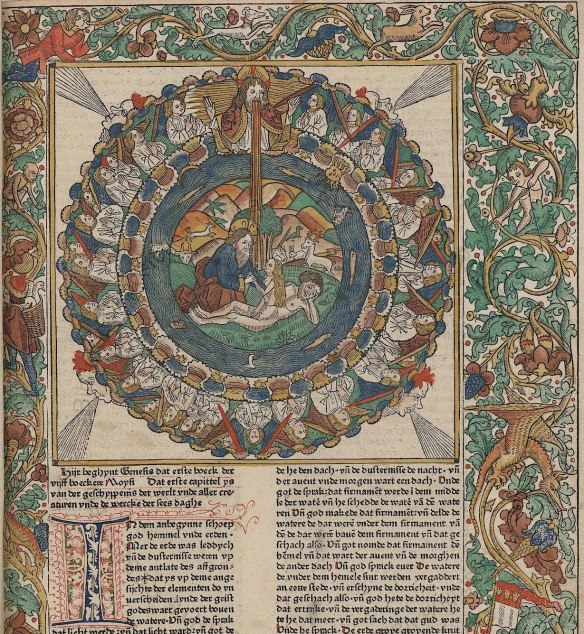
Image: Genesis illustration in the Cologne Bible (1478-1479) from the Vatican Library part of the Digitization Project

St John the Baptist | Art for A Advent 2

Matthew 3:1-2 In those days John the Baptist appeared in the wilderness of Judea, proclaiming, “Repent, for the kingdom of heaven has come near.”

St John the Baptist (detail)
DONATELLO
(b. ca. 1386, Firenze, d. 1466, Firenze)
St John the Baptist (detail)
1438
Painted wood
Santa Maria Gloriosa dei Frari, Venice
Click image for more information.

St John the Baptist

Click image for more information.

Commentary by Hovak Najarian

St. John the Baptist (detail), painted wood, 1438, Donatello, c. 1386-1466

The term, “Renaissance man,” (used loosely today when applied to a contemporary person) is in reference to the great achievers of the fifteenth century. They were not only a “jack of all trades,” they also were masters of them all. Donatello (Donato di Niccolo di Betto Bardi) was such a man. He chiseled stone, cast bronze, modeled clay and stucco, and carved wood as he created a wide range of sculpture including, statues, monuments, and reliefs. This was all done with a high degree of creativity and excellence. Further, his understanding of sculptural space enabled him to be sensitive to how his work would interact in its architectural setting.

The career of Donatello is well known; he worked with Lorenzo Ghiberti on the first set of bronze doors for the Baptistery of Florence Cathedral and he studied the ruins of Roman architecture and sculpture with Brunelleschi in Rome. In his work, he helped to bring sculpture out of the Middle Ages by re-establishing it “in the round” (capable of being viewed from all sides). His studies of Roman sculpture led to imbuing a sense of personality and character in the faces and bodies of the figures he sculpted. His St. John the Baptist’s eyebrows are raised, an eye is squinting, and in the boney fingers of his left hand is a partially unrolled scroll showing the beginning of the phrase, “”Ecce Agnus dei” (Behold the Lamb of God). He stands with his right arm raised and his mouth slightly open as though he is about to speak.

The description of John the Baptist in the Books of Mark and Mathew give us an image of a fearless, camel skin-wearing man who lived in the wilderness and ate locust and honey. In art, he is pictured often as somewhat like a wild man with unruly hair, unkempt beard, and an intense facial expression. As the subject of paintings, he is most likely to be at the Jordan River baptizing Christ or in a ghoulish scene with his head on a platter after Salome danced before Herod.

St. John the Baptist, in the church of Santa Maria Gloriosa dei Frari in Venice, is different from most of Donatello’s familiar work. It is carved in wood and is painted. It is the only sculpture by Donatello in Venice and only his Mary Magdalene, which also is carved in wood, is similar in style. Until it was cleaned in 1973 its date was not known. Under the old paint from a previous restoration, it was discovered Donatello signed and dated it in 1438; much earlier than previously thought. How it came to be in Venice, however, is still uncertain. John the Baptist is the patron saint of Florence and it has been suggested a wealthy Florentine merchant living outside the city commissioned Donatello to carve the St. John for the church in Venice.

Hovak Najarian © 2013

St. Andrew

Today (11/30) the Church remembers Andrew, brother of Peter and one of original 12 Apostles. From a short biography written by James Kiefer for Mission St. Clare:

When the Emperor Constantine established the city of Byzantium, or Constantinople, as the new capital of the Roman Empire, replacing Rome, the bishop of Byzantium became very prominent. Five sees (bishoprics) came to be known as patriarchates: Rome, Alexandria, Antioch, Jerusalem, and Byzantium. Now, the congregation at Rome claimed the two most famous apostles, Peter and Paul, as founders. Antioch could also claim both Peter and Paul, on the explicit testimony of Scripture, and of course Jerusalem had all the apostles. Alexandria claimed that Mark, who had been Peter’s “interpreter” and assistant, and had written down the Gospel of Mark on the basis of what he had heard from Peter, had after Peter’s death gone to Alexandria and founded the church there. Byzantium was scorned by the other patriarchates as a new-comer, a church with the political prestige of being located at the capital of the Empire, but with no apostles in its history. Byzantium responded with the claim that its founder and first bishop had been Andrew the brother of Peter. They pointed out that Andrew had been the first of all the apostles to follow Jesus (John 1:40-41), and that he had brought his brother to Jesus. Andrew was thus, in the words of John Chrysostom, “the Peter before Peter.” As Russia was Christianized by missionaries from Byzantium, Andrew became the patron not only of Byzantium but also of Russia.

See Morning Prayer for November 30th

The Flood | Art for A Advent 1

Matthew 24:39-40 …and they knew nothing until the flood came and swept them all away, so too will be the coming of the Son of Man. Then two will be in the field; one will be taken and one will be left.

The Flood
ABAQUESNE, Masséot
(b. ca 1500, Cherbourg, d. 1564, Sotteville-lès-Rouen)
The Flood
Ceramic mural composition
Musée National de la Renaissance, Écouen
Click image for more information.

Commentary by Hovak Najarian

The Flood, ceramic tile, 1550, Masséot Abaquesne, c.1500-1564

Clay often is regarded to be a lowly substance. It is formed by decomposed rock and organic matter and is used to make bricks and drainpipes. It is underfoot as pavers, and in art it is a material associated with pottery and the crafts. It is not used regularly by artists as a surface on which to paint. Masséot Abaquesne’s “The Flood,” depicting the landing of the ark, is an example of the problem with categories when art is shoe-horned into being either “fine arts” or “crafts.” Abaquesne used tiles, glaze, and metal oxides to create a painting on clay; not on wood panels or canvas.

Abaquesne had a successful ceramics business in Rouen, France. His studio specialized in majolica (muh-JAHL-i-kuh) and faience (pronounced fay-AHNS – French for Faenza, a major ceramic center in Italy), and he was influenced generally by Italian art. For “The Flood,” Abaquesne used a tiled surface instead of a large single piece because clay shrinks when it is fired and in the process, large pieces will tend to warp and not remain flat.

To make “The Flood,” a majolica technique was used. The earthenware tiles were fired at a low temperature then covered entirely with a white glaze but not fired again until after Abaquesne created his painting (on the unfired white surface) using coloring pastes made with oxides: cobalt for blue, iron for dark reddish brown and antimony for yellow. It was then fired in the kiln a second time. The work shown here is one of three created by Abaquesne on the subject of the flood. [Building the ark and boarding it are the subjects of the other two works.] This scene depicts the flood after the water has subsided and the ark has landed. In a dramatic depiction of the aftermath of the event, drowned figures are strewn about and a carrion-eating bird is dining on a dead horse. On the right side of the sky, a dove is returning to the ark with an olive branch and God is in a cloud on the left side observing everything below.

Note:

Majolica ware originated in Spain and during the Renaissance it became very popular throughout Europe. The name is believed to be derived from the Spanish island, Majorca.

In addition to a glazing technique,” faïence,” is a term given to a low fired non-clay material used in ancient Egypt for crafting objects such as small blue scarabs and hippopotami. When archeologists discovered these objects, the color reminded them of the blue glaze that was made famous in the town of Faenza, Italy. They referred to the material as “faience.” Although Egyptian faience is not glazed clay, the term has remained in use.

Hovak Najarian © 2013

More on the Bay Psalm Book

Bay Psalm Book, 1640 | Image via RNS(RNS) Three hundred and seventy-three years ago, when the chief Puritan “divines” of the young Massachusetts Bay Colony printed their own translation of the Bible’s Book of Psalms, they prided themselves on importing the continent’s very first English printing press and establishing the colony as a cultural and educational center.

What they were certainly not anticipating — the little books sold for 20 pence apiece — was that next Tuesday (Nov. 26), Sotheby’s will be auctioning off one of the 11 surviving copies of the Bay Psalter for between $10 and $30 million dollars. In that expected price range, it will be the most expensive book ever sold in public.

Read the entire post here: En route to Sotheby\’s, Bay Psalm Book traces nation\’s seesaw religious history | Religion News Service.

Earlier we shared a post from the NY Times. Here is another perspective provided by Religion News Service (RNS). The auction is Tuesday, November 26, 2013.

As both articles implied the congregation, Old South Church in Boston, was divided about selling this copy. I am reminded of the conversations I’ve had about the Roman Catholic Church selling some (many?) of its Vatican treasures in order to fund service to the poor, outcast, marginalized, and oppressed. It seems this is the purpose (funding service ministries) being pursued by the Old South Church congregation. What are your thoughts about this?

Image: via RNS