Wind Chimes: 23 Apr 2013

“The spirit of Christ must be the soul of all real social reconstruction.”

Toyohiko Kagawa (1888 – 1960)

Since 2009 the Episcopal Church has been exploring a revised Liturgical Calendar titled Holy Women, Holy Men. Stories of women and men living exemplary lives are finding a wider audience. The stories call forth the best in us and pose questions for us who continue our journey on the Way. Today, April 23rd, the church remembers Toyohiko Kagawa a “Prophetic Witness in Japan.”

Toyohiko Kagawa was a

Image of Toyohiko Kagawa on Holy Women, Holy Men“Japanese Christian social reformer. He came of a wealthy family and received his early education in a Buddhist monastery. After conversion to Christianity and disinheritance by his family, he studied at the *Presbyterian seminary at Kobe from 1905 to 1908. Here he became acutely conscious of Christian responsibility in the face of existing social evils and spent several years among the poor in the bad slums of Shinkawa. In 1914 he went to Princeton, USA, to study modern social techniques, and after returning to Japan in 1917 devoted himself entirely to the improvement of social conditions.”

Oxford Dictionary of the Christian Church

Within the political rhetoric of our country today, we who follow Christ, who follow the Way (of Love) can best love our neighbor if we can hold fast to that ancient truth discovered and lived by Toyohiko Kagawa: “The spirit of Christ must be the soul of all real social reconstruction.”

DivLine360x12There’s a peaceful rhythm to sounds in the chimes today. The melody is simple:
have the Spirit of Christ … have the Spirit of Christ …have the Spirit of Christ
What do you hear?

The Lord is my shepherd

Here is a different ‘listen’ to a favorite Psalm. Dedicated to his mother, Bobby McFerrin takes poetic license in this setting of Psalm 23. Click the link to discover more: The Lord is my shepherd.

via The Lord is my shepherd.

Uncovering ancient imagery in 21st century English

The Lord is my shepherd

Psalm 23:1

“The Lord is my shepherd.” This line from Psalm 23 is among the most famous images from the Bible. But as I describe in And God Said, for most people the English words hide the ancient imagery.

So begins Joel M. Hoffman in his post, The Lord isn’t the Shepherd You Think (or: Don’t Mess with the Shepherds) on his blog God Didn’t Say That.

Hoffman, in imagining a 21st century “shepherd,” tells us he would cast Woody Allen to play the role in his imaginary movie. But he doesn’t let us stop there.

So even though the Hebrew in Psalm 23 is ro’eh, and even though ro’eh literally means “shepherd,” I don’t think “The Lord is my shepherd” is a very good translation.

He points us to the qualities of “shepherd” in the Hebrew Bible. Shepherds…

… have a surprising and surpassing ferocity about them

We see … in Jeremiah 49:19, where God is “like a lion” that can’t be stopped. Using increasingly powerful imagery, the text has God ask, “Who is like me? Who can summon me? Who is the shepherd who can stand before me?” (NRSV). In other words, God is so powerful that even a shepherd will be beaten back. In modern terms, again, the imagery is nonsensical. But in the Bible, shepherds were symbols of strength.

… are similar to royalty and nobility

King David was a shepherd. … in Micah 5:5, … shepherds are in parallel with rulers, a literary device that, in the Bible, suggests that they were similar. And in Nahum 3:18 we find shepherds in parallel with nobles.

… have “sex-appeal”

Finally, shepherds were symbols of romance. Song of Solomon, the most overtly sexual book of the Bible, is filled with images of shepherds. … The famous imagery in verse 2:16, “my lover is mine and I am his,” ends with two Hebrew words to describe the heroine’s lover. They translate as, “[the one] who is a shepherd among flowers.”

After this expansion of our wimpy 21st century understanding of “shepherd” Hoffman summarizes: “In short, for the ancient image of a shepherd, think John Wayne, not Woody Allen.”

I encourage you to read The Lord isn’t the Shepherd You Think. You may hear Psalm 23 with new ears, new hope, and new delight.

If you’re in the desert on 4/21/13 come join us in the Sunday Morning Forum at St. Margaret’s at 9:00 am. If not, let me/us know what you think about Joel’s post and linguistic analysis; leave a comment.

How does ‘the Way’ go for you?

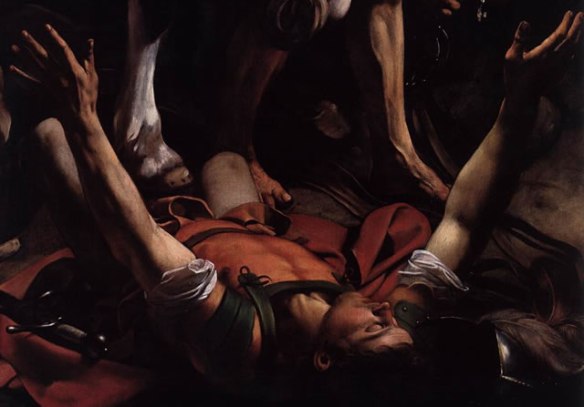
We talked about Saul’s conversion (Acts 9:1ff) on Sunday. As always, Forum members voiced a number of questions, expressed their wisdom learned by experience, and each of us left a little fuller and richer for the fellowship and conversation.

detail-conversion

Some random observations and questions from Sunday:

  • Though much of our art and poetry have God knocking Saul off his horse, the text makes no mention of horses
  • Saul is on his way to round up (and punish) any who “belonged to the Way” (v. 2) This is one of the earliest appellations used for those later called “Christian” (See also: Acts 18:23-26; Acts 19:23; Acts 24:14, 22)
  • The term “Christian” was first used in Antioch (c.40-44 CE) according to Acts:
    • 25 Then Barnabas went to Tarsus to look for Saul, 26 and when he had found him, he brought him to Antioch. So it was that for an entire year they met with the church and taught a great many people, and it was in Antioch that the disciples were first called “Christians.” Acts 11:25-26 NRSV
  • When one of our members suggested that there is often “conversion” (or recommitment in trust) as a response to trial, darkness, dryness, or the ‘Valley of the shadow of death,’ there were many nods and affirming comments.
  • Does conversion come best, deepest, profoundly, only through a ‘dark moment,’ a trial, a letting-go? A question for the week. A question for you.

Come back, as the week progresses we’ll work through some of the other comments from Sunday. Please continue the Sunday conversation by commenting here.

Wind Chimes: 13 Apr 2013

Diana Butler Bass is a favorite author, writer, speaker, and teacher. In early March she posted this to her Facebook Page:

Was asked by an evangelical friend who has found his way to an Episcopal Church WHY the congregation likes scholars like Dom Crossan. Here’s part of my answer:

“Since I wasn’t at Dom’s presentations at the church you mention, I can’t speak directly to them. But I can speak to the ethos of the Episcopal Church. The Episcopal Church understands itself as a big room, a community bound together by prayer and enacting justice, not a particular way of understanding scripture or theology. It is a comprehensive church, one that prides itself on holding a wide variety of views, and always open to new ways of engaging the ancient stories. Thus, as a denomination, everyone is really, truly welcome—and that includes Dom Crossan to Rowan Williams and Marcus Borg to NT Wright! But, of course, not everyone is comfortable with such an ethos. But it does mean that we listen to a wide swath of Christian thinkers — it is NOT unusual at all for a single Episcopal congregation to read books ranging from Crossan to CS Lewis. Or to hear Mary Daly and Phil Yancey quoted in a sermon.”

Every Sunday (at 9 am) we gather at St. Margaret’s in our Sunday Morning Forum. We definitely represent “a wide swath” of Christian thinking and believing. Either before (8 am) or after (10 am) the Forum we worship together and take communion together. Come join us for a wide-ranging discussion, prayers, and communion.

DivLine360x12It is a beautiful spectrum of sounds and rhythms from the chimes today.
What do you hear?

Don’t Doubt Thomas – a sermon

About Thomas and believing. May this give you a fresh perspective on a long-used, often-quoted, dialogue between Thomas and the Risen Christ.

Steve Pankey's avatarDraughting Theology

You can listen to it here.  Or, read on.

“So rejoice! Be perplexed! Ask questions! Sit in amazement!  Do whatever you need to do this Resurrection Day.  But above all, know that God loves you so much that he did the impossible to be in relationship with you.”  That’s how I wrapped up my Easter sermon last week, by giving you permission to take your time in coming to an Easter faith.  Resurrection is hard to believe, even a week later.  Thomas isn’t buying yet.  He wasn’t in the upper room last Sunday when Jesus appeared through a locked door.  He missed seeing the holes in Jesus’ hands and feet and the gaping slit in his side.  He didn’t get commissioned as an Apostle, that is, one who is sent in John 20:21.  He didn’t get the Spirit of new life breathed into him.  He wasn’t there.  John…

View original post 1,235 more words

Incredulity of St Thomas | Art for Easter 2

Incredulity of St Thomas
1572
Oil on panel
Santa Croce, Florence
VASARI, Giorgio
(b. 1511, Arezzo, d. 1574, Firenze)
Click image for more information.

______________
Commentary by Hovak Najarian

Incredulity of St. Thomas, Oil on Panel, 1572, Giorgio Vasari, 1511-1574

The High Renaissance took place in the last quarter of the fifteenth century and continued into the early part of the sixteenth century. By the time Giorgio Vasari was nine years old, however, many of the noted artists were no longer living. The exceptions were Titian and Michelangelo (who lived to be almost ninety years old). Renaissance advancements in art were now left to be sorted out by the next generation. Vasari regarded himself as part of the Renaissance; believing it continued until the death of Michelangelo (1564) and that he and his generation were part of it. In a broader sense he was correct but art historians today use the term “Mannerist” when referring to sixteenth century artists. Unlike artists of the prior century, it was not necessary for Mannerists to be pioneers in finding solutions to technical problems of art. Instead, they often used their abundant skills to emphasize style, dramatic effect, and virtuosity.

When Vasari was young, his precociousness was noted and he was selected to be schooled with members of the prominent Medici family; as an adult this contact was invaluable to his career. When Cosimo I de’ Medici funded changes at the Church of Santa Croce, Florence, he chose Vasari to be the architect and painter. Vasari painted scenes from Christ’s Passion – as well as events that followed – for the private chapels of the Church; the “Incredulity of Thomas” was painted for the Guidacci Chapel. Thomas, having said he would not believe Christ was resurrected until he himself saw the wounds on his hands and side, is shown with Jesus at a gathering with disciples. Vasari leads our attention immediately to center stage where Christ stands bare-chested with arms wide apart as though to say, “Go ahead, see for yourself.” Thomas examines the wound on Christ’s side as people rush out from a background door to also look. Angels have arrived and are floating above, and cherubs are on either side of the arch. The dramatic lighting and hand gestures of Christ and those in attendance add to the theatricality to this scene.

Note

Giorgio Vasari was immensely famous during his lifetime but now he is cited more often for his writings on the lives of artists. The necessity to rely on secondhand sources at times resulted in a few points of misinformation but on a whole, his work provides invaluable insights into the art and artists of his time.

When reference is made to the “High Renaissance” and the time period is elusive, it may help to know Christopher Columbus was a contemporary of Michelangelo, Raphael, and Leonardo. While they were making art, he was sailing. “In fourteen hundred ninety-two, Columbus sailed the ocean blue.”

Hovak Najarian © 2013

Wind Chimes: 1 Apr 2013

Sister Joan Chittister is one of my favorite authors. Here is her “Easter Prayer.” You can find an index to all of her “Ideas in Passing” here. I encourage you to subscribe to her weekly email.

To say “I believe in Jesus Christ . . . who rose from the dead,” is to say I believe that the Resurrection goes on and on and on forever. Every time Jesus rises in our own hearts in new ways, the Resurrection happens again. Every time we see Jesus where we did not recognize him before—in the faces of the poor, in the love of the unloved, in the revelatory moments of life, Jesus rises anew. The real proof of the Resurrection lies not in the transformation of Jesus alone but in the transformation awaiting us who accept it.

To say, “I believe in Jesus Christ . . . who rose from the dead,” is to say something about myself at the same time. It says that I myself am ready to be transformed. Once the Christ-life rises in me, I rise to new life as well. “Christ is risen, we are risen,” we sing at Easter. But it has a great deal more to do with life than with death. If I know that Jesus has been transformed, then I am transformed myself, and as a result, everything around me.

Until we find ourselves with new hearts, more penetrating insights, fewer compulsions, less need for the transient, greater awareness of the spiritual pulse of life, resurrection has not really happened for us. Jesus has risen but we have not. Resurrection is change at the root of the soul. It marks a whole new way of being in life.

Prayer

Jesus, help me to understand that in every life, something good fails, something great ends, something righteous is taken unjustly away, something looms like an abandonment by God. Give me the wisdom to know that You rose from the dead as a sign to us that every one of these “little deaths” is life become new all over again. Be with me in living Your Resurrection over and over again.

Joan Chittister in: Vision and Viewpoint e-newsletter dated 1 April 2013

DivLine360x12The chimes are fairly shouting praises as they sound today. What do you hear?

An Easter Blessing

An 'Easter' image from the John Muir Wilderness

The Lord who conquered darkness with light,
give peace to you.
The Lord who conquered death with life,
give peace to you.
The Lord who conquered loneliness with love,
give peace to you.

Divider

Blessing: David Adam, The Open Gate, p. 110

Image: An Easter moment in the John Muir Wilderness, ©Daniel Rondeau 2007

Songs for Holy Saturday

Surely He took up our pain and bore our suffering…He was pierced for our transgressions and crushed for our inequities; the punishment that brought us peace was on Him, and by His wounds, we are healed.   Isaiah 53:4-5