Retabla of the Trinity, ca. 1936, Watercolor Copy of an Altarpiece, E. (Elizabeth) Boyd, 1903-1974

Commentary by Hovak Najarian

Related post B Trinity Sunday (Pentecost 1), Art for June 3, 2012

When some forms of creative work became valued more than others the concept of art was established and a hierarchy of categories came into being. Painting and sculpture now are called “high arts” and often the crafts and decorative arts are relegated collectively to the category “minor arts.” Today, other creative works are acknowledged only rarely by the art establishment. Folk, naïve, outsider, and visionary are terms used to describe various art forms that are seldom displayed in galleries or museums except for an occasional special exhibition. These works are made typically by people who have had no formal training in art and lack technical sophistication. It is an art that often fulfills personal needs and at times is the result of emotions related to religious beliefs.

During The Great Depression of the 1930s, millions of Americans were out of work but opportunities for jobs in public works projects were made available under the Work Progress Administration (WPA). Among these workers were artists who were employed to paint murals in Post Offices, transportation stations and public buildings. Artists, writers, and photographers also were employed to document our American cultural heritage. [Dorothea Lange’s well known and stirring photographic images now give us a sense of the hardships of migrant workers during the Great Depression.]

One of the artists working for the Federal Arts Project during this era was Elizabeth Boyd. She was enamored by the Southwest after a childhood visit and following the study of art in Paris as a young adult she returned to seek work in New Mexico. The coming of the Depression led her to a government sponsored project that documented a form of folk art called, retablos which were found in churches throughout New Mexico. Retablo is the Spanish term for a shelf behind the altar on which objects are placed; hence, small paintings displayed on it are known as “retablos.” In the Episcopal Church the term for this shelf (on altars placed against a wall) is retable and sometimes candles or flowers are placed there.

When churches were established by Franciscan monks in the American Southwest, materials were in short supply. There was a shortage of art supplies as well and the images that were created tended to be small and personal. Wood was used for painting surfaces and pigments were derived locally from whatever natural sources were available. In subject matter, they represented usually Christ, the Virgin Mary, or one of the many saints. Boyd travelled to churches in remote villages and often her work was in adverse conditions as she drew the retablos and then remained as true as possible to the originals when she painted them with watercolors. With the aid of two assistants, woodblock prints were made of her work and published as New Mexico’s contribution to the Index of American Design.

The Retabla of the Trinity differs from familiar depictions of the Father, Son, and dove representing the Holy Spirit. Instead, the Trinty image rendered by Boyd is of Byzantine origin and is based on an account in Genesis (18:2) that told of three men coming to Abraham. Early portrayals included Abraham as well but later only the three men were pictured. The depiction of the Trinity in this form was carried over into European art but after an edict by the pope in the eighteenth century it was no longer used. It remained in use, however, in the American Southwest and in other parts of the Americas that were settled by Spain.

______________

© 2012 Hovak Najarian
The endless gift of Pentecost

Continuing in the breath, wind, and fire of Pentecost here is the meditation of one of my favorite bishops. Brian Prior is the Bishop of the Episcopal Diocese of Minnesota. You’ll want to read the whole post, of course, but here is how it starts:

It is illusive…but ever present.

Many expect to experience it only  as a lighting bolt while missing the still small voice. There are those who believe it is always manifested in a radical, almost “other- worldly” way, while the ‘everyday-ness’ goes unnoticed. Others have no expectations while the truly miraculous goes unacknowledged.  Some assume that it is brought forth by their own volition all the while it is unquestionably a gift.

Yet once you have had a moment, an experience, an awareness or an openness to its movement in your life…

Keep reading on the Bishop’s Blog.

Go deeper into the miracle of Pentecost

They were all filled with the Holy Spirit
and began to speak in other languages

as the Spirit enabled them to speak.
from Acts 2:1-11 (a reading appointed for Pentecost)

Other languages. Real languages. The disciples, who spoke Aramaic (and with an accent) suddenly were able to speak in other people’s languages. The true miracle and gift of Pentecost is not ecstatic prayer, but conveying love by bridging differences, by reaching out to the Other. Whatever separates us is the place where the miracle of Pentecost happens.

I encourage you to read the entire post: Loving the other

Again I encourage you to take a look at the meditation offered by Steve Garnaas-Holmes on his blog Unfolding Light. Read the meditation with your own experiences of the Holy Spirit (gift of your Baptism) and the prayers of the Church that the Spirit give you an “inquiring and discerning heart, the courage to will and to persevere, a spirit to know and to love you, and the gift of joy and wonder in all [God’s] works.” (Prayer for the (newly) baptized, adapted)

Let the miracle of Pentecost emerge from your daily comings and goings, your work and play, your busy-ness and rest.

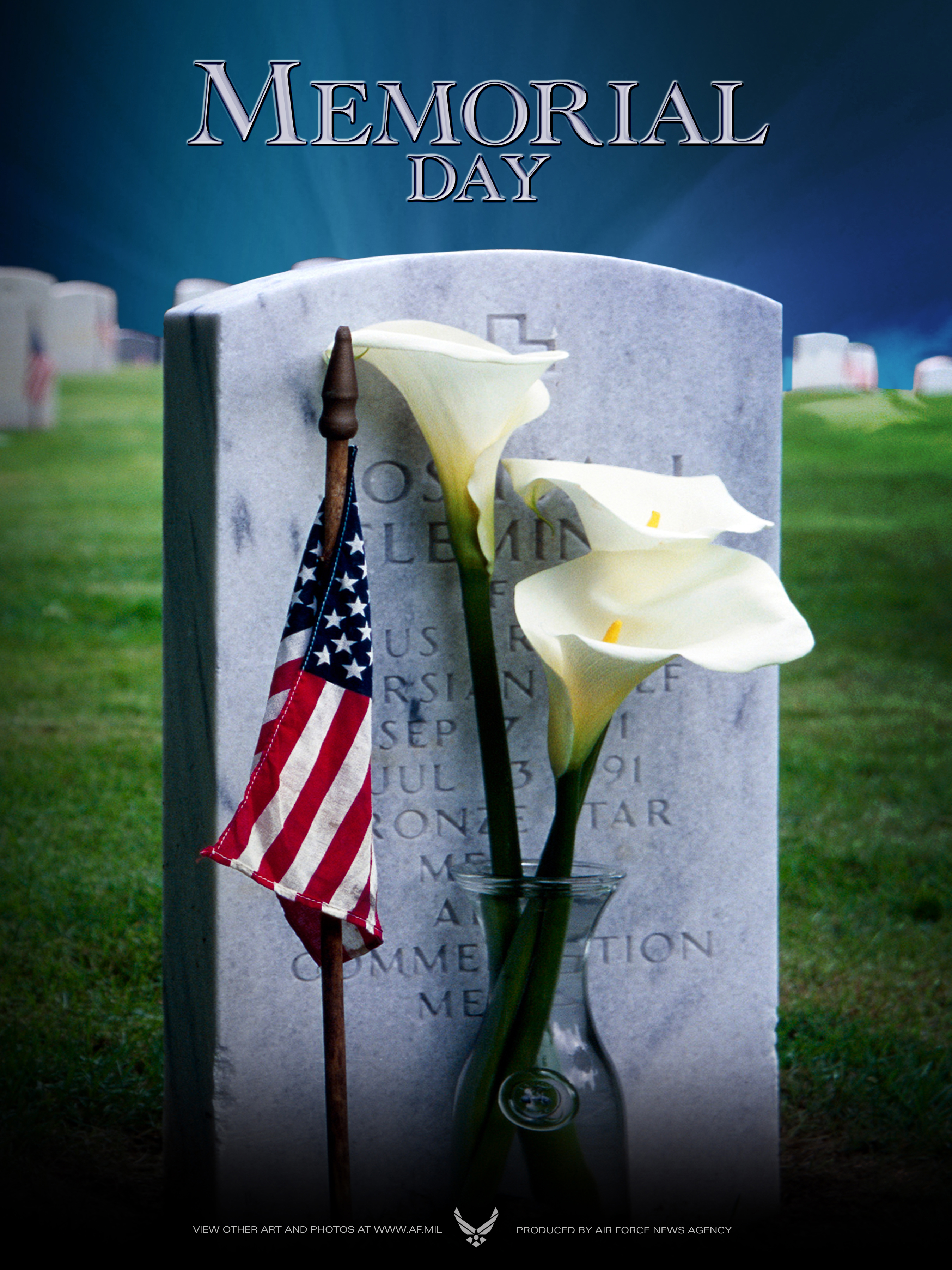
Memorial Day: as we remember may we also become committed to work for peace

Memorial Day, which is observed on the last Monday of May, commemorates the men and women who died while in the military service.  In observance of the holiday, many people visit cemeteries and memorials, and volunteers often place American flags on each grave site at national cemeteries.  A national moment of remembrance takes place at 3:00 p.m. local time. —Dept. of Veterans Affairs

My hope this Memorial Day is that in the midst of whatever holiday fare you have planned today you will take a moment to remember the sacrifices made on our behalf. To help you here are some links I have found helpful in my spiritual journey:

Here is a short prayer shared by the Rev. Gagne in his essay. Let it be our prayer today.

 Loving God, we pray to you for people of every race, religion, langauge and nation. Help us always to respect and love each other for You have made us all. Let those who have given their lives for the sake of justice, peace and freedom be rewarded by your generous love. May their families and friends, and we who honor them today, remember them with love, now and always. Amen.

Come, Gracious Spirit

Now it is after sunset (in my patch of California). On the Eve of Pentecost I share with you this presentation of the hymn “Come, Gracious Spirit.” Enjoy (more than once) as you prepare for (or celebrate) Pentecost.

So you know: “A Christian hymn of prayer to the Holy Spirit written by Simon Browne, 1720. Sung in the video by the Altar of Praise Chorale.” [YouTube caption]

Game-show God — A Nuns Life

“This is not what we were praying for, but this is what God sent.” After last night’s [5/23/12] In Good Faith podcast with Jane Knuth, I couldn’t get these words out of my head. … Late into the night I thought about this story and about the various reactions I’ve had when God’s response to me was unfathomable at the time. Sometimes I felt disappointed, confused, frustrated. Other times I had a good laugh, a new way to look at a situation, a deep sense of trust.

Sometime after midnight, I started to imagine God as the host of a TV game show called Jeopardy. On the show, the contestants get an answer first, and then they have to come up with the right question.  It made me smile to think that maybe God is always giving me answers, and that maybe my prayers are actually questions.

What are some of the reactions you’ve had to God’s response to your prayers? What image of God and prayer does it bring to mind for you?

Read the entire post (I recommend it) here: Game-show God — A Nuns Life by Sr. Maxine

With Sister Maine I ask you “What are some of the reactions you’ve had to God’s response to your prayers?” I have experienced disappointment, confusion, and frustration—as she has. I would add disorientation, bitterness, and despair.

Fortunately God’s “angel” (messenger) has often been timely in arriving and helping me back to trust (in God’s love, and in God’s joy), back to hope (that with God all things are possible and all things will work toward the good), and back to that Peace that passes all understanding. Waiting for the angel, doing the work, takes patience. I know.

Please leave a comment, help me to hear your story, let us together fashion our story.

When there is no water from the faucet, because there is no faucet

Moving from study to action is one of the goals for those who participate in the Sunday Morning Forum, here, or in the classroom, or both. It works the other way, too: action needs to be informed by study. What are the needs of the world around us? What is being done? Listen…are we being called to minister here? Listen…are we being called to support the efforts of others? Listen…what is the Spirit saying?

In my listening i hear again and again the whisper of the Spirit to help others bring clean water to those who must work hard and risk much, every day, to provide water for their families. During Advent and Christmas the ministry of World Vision and charity: water were highlighted in the Advent & Christmas Calendar. As we prepare for Pentecost I put them in front of you again. These two videos are worth seeing time and again to help us remember that the need is still great and that others have already begun to address the need.

They help me to Listen so that I may hear what the Spirit is saying. They make me wonder what the need is in my own part of the world. I pray that they may serve the same purpose in you.

To “see” what the previous video illustrated graphically, I encourage you to watch “Walking in Sabina’s Shoes” from World Vision:

You decide

“Recommend books, poetry, music, movies, videos, and so on,” we tell each other on Sunday. Just last Sunday (5/20/12) Stan recommended The Last Week by Marcus Borg and John Dominic Crossan. (It is available at the Rancho Mirage Public Library.) Here are 2 Book Reviews to help you decide to pick it up and read.

A book review from Spirituality & Pracitce

Marcus Borg (Meeting Jesus Again for the First Time) and John Dominic Crossan (Jesus: A Revolutionary Biography) set out to explore the last week in Jesus’ life against the backdrop of Roman imperial control. Their purpose is not to attempt a historical reconstruction of what has become known as the “Passion” or suffering of Jesus, but to probe the things Jesus was passionate about. The text they use is the Gospel of Mark, the earliest to be written, the most succinct, and the one with the most time markers for the week’s events. Read more.

A book review from Journey with Jesus

In this simple exposition written for a general audience, two leading New Testament scholars use the Gospel of Mark to explain what happened to Jesus during his final week. They use Mark because most scholars consider it the earliest of the four Gospels, the primary source for Matthew and Luke, and because when you read carefully you see that Mark details the last eight days of Holy Week, from Palm Sunday through Easter Sunday. Read more.

Keep the conversation going: what is your experience with this book?

Ever heard of the Five Marks of Mission? Well …

On Sunday, believing ourselves “sent into the world” by Jesus in his prayer—John 17:18—we looked at the “Five Marks of Mission” set before Episcopalians (and all Anglicans worldwide) in 1984 and again in 1990.

“The Mission of the Church is the mission of Christ.”

  • To proclaim the Good News of the Kingdom
  • To teach, baptise and nurture new believers
  • To respond to human need by loving service
  • To seek to transform unjust structures of society
  • To strive to safeguard the integrity of creation and sustain and renew the life of the earth

See: http://bit.ly/KCHAf6 (Anglican Communion)
(Bonds of Affection-1984 ACC-6 p 49,
Mission in a Broken World-1990 ACC-8 p 101)

Around the table each of us found one of the marks “hitting the mark” in our heart. For me it was the last mark “To strive to safeguard the integrity of creation and sustain and renew the life of the earth.” Men and women of faith have reached differing conclusions about “how” this ought to be undertaken, or if it should be undertaken at all.

For another the fourth mark “To seek to transform unjust structures of society” raised the question of discerning a God-given mission amidst the current political environment in America where men and women of faith who have reached different conclusions about what is an “unjust structure” of society tend to vilify and even demonize each other publicly.

It was a lively discussion. It raised more questions than it answered. It led us to pray for each other.

  • Which of the “marks” speaks most vividly to you?
  • What questions are raised in your heart as you begin to expand the summary statement of that mark?
  • How do you see these marks flowing from your Baptismal Covenant (with God and other Episcopalians)?
  • Or, do you see these marks flowing from the Baptismal Covenant at all?
  • How do you discern God’s call to you? Who or what are your guides in discernment?

Please offer a question or comment, let’s continue the conversation.

B Pentecost, Art for May 27,2012

BASTIANI, Lazzaro
(b. ca. 1430, Venezia, d. ca. 1512, Venezia)
Click to open Web Gallery of Art Artist Biography and to explore other works by this artist.

Pentecost
1484-90
Tapestry in wool, silk and silver thread
Santa Maria della Salute, Venice
Click to open Web Gallery of Art commentary page. Click image for large view.

Related art commentary by Hovak Najarian.