

“The Crucifixion”
Samuel Barber (1910-1981) was a highly versatile composer known for his two operatic works (Vanessa and Antony and Cleopatra), along with his many works for orchestra, strings, piano, and voice. Of his compositions for voice and piano, perhaps his best known and most loved is his collection of Hermit Songs. The Hermit Songs is a setting of semi-reverent, semi-crass texts written by Irish monks between the 8th and 13th centuries. The cycle was commissioned by the Elizabeth Sprague Coolidge Foundation in 1953. That same year, it was premiered at The Library of Congress by soprano Leontyne Price. Barber accompanied.
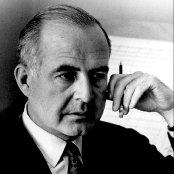
Of the ten Hermit Songs, the most poignant to me has always been “The Crucifixion.” (Listen once, and you’ll understand exactly why.)
Given that we are just over halfway through Lent, it seems appropriate to share it today. The text reads as follows:
At the cry of the first bird
They began to crucify thee, O Swan.
Never shall lament cease because of that.
It was like the parting of day from night.
Ah, sore was the suffering borne
By the body of Mary’s son.
But sorer still to Him was the grief
Which for His sake came upon His mother.
–Translation by Howard Mumford Jones
The mural and the fresco
Editor’s Note: Hovak Najarian, Art History Professor Emeritus from College of the Desert, will begin to help us understand the art that informs our faith and understand the faith that informs our art. In our lectionary on Sunday we read from Numbers 21:4-9. Michelangelo’s fresco the Brazen Serpent, from the ceiling of the Sistine Chapel, opens up this scene from the Exodus. Enjoy the art, enjoy this background to the art. Keep learning.
Become more familiar with often encountered terms:
Mural: A mural is a large work of art that is usually created directly on a large architectural surface. The murals on the ceiling of the Sistine Chapel often are referred to as “ceiling frescos” because the fresco process was used to paint them. In the same manner, critics often refer to an oil painting simply by its medium, “oil,” but all paintings are not oils and all murals are not frescos The terms mural and fresco are not synonymous. Mural identifies a work’s category (the type of work that it is) and fresco refers to its medium (the material that is used to make it).
Fresco: In the fresco process, an artist paints directly on wet plaster with water based pigments. Before painting begins, a plasterer covers an area of a wall (or ceiling) according to an estimate of how much the artist believes can be painted before the plaster sets. While the plaster is still moist, the pigment is absorbed into its surface and when it is set the pigment becomes an integral part of it. The pigment is not on the wall or ceiling, it is within its surface.
If a plastered area has set before it can be painted it is no longer capable of absorbing pigment and must be chipped off. A fresh area of plaster is spread on the wall before work continues. The removal of plaster is done along a contour of a figure in order that a seam is not apparent. This procedure is repeated until the mural is completed. It is a time consuming and messy process and is seldom used now unless a particular effect is desired. Michelangelo worked on the ceiling frescos of the Sistine Chapel from 1508 to 1512 AD.
Sistine Chapel: This chapel is named “Sistine” because it was Pope Sixtus who had it restored in the latter part of the fifteenth century.
______________
© 2012 Hovak Najarian
B Lent 4, Art for Readings for March 18, 2012

Expanding and refining our vision
Earlier this month I introduced you to Hovak Najarian who will expand our vision as we view Stan’s offerings in art each week. Not only will Hovak expand our vision but he will offer an experienced and educated eye to help us refine our vision as we enter the world of art. On the Third Sunday in Lent Stan directed our eyes to Rembrandt’s painting of Christ driving the Money-Changers out of the Temple. Hovak presents this additional information to help us into the art. ~dan
Comments on Rembrandt’s Christ Driving the Money-Changers from the Temple by Hovak Najarian
Rembrandt’s painting, Christ Driving the Money-Changers from the Temple was painted only a year after his earliest dated work but it already shows his interest and ability to create paintings of emotional depth. Like his teacher, Pieter Lastman, Rembrandt was particularly interested in faces and in “Money-Changers,” each face, figure, and gesture is a focal point of deep expression.
The art of the Italian Renaissance grew out of a rebirth of classicism (the art of the Greeks in particular). The Greek gods were sculpted with idealized human proportions and this idealization and refinement carried over into Renaissance painting and into the works commissioned by the Roman Catholic Church and wealthy families. The art of Protestant Northern Europe of the seventeenth century, however, did not reflect the classic ideal and their paintings were less likely to be of Mary and child, the crucifixion, or one of the saints. Their figures were more like everyday people, not idealized images.
Dutch businesses thrived during Rembrandts time and he earned a very good income from painting portraits of his patrons. Rembrandt also painted Biblical subjects of deep emotional content. There is realism in the faces of the people in “Money-Changers.” They are not men with classic profiles set in place for a lovely picture. The money-changers’ faces show furrowed brows, mouths agape, and surprised reactions as Jesus moves into action. Jesus is not centrally located in the scene as is often the case but rather he is at the upper left side as though he just entered the scene and caused the money-changers to scramble. He is not a handsome man with a sweet beatific expression. He looks tough, serious, and his eyes are focused and intense. The money-changers seem like real people in a real situation; the painting does not give the effect of a scene that is staged.
The facial expressions and sense of activity of the figures seen in Rembrandt’s earlier paintings gradually changed in focus as he became older. Instead of movement, his figures tend to remain still with a sense of heavy emotional weight and feeling concentrated in facial expressions.
______________
© 2012 Hovak Najarian
We are brothers and sisters…
ONE Episcopalian buys a brick
Another EPISCOPALIAN finds hope
With the entire Episcopal Church—brothers and sisters in Christ, though separated by thousands of miles—the people of St. Margaret’s are giving to help in the rebuilding of Haiti. In particular we are giving to assist in the rebuilding of the cathedral in Port-au-Prince. Our Presiding Bishop, Katherine Jefferts Schori gives us perspective:
The Episcopal Church as a whole is partnering to help the Diocese of Haiti rebuild the cathedral complex in Port-au-Prince. Before the earthquake, that complex included not only the cathedral with its world famous murals (three have been conserved), but a music school and philharmonic orchestral, a vocational school, a convent, and diocesan offices. Partnerships have helped to provide necessary infrastructure for strategizing and planning the redevelopment work. Read her complete statement.
Bishop Jean Zaché Duracin of the Diocese of Haiti narrates a powerful video about the conditions in Haiti, images of rebuilding, and offers his thoughts and reflections on the second anniversary: WE ARE ONE
B Lent 3, Art for Readings for March 11, 2012

Christ Driving the Money-Changers from the Temple
c. 1626
Oil on panel, 43 x 33 cm
Pushkin Museum, Moscow
Click to open Web Gallery of Art image. Click again for extra large view.
Contemporary analysis sees Jesus’ action as an attack on Temple political practice itself, not money-changing per se. Money-changing was necessitated by the required ritual sacrifice by pilgrims.
In Christian art whips, flying coins, overturned tables and fleeing Jews make for exciting images and reinforce prejudicial Jewish stereotypes.
sch
Easter Hymn Post–“The Old Rugged Cross”
I may have mentioned this before, but I love hymns. The texts possess a richness that is, in my opinion, difficult to find in any other genre, with the exception of the art song. This holds true for “The Old Rugged Cross.”
To be honest, I’ve never heard “The Old Rugged Cross” sung in an Episcopal church…or in any church other than the tiny Baptist church I attended as a very young child. And when we sang it, my friend, it didn’t have to be Easter. “The Old Rugged Cross” was appropriate on Christmas Eve, the Fourth of July, Mother’s Day, and any other day you can think of. Or at least that’s how it seemed to me.
So, given my early acquaintance with the hymn, I’ve never really given much thought as to who wrote it or why, but I’m glad that I started doing a little digging. It is difficult to get solid information on the hymn because most of the stories are passed down by word of mouth or presented on personal websites. However, here’s what I’ve found: The hymn was written by an itinerant Methodist minister named George Bennard (1873-1958) in 1913.
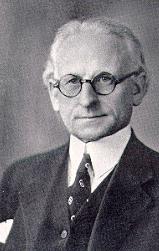
While on his route through the northern states, he began meditating on Christ’s suffering on the cross. He is reputed to have written, “I saw the Christ of the cross as if I were seeing John 3:16 leave the printed page, take form, and act out the meaning of redemption.” (1)
When he arrived home to his apartment in Albion, Michigan, he began setting text to a tune he had already composed. One story goes that he only had the phrase “On a hill far away stood an old rugged cross” until he was harassed by some teens during a service. According to the story, after that incident, the rest of the words came to him. The composition process did not happen quickly, and he spent the next few months revising the text and asking for input from friends and colleagues.
In 1913, the hymn was debuted at the First Methodist Episcopal Church of Pokagon, Michigan. Four members of the choir sang, accompanied by piano and violin. His friends, Rev. and Mrs. Leroy Bostwick, paid to have the hymn printed.
The song grew in popularity and became well-loved throughout the northern states. In 1915, two years after its debut, evangelist Billy Sunday and his song leader Homer Rodeheaver bought the rights to the song for $500, and its popularity grew nation-wide thanks to Billy Sunday’s tent revivals.
Bennard died in 1958 after writing several more hymns and spending his adult life ministering to others. Because he sold the rights to “The Old Rugged Cross” so soon after its composition, he never became wealthy from the song.
When I’ve heard the hymn, it’s usually been in a slow, gospel style like this. However, there are also jazz renditions, instrumental blues covers, and, of course, Elvis.
The melody and the style might not be everyone’s cup of tea, but the words truly are timeless. And, like I learned at that little Baptist church, appropriate all year long.
On a hill far away stood an old rugged cross
The emblem of suffering and shame
And I love that old cross
Where the dearest and best
For a world of lost sinners was slain
Chorus:
So I’ll cherish the old rugged cross
‘Til my trophies at last I lay down
I will cling to the old rugged cross
And exchange it someday for a crown
Oh, that old rugged cross so despised by the world
Has a wondrous attraction for me
For the dear Lamb of God left His glory above
To bear it to dark Calvary
In that old rugged cross, stained with blood so divine
A wondrous beauty I see
For ’twas on that old cross Jesus suffered and died
To pardon and sanctify me
To the old rugged cross I will ever be true
Its shame and reproach gladly bear
Then He’ll call me someday to His home far away
Where His glory forever I’ll share.
Sources:
http://www.lectionary.org/HymnStories/The%20Old%20Rugged%20Cross.htm (1)
http://www.the-oldruggedcross.org/history.htm
http://www.albionmich.com/history/histor_notebook/R980413.shtml
Be aware. Do good. International Women’s Day 2012

March 8th is “International Women’s Day, a day of remembrance and reflection celebrated around the world since 1913,” according to Episcopal News Service.
Here are a few of the posts on our blog that have sought to increase awareness of the needs and issues of women and girls throughout our world and right in our own neighborhoods. As always, my hope and prayer is that with increased awareness of need and the whisper of the Holy Spirit, individual and collective action to meet these needs will result. Blessings on this International Women’s Day. ~dan
Episcopal Women’s Caucus and Anglican Women’s Empowerment – introduced on the Seventh Day of Christmas, this post includes links to other organizations by and for women and girls
Two Against Gender Violence – introduced in our Advent Calendar Day 14, this post links to ECS Julian’s Housing Program for Women and Children and Shelter from the Storm
Anglican Women gather in New York to consider Communion’s Advocacy Efforts – a post linked to an Anglican Communion News release in January. The post indicates how the Anglican Communion is addressing the issue of empowering women in rural settings.
charity: water – posted in our Advent Calendar, Day 24, this post raises awareness about how women and girls are adversely impacted by doing the work of obtaining water for the household (“women’s work”) and how charity: water by bringing water to a village (via wells, or filtration and storage systems) positively impacts the lives of these women and girls (Recommended: Water Changes Everything video)

______________
Image 1 from the International Women’s Day website | Image 2 from 3 inspiring french women
Observing a holy Lent: giving alms
Are you ready for a challenge? I am. Here we go.
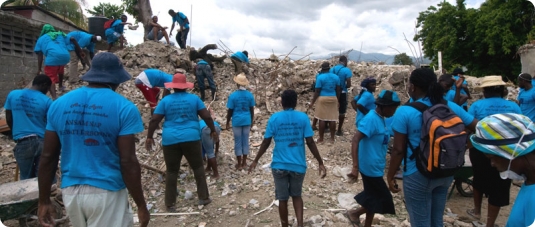
On Sunday, March 4th, over a dozen Forum participants gathered with other parishioners to hear Sandra Swan talk about Haiti, about Episcopal Relief and Development, and about the efforts of every diocese and parish within the Episcopal Church—including St. Margaret’s—to learn about and “give alms” for the rebuilding of Haiti. Lane and Chet, the Vestry and its Outreach Commission, have made this our charitable effort in Lent 2012 (you can see the bricks in the Narthex every Sunday to remind you of this project).
Today, I challenge our Sunday Morning Forum (you and me) to contribute $1,000 to this Lenten alms giving. This seems like a modest goal for us who seek to be “doers of the word.” (James 1:22)
We are averaging over 20 folks in our Sunday morning gathering on campus. With just the Sunday morning crowd and a donation of $50 each we can make this goal. Reaching out to our friends and family and online Forum members we may exceed this goal for the glory of God and the relief of his people in Haiti.
If you have already given to the Haiti effort, let me know and we’ll add that to our total. Today Carol and I have donated $100 for the rebuilding of Haiti. Let’s do this as part of our effort to put our faith into action. Thank you. ~father dan
Donate Now as a doer of the word
- Use ParishPay (a secure website used by the church). Under One-Time Donations designate Rebuild Haiti to make your donation. (The option Carol and I used)
- Use the Episcopal Relief and Development secure website to make your donation; designate “Haiti Earthquake Response” to make your donation
- Write a check to St. Margaret’s Episcopal Church and indicate “Rebuild Haiti” on the Memo Line. Send check to: St. Margaret’s Episcopal Church | 47535 Highway 74 | Palm Desert, CA 92260 or drop the check into the Sunday collection at worship.
All contributions to St. Margaret’s for Haiti Relief will be sent to Episcopal Relief and Development whose workers and whose aid arrived in Haiti within hours of the January 12th earthquake in 2010 and whose commitment is to continue “its support throughout the recovery and rehabilitation process” (no matter how long it takes).
Additional information about how donations to ERD are used:
- View the Haiti Earthquake Response Work page of ERD
- Download the Haiti One Year Report (PDF)
Additional information about how ERD is joined in a cooperative effort with other charitable organizations:
Visit the InterAction Haiti Aid Map for an interactive look at where Episcopal Relief & Development is active. Use this link to view the combined efforts of all Non-Govermental Organizations (NGOs) in Haiti.
Additional information about our parish efforts to contribute to the rebuilding of Haiti:
- Sherry Wollenberg, our Forum member, (on Sundays in Lent you will find her near the bricks and the wheelbarrow in the Narthex or on the patio)
- Deacon Cherry (seemingly everywhere on Sundays in Lent and via email: Deacon Cherry)
 Hear what the Spirit is saying