9/11 Schedule for St. Margaret’s in Palm Desert, CA

Save the date (and time)! You are invited to save the dates and times for 10th Anniversary remembrances at St. Margaret’s and in the community of Palm Desert, CA.

  • Friday September 9th LABYRINTH WALK beginning at 7:30pm
  • Saturday, September 10th HIKE AND PRAY TO THE CROSS beginning at 6am
  • Sunday, September 11th REMEMBER IN WORSHIP
    • 8am Service of Holy Communion
    • 10am Service of Holy Communion with commemorative prayers and music
  • Sunday, September 11th COMMUNITY CONCERT & PICNIC
    • Begins at 7:15pm more details to follow

Details are being finalized as this is written, times and dates are firm—plan now to attend one or more of these events.

9/11 story shows the way to bring Paul’s words to life

Do not be overcome by evil, but overcome evil with good
—Paul to the Romans a long time ago

“Do something extraordinary!” was probably not in the mind or heart of Susan Retik as she grieved the loss of her husband in the events of 9/11. Susan was pregnant with their third child, at home in Boston, when she heard that her husband had died as United Flight 11 was crashed into the North Tower in New York by terrorists.

At the right time, however, she and Patti Quigley, another 9/11 widow, did something extraordinary. Together they started Beyond the 11th Foundation. The Foundation helps widows in Afghanistan to earn a living to support their families.

We have presented Susan’s story here: Is it possible to forgive? It is the subject of a documentary, Beyond Belief, available on DVD (and streaming on Netflix). I bring her story to your attention again after reading it again in USA Today: “Lessons from one widow to another

As we prepare for Sunday (8/28/11) I offer this to you: What Susan and Patti did in the sorrow and grief following 9/11 was (purposefully or not) to give flesh and blood, voice and touch, to the words of the Apostle Paul: “Do not be overcome by evil, but overcome evil with good.” (Romans 12:21)

In our day with the 24/7 stream of news about evil and its aftermath it is so tempting to do nothing because the evil is so great and so pervasive. Long ago Paul spoke words to shatter such temptation, inaction, and defeat. In our own country, in our own day, Susan and Patti have not only spoken the same words but they have acted, they have done something extraordinary, to shatter the same temptation and defeatist attitude. They continue to work to overcome evil with good. And so must we.

Some questions to considerWhat small, ordinary, commonplace action are you called to share in order to overcome evil with good? What community, working to overcome evil with good, are you invited to join (for many together can do more than one alone)? To what community do you already belong where, working together, you strive to overcome evil with good? How will you overcome evil with good in your own time, with the skills you have, in the time you have, in the place you are? Be sure to leave a comment here to encourage me and others.

Proper 17A: Art for Track 1 Readings

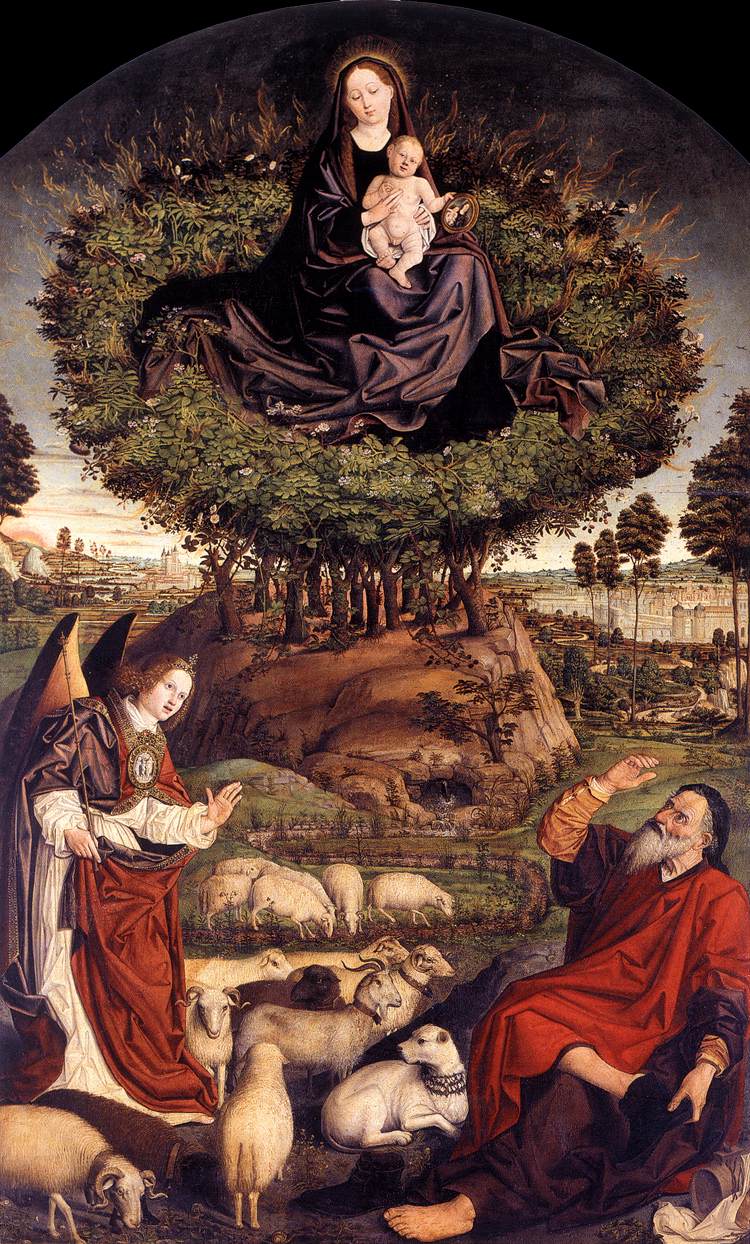
A different presentation of Moses and the Burning Bush. Original post updated 8/28/20

Moses and the Burning Bush, Nicolas Froment (1476)

The Burning Bush
1476
Wood, 410 x 305 cm
Cathedrale Saint Sauveur, Aix-en-Provence
FROMENT, Nicolas
(b. ca. 1435, Uzes, d. ca. 1486, Avignon)Barcelona)
Click to open Web Gallery of Art display page.

Exodus 3:1-15 is one of the readings appointed for Proper 17A (Continuous Narrative). Here is an interesting depiction of that moment.

What is going on here? Mary standing in for God? Well not exactly—the infant Jesus represents God in the burning bush. Why Mary?

Welcome to typological and allegorical interpretation where Mary represents many ideas and connections. Notice the little mirror held by Jesus. Perhaps Mary, sometimes known as “the reflection of the Church” or “the reflection of faith,” brings our witness to this foundational story of God acting for justice and order in our lives.

Well. . . what do you think?

This week we have (haven’t we?) been thinking about Spiritual Gifts (the main topic of conversation on Sunday Morning in the Forum). Rather than cite scholarly sources (which I have been reading), rather than offering extensive quotes, I will offer my current understanding of Spiritual Gifts as an invitation for you to also share.

You and I do not have to be experts, scholars, or theologians, to have an opinion and an understanding by which we live our faith—though it is helpful to let these opinions and understandings mature as they guide us (i.e., let them change as we gain more experience and understanding).

For brevity I will offer an “Executive Summary” of my current understanding. This is not meant to be exhaustive or the definitive “last word” on the topic of Spiritual Gifts—you know, I’m still learning a lot.

  • Everyone, including me, is gifted by God in some way
  • Gifted by God is foundational: God chooses which Spiritual Gift to offer, God takes the initiative, always
  • We choose to accept the gift or not (we always have this freedom, another gift of God’s initiative)
  • We choose to exercise the gift or not (don’t you love this gift of free will?). My own experience tells me that the choice to exercise the gift (or not) ebbs and flows like a tide (though not so regularly). Sometimes I do this easily and well and for a prolonged period (you could float a boat); at other times it is as if I have amnesia (or sloth) and the gift is not used (that boat is mired in the tidal mud).
  • The Spiritual Gift is meant (by God) to be used for the well-being of the Body of Christ (=the Church) and for the welfare of all God’s people and all of God’s creation (=the world). It is not meant to be hoarded, it is not meant to a personal delight nor a self-esteem booster—it is meant to be shared for the good of all (inside and outside the Church, indeed, to be shared for the good of all creation).
  • I’m still working out what the Spiritual Gifts are (according to our “teachers” in the Bible and in our Christian Tradition). As you heard Stan mention on Sunday there are multiple internet resources for exploring the meaning of and kinds of Spiritual Gifts.
  • Believing the Church (at its best) to be organic, living, changing, adapting—the “Body” of Christ—the gifts (from God) are meant to part of an organic whole, not part of some grand Organizational Flow Chart.
  • Closely linked to the organic nature of the Church is that the local church may need different gifts at different times (as communities and their needs change) so I believe a couple of things can happen: the gift you’re given changes to meet the new needs and/or new members are brought into the community with the necessary gifts to meet the new (changing) needs.

That’s probably enough for now. What do you think? What would you like to add (for me and others)? How can we grow together in our understanding of God’s generosity? Leave a comment, please. Let’s see where the Spirit will lead us.

It’s a great question

You are in for a treat. Often in the Sunday Morning Forum we open the First or Second Lesson or the Psalm appointed for the Sunday. Often our preacher takes up the Gospel Text. Today, The Rev. Troy Mendez (Associate Rector for Pastoral Care at St. Margaret’s) shares his sermon from Sunday, August 21, 2011. He begins with a story and finishes with an exhortation we can accomplish—with God’s help. ~dan

Are you Jesus?

Sermon for Proper 16A by The Rev. Troy Mendez
Associate Rector for Pastoral Care at St. Margaret’s in Palm Desert, CA 
 

Let the words of my lips and the meditations of our hearts be acceptable in your sight, O Lord, our strength and our redeemer. Amen.

In his book, The Signature of Jesus, Brennan Manning tells us a story about five business colleagues who travelled on a day trip from Chicago to Milwaukee.   All of these 5 people had evening engagements back home, and so they planned their business meetings so that they could be back in Chicago for dinner.  Well, just as you’d expect, the meetings in Milwaukee ran way late, and there was no time to get on the train to Chicago.  As each of the friends ran towards the platform, one man raced through the station and kicked over a large basket of apples that a 10 yr old boy who had been standing by was selling.  As all the other friends ran-on because the train was leaving, one man stopped and felt compassion for the boy whose apple stand had been overturned.  He told the group to go on ahead, and he’d call and push back his evening dinner.   He ran back to the makeshift apple stand and realized that the 10-yr old boy was actually blind.  The man saw the apples everywhere and gathered them up….but he noticed something.  A lot of the apples had been damaged …some were bruised or split….so he reached into his wallet.  He said to the boy, “here’s $20 for the apples we damaged.  I hope we didn’t ruin your day.  God bless you.”   And as the man started to walk away, the blind boy called after him …..called after him wanting him to stop, and finally the man – already well on his way – came back towards the boy, and the boy asked “Are you Jesus?[i]

Are you Jesus?   One can only imagine what that man felt when he was asked the question.  We have no idea how he responded.  But when I re-read this question at the end of the story, I was a bit taken aback, because the story itself ended differently than I had predicted.  But I think the boy’s question is insightful, and calls us to explore what he asks.  Are you Jesus? Who is Jesus?

Now I realize scholars have written volumes about this very question, and so I want to narrow the context of the question to our gospel reading today.

Just like the business people in the story I just told, the disciples in today’s gospel reading have been travelling with Jesus – they had been up in the far north, actually near Sidon in modern day Lebanon.   Much like the distance between Milwaukee and Chicago or Los Angeles and San Diego, Jesus and the disciples were going back from Sidon back to Galilee.  Now remember from what we’ve heard over the past few weeks – Jesus and all the disciples in attendance had witnessed amazing things….Jesus healing a foreign woman, feeding miracles,   teaching in countless parables , continuously turning the world upside down, about the meaning of the Kingdom of God.

And the story today brings us to the region of Caesarea Phillippi….a place still in the far north.  This city pre-dated the Roman empire by several hundred years, and it was a cross-roads for all sorts of religions.  So in Jesus’s time, even though it was known as the Roman City of Caesarea Phillippi, the site where our story takes place had been an ancient place of great sanctity for a myriad of generations, a myriad of cultures, each with their own Gods – this city — at the source of the Biblically important  Jordan river, was a modern Dallas of Deities, an Indianapolis of Images and Statues—a Garden of the Gods – a Pantheon of Polytheism…And yet this is the exact place that Jesus and his disciples visit, and Jesus’s true identity is named and affirmed in such an unlikely locale.

One can only imagine what brought about the question Jesus begins to ask, but he starts very tactfully and asks the apostles, “Who do people say that the Son of Man is?  To which they give a myriad of examples of what people are saying.

But then Jesus gets personal, and he looks for an exact answer when he asks, But you – you who have spent all this time with me, you have seen all these things with me, you who realize the Kingdom of God is literally bubbling up from every surface – you — who do you say that I am?

And this time, Peter gets it right.  He responds immediately by saying, “you are the Messiah, the son of the living God.”  Notice his choice of words about God – not a god of somewhere else or a God of a temple on a hillside, not a static god, no —  but the living God –a God who is alive.   That one God that the people of Israel knew – not the Pantheon of Ceasarea Phillippi—but that one God who lives and is truly merciful—seeking to rescue us from our enemies, from the hands of all who hate us—the  God who sets us free to live and move and to learn how to love one another.

Messiah?  Son of the Living God?   Who is Jesus?  Who do you say that Jesus is?  As Brennan Manning asks, “Who is this Jesus who is a magnetic field for so many people and a stumbling block for others?”  Why is it that almost every time we see this need to identify Jesus in one way or another, Jesus tries to re-define, tries to clarify, tries to deepen to shape to further our understanding of who he is.  Our world keeps getting  turned upside down.  And then we throw in his cross and resurrection and the question becomes an even greater one.

So let’s take a step back and think about the times in our lives that we have limited Jesus by the way that we perceive him.  In the story I alluded-to at the beginning, the boy asks if the man is Jesus…why?  Well, it’s obvious that the man showed mercy and kindness – true traits we know about Jesus.  But is Jesus only that?    According to Peter’s response, Jesus is Messiah, son of the living God.  A Messiah is surely much more than just mercy and kindness, even though those are great things.

It seems to be a human tendency to construct Jesus in our own terms of reference and reject any evidence that challenges our life situations.   We saw some churches express Jesus in new ways in the 60s – personifying Jesus as an agitator and a social critic—countercultural, a societal dropout.    In the 1980s, in the age of Jim Bakker and Jimmy Swaggart, and Oral Roberts, and Jerry Falwell, Jesus was the provider of the good life…the Lord of the spa…a driven executive on a messianic mission.[ii]

But then hard times hit many people, and the TV televangelists had their own scandals, and many of us kept going with our own contextually specific terms of reference about  Jesus and we kept getting bruised and our lives got split, and so the question “who is Jesus?” looms.

I want to be clear and say that aspects of how we’ve all defined Jesus are not intrinsically wrong…some of it might not be 100% correct, however well intentioned,…they’re not intrinsically wrong, but the reality is that we have limited ourselves.  We have limited our ability to see Jesus for who he truly is….Messiah, Lord, son of the Living God – fountain of all love and mercy, forgiveness, restoration, and one who is personal — not an idea—but someone who breathed his Spirit upon his apostles after he rose and offered them the charge to go and make disciples of all nations….that means us!   We, in our many walks of life, in our varied educational backgrounds, family histories, cultures, orientations, in our talents and abilities—we’re called to be disciples of Jesus for one another and for the world.   Not to limit ourselves or to limit God, but to imagine all that God can be…and to be God’s loving presence, in our hearts, and in the lives of everyone around us!

Paul talks about this in the letter to the Romans that we read today – out of many members, we have one body in Christ – we belong to God, and we belong to one another.  Although our gifts differ, and our understandings of God aren’t always the same – that’s not a bad thing! – OK  this is Paul talking who many deem as rigid with some type of slanted agenda – read this— Paul is saying “We have gifts that differ according to the grace given to us – prophecy in proportion to faith; Ministry, in ministering; the Teacher, in teaching…the giver in generosity…the compassionate, in cheerfulness…..We all have a part to play.

So who is Jesus?  If we truly define Jesus as Messiah and Lord….the son of the Living God, then we have to continue to learn about Jesus together.  Peter’s confession tells us what conclusion we’re striving to affirm & reaffirm—and through faith, through prayer, and through our community life and fellowship—we’ll see the presence of Jesus Messiah among us – we’ll see the living God at work in the world around us, healing, feeding, strengthening the world, and we will help God—yes, that’s right – we’ll help God continue to usher in the fullness of creation – the pinnacle of all that God hopes and desires and dreams for us – that Kingdom of God

And so even though our American lives in the year 2011 are quite often way too hurried, there’s hope.  We often race for trains and kick over apple baskets.  But we have Jesus as Lord, Jesus as Messiah who can set us back on our feet, whether we’re the ones who kick things over or we’re the ones who get kicked over…this living God who longs to be in relationship to us, to live for us, to die for us, to rise again for us…this Lord empowers us, sets us free, to take the best that we have individually to offer—not just in Chicago or Los Angeles or Milwaukee or San Diego – but here in the desert—at this church up on a hill, and allows us to collectively, as members of Christ’s body, allows us to re-member Jesus’s presence on Sundays as we gather together, and every day of our lives.

A great book by Sara Miles, called Jesus Freak,  sums all of this up really well.  She writes:

Who is Jesus?   Jesus is real, and so, praise God are we.   Tremendous things the resurrected Jesus does on earth he does through the body of Christ – through our bodies.  You’re fed, you’re healed, you’re forgiven, you’re pronounced clean.  You are loved, and you will be raised from the dead.[iii]

Go!   Go with Jesus, Messiah

Go with the Son of the living God.

Go and do likewise.


[i] Brennan Manning,  The Signature of Jesus.  Colorado Springs:  Multnomah Books, 1988.

[ii] Brennan Manning,  The Signature of Jesus.  Colorado Springs:  Multnomah Books, 1988.

[iii] Sara Miles,  Jesus Freak.  San Francisco: Jossey-Bass.  2010.

Two Fathers and Forgiveness: If they can do it . . .

Here is another story from our own day about forgiveness of “biblical proportions.”

As I re-read this article (from my “clippings” file) I thought again about the small acts of forgiveness that I have been asked to make. I thought again of the little annoyances that have the potential of becoming destructive prisons if simple words of forgiveness are never spoken. I also thought about the stories shared with me over the years of “heroic acts” of forgiveness that proved liberating: forgiving betrayals in the marriage relationship, forgiving coworkers whose dishonesty cost a job, forgiving family members for lies and half-truths leading to estrangement, and more. In both the little and the big moments of forgiveness there is seldom forgetfulness—one remembers the hurt, the wrong—but there is always a sense of freedom from the pain when the words of forgiveness can be spoken.

Let the big stories, such as these, inspire the small stories of forgiveness in your life. Also, let the big stories, such as these, inspire the the heroic acts of forgiveness to which you may be called. ~dan

Before the men sat in the kitchen, a humble place for such an event, they had walked in the garden. Two fathers, both raised in Catholic schools, both divorced from their children’s mothers, both who helped raise a son and a daughter, talked for more than an hour.

That the meeting took place seems miraculous. One man owns a business and had traveled from middle America. The other, in whose house they met, works in a New York state factory. They want the same thing: to save the son of the New York man from execution.

The father from Oklahoma, Emmett E. “Bud” Welch, had buried his daughter, Julie-Marie, on a 1995 spring day.

New York state resident William McVeigh is the father of the man sentenced to die for killing Julie-Marie and 167 others on April 19, 1995, in the Oklahoma City bombing of the Murrah Federal Building.

via Oklahoma City Bombing: Two Fathers and Forgiveness – April 2000 Issue of St. Anthony Messenger Magazine Online.

Is it possible to forgive like this really? Today? Ever?

Ah, Joseph! His own brothers hated him, (Genesis 37:4), and kidnapped him, (Genesis 37:23). They had even planned to murder him, (Genesis 37: 18ff). They “settled” for selling him into slavery, (Genesis 37:28), a possible if not likely death sentence.  (1)

  • Instead of revenge, Joseph forgave and embraced his brothers. (Genesis 45:1-15)

As Sherry and I prepared for Sunday’s Forum (8/14) she asked a really good questions:

A spectacular example of forgiveness and generosity of spirit:  how can Joseph do that?  Is forgiveness on this scale unreasonable to expect of mere mortals?

The Forum took up the question. Some of our number felt that Joseph may have needed to ask forgiveness of his brothers, suggesting that he may have baited them into their treachery. The discussion was lively and not always what you would expect.

My answer to Sherry’s question about forgiveness: “Yes, mere mortals are capable of such forgiveness.” You and I are, with God’s grace, capable of both ordinary and extraordinary forgiveness. Some examples:

  • We’ll start out close to home: child-parent issues. Bryan McGuire offers what he learned about his dad when he himself became a father; Bryan learned and offered forgiveness: Forgiving my dad (an audio piece from This I Believe)
  • Another audio clip from This I Beiieve: The Long Road to Forgiveness by Kim Phuc who was badly burned by Napalm in 1972 in Viet Nam. She shares her story of being able to forgive. [Transcript of this piece with the photo of Kim Phuc in 1972 after her village was attacked]
  • From 9/11 – Two 9/11 mothers who found forgiveness and friendship – this video speaks to us of the forgiveness found by two women — whose family members were on opposites sides of the 9/11 tragedy — one of whose sons contributed to the death of the other’s son. Click on the image below to see this powerful video.
  • Beyond the 11th – a website detailing the effort of 2 American widows—both pregnant when their husbands were killed in the 9/11 attacks—to help widows in Afghanistan. A documentary, Beyond Belief, is available on Netflix.

The effort to forgive requires effort (and grace, I believe). We all have stories to tell. We can help each other by telling the stories. What stories inspire you? Leave a comment, start a conversation.

____________
(1) WorkingPreacher.org for August 14, 2011. Commentary on Genesis (Alt. 1st Reading) by Wil Gafney

Ever want to “smite” someone?

Joseph made himself known to his brothers…

Hated by siblings? Betrayed? Treated unfairly? Abandoned? Sold as a slave? Hurt? If you are Joseph this is part of your story as you encounter your brothers after their destructive actions (See Genesis 37 read in church on 8/7/11 and Genesis 45 read in church Sunday 8/14/11 ).

How great, if he was human at all (and I believe he was), must have been his desire to take revenge, to “smite” his brothers then and there, to wreak his own kind of destruction on them and their families? He had the power to satisfy that urge.

Instead of smiting (what we expected, if we were honest) we heard that Joseph revealed who he was (apparently he was unrecognizable at first), invited his brothers to draw closer to him, he forgave them their hatred and treachery, and he embraced each one and wept with them in the moment of forgiveness. Here is a story of forgiveness of “biblical proportions.” It leaves me with many questions.

Foremost question: Is this kind of forgiveness (of biblical proportion) possible today? My one word answer, “Yes.” Which then leads to a host of questions: How is this possible? Are there any contemporary (20th and 21st century) models of such forgiveness out there? Am I capable of such forgiveness? Are we capable of such forgiveness? What role do we play in such forgiveness? What is God’s role in such forgiveness? What is at stake? I’ll admit I have more questions than answers. How about you?

I’ll have more to say about this passage—it is rich with mystery—but for now, I offer this poem as a way into the mystery of forgiveness:

Forgiveness

Forgiveness is the windblown bud
which blooms in placid beauty at Verdun.

Forgiveness is the tiny slategray sparrow
which has built its nest of twigs and string among the shards of glass
upon the wall of shame.

Forgiveness is the child
who laughs in merry ecstasy beneath the toothed fence
that closes in Da Nang.

Forgiveness is the fragrance of the violet
which still clings fast to the heel that crushed it.

Forgiveness is the broken dream
which hides itself within the corner of the mind oft called forgetfulness
so that it will not bring pain to the dreamer.

Forgiveness is the reed
which stands up straight and green
when nature’s mighty rampage halts, full spent.

Forgiveness is a God who will not leave us after all we’ve done.

____________
A poem by George Roemisch and quoted by Dear Abby in her column Feb. 10, 1998.

A Proper 16 Art for Readings August 21, 2011

 The Midwife Puah
Dramatized by actor Anita Gutschick
Women of the Bible
Click to open the display page for this work,
view a short demo video and explore the
Women of the Bible webpage.

What do you know about faith within the chaos? Maybe more than you think.

Remember? The week began with a story about Jesus walking on the water. Before heading into the weekend and the next (lectionary) story let’s take one more look at Matthew’s account of Jesus and Peter and water and storm and … faith. Let’s take another look at what it could mean to us, far removed from that night and the Sea of Galilee, but plenty acquainted with chaos. I commend this reflection about our Gospel Story to you:

In Matthew’s Gospel, the story of Jesus walking on water morphs into a story of Peter walking on, then sinking into, the same water. It begins as a statement about Jesus’ authority; for Jesus’ contemporaries had learned from scripture that such mastery over the waters is God’s accomplishment. When Peter tells Jesus to call him, too, onto the lake, the story transitions into an illustration of what it looks like when people express faith in Jesus. Read the entire post: Matthew 14:22-33: Faith within the Chaos

I invite you to also check out St. Peter is walking on the water by Luis Borrassa in our Art & Music category.

Please make the time to leave a comment or two. Please get a conversation started as you consider this reflection on an ancient story which has a lot to say to us 21st Century citizens.