Mercy

… for I was hungry and you gave me food, I was thirsty and you gave me something to drink, I was a stranger and you welcomed me, I was naked and you gave me clothing, I was sick and you took care of me, I was in prison and you visited me.…  Matthew 25:35-36

Caravaggio's Seven Acts of Mercy

A Caravaggio masterpiece on mercy calls to Pope Francis across the centuries

Begin quote

(RNS) If Pope Francis wanted a single image to illustrate the special Year of Mercy that is the current focus of his ministry and, indeed, the theme at the heart of his pontificate, he could do no better than choosing an underappreciated masterpiece by the thrilling Italian artist known as Caravaggio.

In fact, the 400-year-old canvas, an altarpiece in a Naples church titled “The Seven Acts of Mercy,” may represent the perfect combination of the man — or, rather, two men — and the moment: a brilliant painter with a scurrilous reputation who was striving for redemption, and a popular pontiff struggling to make the church more welcoming to outcasts.end-quote-black-71by52

Why does this painting call across the centuries?

I invite you to read the entire essay posted by Religion News Service on March 30, 2016 and learn more about Caravaggio, this remarkable painting, the theme of mercy, and how this painting (and Caravaggio himself) calls us to act with mercy and live with hope. ~Fr. Dan

Keep learning

Vatican restoration uncovers work of Renaissance master

Art restorers recover the 500-year old apartments of Pope Alexander VI, bringing new life to the works of the Renaissance artist “Pinturicchio.” The restoration brings attention not only to the masterful frescoes but also to the the story of the controversial pope who commissioned them, Rodrigo Borgia.

Source: Vatican restoration uncovers work of Renaissance master on Crux

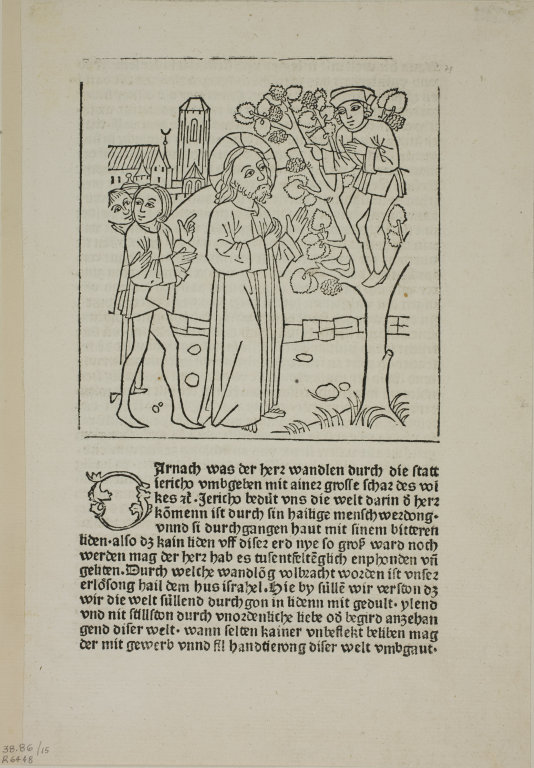
Jesus calling Zacchaeus | Art for Proper 26C

Luke 19:5 When Jesus came to the place, he looked up and said to him, “Zacchaeus, hurry and come down; for I must stay at your house today.”


2016-1030-prop-26c-jesus-zacchaeus

Jesus Calling Zacchaeus
a woodcut made by and unknown artist

Click the image for more information

Commentary by Hovak Najarian

In the early 1450s, Johannes Gutenberg of Mainz, Germany, developed a successful printing press with moveable type. The technology spread rapidly and within a few decades Gutenberg’s invention was being used at other cities in Europe. In Ulm, (about 135 miles from Mainz), Johann Zainer set up a press to publish both sacred and secular books. Among them was, The Spiritual Interpretation of the Life of Christ, c. 1485.

With the invention of moveable type, it was no longer necessary to hand-letter a text but readers of the day were accustomed to seeing illustrations in a book. Publishers met this expectation with woodcuts. An image, carved in relief on a block of wood and set in place, could be inked and printed together with the text. The time of hand-painted illustrations, as in a codex, had passed. For special editions, however, woodcuts often were colored by hand after being printed.

Included in Zainer’s illustrated book about Christ’s life is, Jesus Calling Zacchaeus. It is a composition that may have been based on a contour drawing made originally as a study for stained glass. This image depicts an occurrence at the time Jesus was passing through Jericho while on his way to Jerusalem. Because of the crowd, Zacchaeus, a wealthy tax collector and a man of short stature, was unable to see Jesus. In order to have a higher vantage point he climbed a nearby sycamore tree. Jesus saw Zacchaeus and spoke to him by name.

In this woodcut, Christ is the central figure and is greater in size in keeping with the practice of depicting important people to be larger than others in a composition. Two people follow Jesus but the crowd that is noted in the Bible, is not shown. Instead, attention is on Jesus at the moment he arrives at the tree where Zacchaeus is perched. One of the figures behind Jesus spots Zacchaeus and turns to a person next to him and points, perhaps saying, “Look, there is a man in that tree!” Jesus’ left hand is raised to greet Zacchaeus, while his right hand motions for him to come down. “Zacchaeus, come down immediately,” Jesus said, “I must stay at your house today.” Zacchaeus welcomed Jesus to his home but the crowd was dismayed that Christ would choose to stay with a tax collector.

While with Jesus, Zacchaeus was repentant and offered to give half his possessions to the poor. If he had cheated anyone, he said, he would repay them four times the amount. Jesus responded, “Today salvation has come to this house…”

Note: The sycamore tree mentioned in the Bible is related botanically to fig trees. It is not of the same specie as the familiar sycamore in America or the maple-related tree in England. This tree, often called, “sycamore fig,” has edible fruit and has been cultivated in the Holy Land since ancient times. The above woodcut is unusual in that clusters of figs have been included among the leaves of the tree.

Hovak Najarian © 2016


The Pharisee and the Publican | Art for Proper 25C

Luke 18:13 “…the tax collector, standing far off, would not even look up to heaven, but was beating his breast and saying, ‘God, be merciful to me, a sinner!'”

The Pharisee and the Publican, wood engraving, 1864, John Everett Millais, 1829 – 1896
Click the image for more information

In mid nineteenth century France, Neoclassicism continued to be the style taught in academies, and Romanticism was receiving a great deal of attention. Realism (paintings of everyday activities of common folks) also had followers, and other artists were painting landscapes in the open air. To varying degrees, English artists were influenced by these styles but they tended to remain independent.

Three young English artists – John Everett Millais, William Holman Hunt, and Dante Gabriel Rossetti – were not enamored with French styles or with contemporary painting in England. They also were not pleased with the direction art had taken in the centuries following the Renaissance. In 1848, they formed a brotherhood and called themselves, “Pre-Raphaelites.” Other artists joined them. As a group, they found inspiration in nature and in the art of the middle ages – a time before the painter Raphael and the Renaissance – hence the name, “Pre-Raphaelites.”

Within a few years, Millais’ outlook expanded and he moved away from Pre-Raphaelite principles. He did, however, continue his interest in the spiritual aspects of art. Among his many works are drawings that illustrate parables found in the Bible; these were reproduced as wood engravings by the noted Dalziel Brothers and published in 1864 under the title, “The Parables of Our Lord.” The Pharisee and the Publican is an illustration from this book.

In a typical illustration of this parable, the Pharisee is at a temple, standing in the foreground with arms raised pretentiously in prayer. The publican is often on his knees in the background. In Millais’ composition, the positions have been reversed and the contrast between the two is made even greater by the use of light and shadow. The tax collector is standing in the dark area of the foreground and is the immediate focus of our attention. It is the Pharisee who is now in the background. He and the other men are secondary figures and light in value.

There are differences in body language as well. The publican’s weight is on one leg as he slumps over and leans against a Solomon’s column for support. There is a sense that his mind in burdened and even the twist of the column suggests swirling thoughts. His hands are “beating his breast” and his head is downcast as he is saying, “God be merciful to me, a sinner.” By contrast, the self-satisfied Pharisee is standing among other worshipers and is leaning back in pride. His chin is thrust forward as he strokes his beard.

Note: “Solomon’s column,” is one of the terms given to pillars that have a corkscrew-like shaft. Constantine brought a set of these columns to Rome (for St. Peter’s Basilica) and it was said they were from Solomon’s Temple. This source is unlikely but the descriptive term, “Solomon’s column,” continues to be used.

Hovak Najarian © 2016

Church of the Holy Sepulchre

RNS-MOSAIC-JERICHO
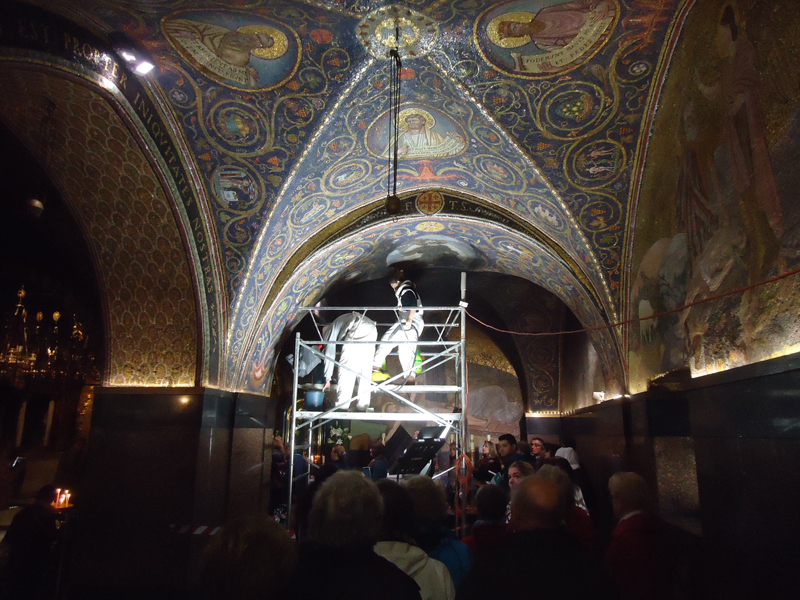
A Palestinian team from the Mosaic Center, Jericho, restores a mosaic in Jerusalem’s Church of the Holy Sepulcher, the traditional site of Jesus’ crucifixion, burial and resurrection. Photo courtesy of Mosaic Center, Jericho

From Religion News Service

JERUSALEM (RNS) The tens of thousands of Christians who visited the Church of the Holy Sepulchre this month got a special Easter treat: the chance to view the newly cleaned and restored mosaic that covers the ceiling and walls of a Franciscan chapel dedicated to Calvary, or Golgotha, the hill where Jesus was crucified.

They might also pause to marvel at this: the work of restoring those mosaics involves a joint effort of Palestinian Christians and Muslims.

I encourage you to read the whole article Mosaic restoration depicting Jesus at Calvary an interfaith effort. It is demonstrates the mystery and power of art to transcend politics and religious differences while creating community.

Image:  via RNS


Look again

mary-700x438

How would you picture Mary?

The Blessed Virgin Mary was thoroughly Jewish. Different cultures and ethnicities have often portrayed her, Jesus, and others from the Bible as being from their group.

Since Christianity for many centuries was based largely in Europe, these important characters of salvation history have often been depicted as white Europeans. Which is fine! But other cultures have also depicted them according to their own appearances.

Take a look at how others have pictured Mary: 13 Beautiful Non-White Depictions of the Blessed Virgin Mary a post on ChurchPop by the Editor

Image: via ChurchPop

The Book of Kells for you to see

Trinity College in Dublin has made the Book of Kells available to all. See for yourself.

Symbols of the Four Evangelists from the Book of Kells

Quote . . .The Book of Kells contains the four Gospels in Latin based on the Vulgate text which St Jerome completed in 384AD, intermixed with readings from the earlier Old Latin translation. The Gospel texts are prefaced by other texts, including “canon tables”, or concordances of Gospel passages common to two or more of the evangelists; summaries of the gospel narratives (Breves causae); and prefaces characterizing the evangelists (Argumenta). The book is written on vellum (prepared calfskin) in a bold and expert version of the script known as “insular majuscule”. It contains 340 folios, now measuring approximately 330 x 255 mm; they were severely trimmed, and their edges gilded, in the course of rebinding in the 19th century. Abstract posted by Trinity College Dublin

What did Jesus look like?

Question: what did Jesus look like?If you close your eyes and pose this question to yourself, “What did Jesus look like” you would undoubtedly come up with an image.

A recent segment on Religion & Ethics elaborates one man’s research into the question. It is an affirmation of our continuing exploration of art and faith. Each influences the other.

Go to: Depicting Jesus

Henry Francis Lyte (1793-1847)

https://i0.wp.com/www.cyberhymnal.org/img/l/y/lyte_hf.jpg
Henry Francis Lyte

The other night, we were in church listening to the usual worship songs. It’s a non-denominational church, so it was light on the hymns and heavy on the more contemporary stuff, as you can imagine. I’ve made my peace with “worship music,” understanding that not everyone loves 300 year old hymns, and that’s ok. But the band began to play a song that I had never heard before, and the text and the melody immediately caught my attention. The melody was beautiful, simple, and so singable, but it was the text that really stood out.

Jesus, I my cross have taken, all to leave and follow Thee.
Destitute, despised, forsaken, Thou from hence my all shall be.
Perish every fond ambition, all I’ve sought or hoped or known.
Yet how rich is my condition! God and Heaven are still mine own.

Let the world despise and leave me, they have left my Savior, too.
Human hearts and looks deceive me; Thou art not, like them, untrue.
And while Thou shalt smile upon me, God of wisdom, love and might,
Foes may hate and friends disown me, show Thy face and all is bright.

Go, then, earthly fame and treasure! Come, disaster, scorn and pain!
In Thy service, pain is pleasure; with Thy favor, loss is gain.
I have called Thee, Abba, Father; I have set my heart on Thee:
Storms may howl, and clouds may gather, all must work for good to me.

Man may trouble and distress me, ’twill but drive me to Thy breast.
Life with trials hard may press me; heaven will bring me sweeter rest.
Oh, ’tis not in grief to harm me while Thy love is left to me;
Oh, ’twere not in joy to charm me, were that joy unmixed with Thee.

Take, my soul, thy full salvation; rise o’er sin, and fear, and care;
Joy to find in every station something still to do or bear:
Think what Spirit dwells within thee; what a Father’s smile is thine;
What a Savior died to win thee, child of heaven, shouldst thou repine?

Haste then on from grace to glory, armed by faith, and winged by prayer,
Heaven’s eternal day’s before thee, God’s own hand shall guide thee there.
Soon shall close thy earthly mission, swift shall pass thy pilgrim days;
Hope soon change to glad fruition, faith to sight, and prayer to praise.

Certain lines from the text stayed in my head all night and into the next day, when I finally had a moment to sit down and search for the author. Turns out, Henry Francis Lyte (who, I am ashamed to admit, I’ve never heard of!) also wrote the text for two other well-loved and often-sung hymns–Praise, My Soul, the King of Heaven and Abide With Me.

If you have a moment, give these a listen.

For more info on Lyte, here are some sources.
Cyberhymnal
Poemhunter
Christianity

One Million Bones

Banner for One Million Bones Project

On Wednesday April 24, 2013 our group of “hikers” walked with Hovak Najarian into a place of death as we remembered the Armenian Genocide (1915). For some, like me, it was the first time I had ever heard of the atrocities in Armenia at the start of World War I. This is the handout that opened our eyes and hearts.

As we remembered this genocide, “the first genocide of the 20th century,” we were forced to look at how this evil has continued and still continues into our own day. We discovered several resources that can only serve to help us ask and answer the question, “How am I to love my neighbor as I love myself?”

The One Million Bones Project recently came to my attention via the TED Blog. Combining ‘art’ and study a stunning visual installation is being prepared for The Mall in Washington, D.C. and will be in place June 8–June 10, 2013.

Here is a quick look to explain how this project and its installations work. This video documents a smaller installation done in Albuquerque, NM:

My introduction to the One Million Bones Project came via the TED Blog interview with Naomi Natale posted on May 24, 2013:

For four years, artist Naomi Natale’s social art practice, the One Million Bones project, has used education, hands-on artmaking and public art installation to raise awareness of ongoing genocide and mass atrocities. On June 8, Naomi and the One Million Bones team will be joined by thousands of volunteers to lay down the one million human “bones,” which participants have made by hand, on the National Mall in Washington, DC — creating a striking visual representation of conflicts we cannot continue to ignore.

Introduction to the interview with Naomi Natale

Please read the entire interview. Please listen to the Spirit and make your own determination about what you can ….

Additional Resources