Wind Chimes: 15 Jan 2013

A young Golden Eagle in flight

As the chimes move in accord with the wind and make their sounds, I hear both trust and playfulness. Let the sounds create an image of an eagle soaring; imagine that eagle is you and the wind supporting you is the Spirit. What do you hear?

Trust the wind (Spirit) and soar

In our Daily Office, (Morning Prayer for 1/15/13), we read from Isaiah:

Have you not known? Have you not heard? The Lord is the everlasting God, the Creator of the ends of the earth. He does not faint or grow weary; his understanding is unsearchable. He gives power to the faint, and strengthens the powerless. Even youths will faint and be weary, and the young will fall exhausted; but those who wait for the Lord shall renew their strength, they shall mount up with wings like eagles, they shall run and not be weary, they shall walk and not faint. Isaiah 40:28-31 NRSV

Consider now this meditation from Lowell Grisham, Rector of St. Paul’s in Fayetteville, AR

What a compelling image. When the pressure is on; when we are weary and worn out; when there is more than we can handle; when we don’t know what to do… Isaiah says “Wait.” Breathe deeply. Be conscious and mindful. Wait for God.

I can see in my minds eye the next movement, an eagle beginning to mount the skies. With slow and deliberate movement, a perching eagle will spread her wings, feeling for the power of the wind. And then, gently, like sliding into water, the great bird will trust itself to the sky, throwing its arms out in a wide embrace. It catches the power of the wind and goes soaring, adjusting with modest effort as it picks up the drafts. In a similar way we can run and not be weary; walk and not be faint.

That’s the image I want to take with me today when that inevitable moment of weariness comes.

Please read the rest of his meditation, “Encouragement,” here.

You may visit the website of St. Paul’s Episcopal Church, Fayetteville, here.

Image: Wikimedia Commons

Wind Chimes: 14 Jan 2013

Friends

What does a question sound like? What does friendship sound like? Today, I hear an important question in the sounding of the chimes. What do you hear?

Could it be true? How will you answer?

Today [Jan 12th] as Cistercians we celebrate the life and teaching of our own Saint Aelred of Rievaulx, a 12th-century monk of Great Britain. In his well-known treatise, Spiritual Friendship, Saint Aelred declares rather boldly that “God is friendship.” This is his own gloss on Saint John’s words, “God is love.” And clearly it expresses Aelred’s own experience of God’s intimacy.

Saint Aelred on the blog of St. Joseph’s Abbey, Spencer MA

Read the entire post (it’s short) to hear the question of the monks. Hear the question of the monks in the glorious sounds of the Good News proclaimed on Sunday (believing that what was true of Jesus and for Jesus is true of us and for us): “You are my Beloved.” (Luke 3:21-22)

Image: Clip art, photos, and animations on office.microsoft.com

Wind Chimes: 12 Jan 2013

Going somewhere

Sometimes the sounds from the chimes are rhythmic, like the regular movement of a person from one place to another. We’re all on a journey. What do you hear?

The Journey Prayer

God, bless to me this day,
God bless to me this night;
Bless, O bless, Thou God of grace,
Each day and hour of my life;
Bless, O bless, Thou God of grace,
Each day and hour of my life.

God, bless the pathway on which I go;
God, bless the earth that is beneath my sole;
Bless, O God, and give to me Thy love,
O God of gods, bless my rest and my repose;
Bless, O God, and give to me Thy love,
And bless, O God of gods, my repose.

Prayer of St. Brendan the Voyager, Irish Monk, (484-577)

Prayer: Quoted by Daniel Clendenin on Journey with Jesus: Poems and Prayers

Image: Wikimedia Commons

Wind Chimes: 11 Jan 2013

Sometimes, God just wants to hang out with us

Listen. Do the chimes sound like the start of a conversation? Be still. Listen. What do you hear?

A God who is Friend

If you haven’t discovered inward/outward, today is a good day to change that. The site “is an ongoing, online conversation sponsored by The Church of the Saviour in Washington, DC.”

As preparation for hearing the Gospel this Sunday (Luke 3:15-17, 21-22) listen to these words from Oscar Romero:

This is the beauty of prayer and of Christian life: coming to understand that a God who converses with humans has created them and has lifted them up, with the capacity of saying “I” and “you.” What would we give to have such power as to create a friend to our taste and with a breath of our own life to make that friend able to understand us and be understood by us and converse intimately–to know our friend as truly another self? That is what God has done; human beings are God’s other self. He has lifted us up so that he can talk with us and share his joys, his generosity, his grandeur. He is the God who converses with us.

Quote: Oscar Romero in The Violence of Love as quoted by inward/outward 8/13/12

Image: dreamstime images

Wind Chimes: 10 Jan 2013

Gracious Father, we pray for thy holy Catholic Church. Fill it with all truth, in all truth with all peace. Where it is corrupt, purify it; where it is in error, direct it; where in any thing it is amiss, reform it. Where it is right, strengthen it; where it is in want, provide for it; where it is divided, reunite it; for the sake of Jesus Christ thy Son our Savior. Amen.

A prayer (updated) of William Laud (see The Book of Common Prayer, p. 816)

The chimes produce a mixed sound today: sometimes a violent crashing sound, sometimes a soft peaceful sound. What do you hear?

William Laud, Archbishop of Canterbury, d. 1645

Today (January 10th) the Episcopal Church remembers William Laud, Archbishop of Canterbury (1633-1645). Laud’s short biography in Holy Women, Holy Men tells the truth, “Laud’s reputation has remained controversial to this day. [He is] [h]onored as a martyr and condemned as an intolerant bigot ….”

Given the current concern among some in England about “The Succession to the Crown Bill” it is informative to remember today that, “Laud believed the Church of England to be in direct continuity with the medieval Church, and he stressed the unity of Church and State, exalting the role of the king as the supreme governor.” (“William Laud” on Holy Women, Holy Men).

Wind Chimes: 08 Jan 2013

It’s a poetic sound in the chimes tonight. What do you hear?

We three kings of Orient are

If you haven’t discovered Hymnary.org yet, now would be a good time. The text of this favorite Epiphany hymn was written by John H. Hopkins (an Episcopal deacon) in 1867 and the text and more is set out nicely by Hymnary. It is a rich source of texts, history, music, and much more.

1
We three kings of Orient are:
Bearing gifts we traverse afar—
Field and fountain, moor and mountain—
Following yonder star.

Chorus:
Oh, star of wonder, star of night,
Star with royal beauty bright,
Westward leading, still proceeding,
Guide us to thy perfect light.

2
Born a King on Bethlehem’s plain:
Gold I bring to crown Him again,
King forever, ceasing never,
Over us all to reign.[Chorus]

3
Frankincense to offer have I,
Incense owns a Deity nigh;
Prayer and praising, all men raising,
Worship Him, God on high.[Chorus]

4
Myrrh is mine, its bitter perfume
Breathes a life of gathering gloom—Sorrowing, sighing, bleeding, dying,
Sealed in the stone cold tomb.[Chorus]

5
Glorious now behold Him arise:
King and God and Sacrifice;
Alleluia, Alleluia!
Earth to heaven replies.[Chorus]

Source: “We three kings of Orient are” on Hymnary.org

Video: We three kings of Orient are sung by Kings College Choir, Cambridge

Wind Chimes: 07 Jan 2013

Pray

But if we hope for what we do not see, we wait for it with patience. Likewise the Spirit helps us in our weakness; for we do not know how to pray as we ought, but that very Spirit intercedes with sighs too deep for words.

Romans 8:25-26 NRSV

The chimes are a call to prayer (again). What do you hear?

Continuing prayer for our new Congress

I’ll confess that I often don’t know how to pray, even when my hopes seem to be in accord with God’s love. On January 3, 2013 many, including me, began a 21-day prayer vigil for our new Congress and the President. In addition to our daily and weekly prayers for our political leaders, this is a special time of prayer requested by an interfaith coalition of folks like you and me. Commit to praying, and let us trust the Spirit to work in ways we can barely imagine. Read more about this effort and sign-on to pray here: Call to Prayer. Then, join us in praying for our new Congress.

The Home Page for The Faith & Politics Institute

Image: Dreamstime

Wind Chimes: 03 Jan 2013

On that day: The deaf will hear the words of a scroll and, freed from dimness and darkness, the eyes of the blind will see. The poor will again find joy in the Lord, and the neediest of people will rejoice in the holy one of Israel.

Isaiah 29:18-19 CEB

Today, January 3rd, the Episcopal Church remembers William Passavant (October 9, 1821 – January 3, 1894).

William Passavant was a Pennsylvania Lutheran pastor who left an uncommonly rich legacy of service. He was driven by a desire to see the consequences of the Gospel worked out in practical ways in the lives of people in need. For Passavant, the church’s commitment to the Gospel must not be spiritual only. It must be visible. For him, it was essential that Gospel principles were worked out in clear missionary actions.

Learn more about William Passavant on Holy Women, Holy Men

In the Collect we ask God, the Compassionate, to “inspire us by his example, that we may be tireless to address the wants of all who are sick and friendless….”

One of the goals of the Sunday Morning Forum is to hear the Spirit calling us to such service and gracing us to serve to the welfare of others and the glory of God. The chimes sound, “you are called to serve.” What do you hear?

Additional information about William Passavant on Wikipedia

Wind Chimes: 29 Dec 2012

In the beginning was the Word, and the Word was with God,
and the Word was God.

And the Word became flesh and lived among us, and we have seen his glory, the glory as of a father’s only son, full of grace and truth.

View the lyrics, music, and background for this Hymn.

The chimes sound like a dialogue tonight. The Spirit-wind creates all that is, seen and unseen. We respond in song. What do you hear?

Wind Chimes: 28 Dec 2012

In the beginning was the Word, and the Word was with God,
and the Word was God.
[…]

And the Word became flesh and lived among us, and we have seen his glory, the glory as of a father’s only son, full of grace and truth.

John 1:1, 14 NRSV

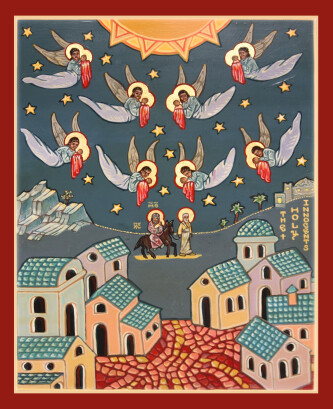
Holy Innocents Icon
Holy Innocents Icon, ca. 2010

When the magi had departed, an angel from the Lord appeared to Joseph in a dream and said, “Get up. Take the child and his mother and escape to Egypt. Stay there until I tell you, … When Herod knew the magi had fooled him, he grew very angry. He sent soldiers to kill all the male children in Bethlehem and in all the surrounding territory who were two years old and younger, according to the time that he had learned from the magi.

Matthew 2:13, 16 CEB
From the Gospel read on the Feast of the Holy Innocents,
December 28th

Remembering Holy Innocents, December 28

The merriment of Christmas and the profound mystery proclaimed by John (John 1:1ff) are in stark contrast to the brutal events perpetrated by Herod (Matthew 2:13ff), the violent slaughter in Newtown, CT, and daily reports of the death of children (0–17) due to abuse, neglect, and violence.

John Thatamanil, is an Associate Professor of Theology and World Religions at Union Theological Seminary in New York and is a member of St. Augustine’s Episcopal Chapel at Vanderbilt. Yesterday (12/27/12) he posted an essay “Christmas in Newtown and Bethlehem.” In it, he speaks to the contrast and its meaning for us who seek to follow Christ:

Quote . . .The slaughter of innocents and the birth of a child in excruciating vulnerability — this is a profoundly counterintuitive way to speak of God’s coming. Unlike the light and unblemished merriness that we wish each other every Christmas, the Bible offers no happily-ever-after fairy tale. The world into which the Christian Messiah enters is shattered by terror and ruled by Roman imperial power and its client dictators.
The Gospel narratives suggest that the coming of God does not (then or now) undo our capacity to inflict violence upon each other nor does it radically reconfigure the conditions under which we live out our lives. On the contrary, these very conditions, in all their fragility, are sanctified by incarnation. When God assumes flesh and enters the world, this very world is accepted and embraced.

God does not first remake the world in order to enter it, and entering the world does not diminish the dignity of divinity. The incarnation affirms that our fragility and frailty are not contrary to divine intention. Rather, they too are taken up by divinity when God becomes flesh. This world, as it stands, offers the necessary conditions for love and community. The coming of God as a child affirms that this fragile world is as it ought to be.

God does not come to eradicate vulnerability but to teach us how to welcome it. Love comes to open our eyes to look for holiness not in might and power, not in any futile attempt to secure ourselves against each other by force of arms, but precisely in our delicate bonds with each other.

I invite you to read his entire essay on The Huffington Post.

The wind blows. The sounds from the chimes burst out like merriment, then jangle in discord, and then are silent. All this happens in the space of minutes. What do you hear?

Icon: Suzanne Zoole commissioned by The Rev. Michael Sullivan and Holy Innocents Episcopal Church in Atlanta, GA. About the icon.