In the beginning was the Word, and the Word was with God, and the Word was God.
[…] And the Word became flesh and lived among us, and we have seen his glory, the glory as of a father’s only son, full of grace and truth.
John 1:1, 14 NRSV
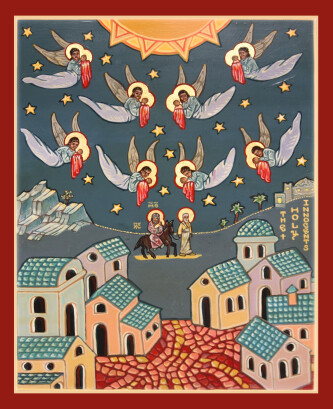
Holy Innocents Icon, ca. 2010
When the magi had departed, an angel from the Lord appeared to Joseph in a dream and said, “Get up. Take the child and his mother and escape to Egypt. Stay there until I tell you, … When Herod knew the magi had fooled him, he grew very angry. He sent soldiers to kill all the male children in Bethlehem and in all the surrounding territory who were two years old and younger, according to the time that he had learned from the magi.
Matthew 2:13, 16 CEB
From the Gospel read on the Feast of the Holy Innocents,
December 28th
Remembering Holy Innocents, December 28
The merriment of Christmas and the profound mystery proclaimed by John (John 1:1ff) are in stark contrast to the brutal events perpetrated by Herod (Matthew 2:13ff), the violent slaughter in Newtown, CT, and daily reports of the death of children (0–17) due to abuse, neglect, and violence.
John Thatamanil, is an Associate Professor of Theology and World Religions at Union Theological Seminary in New York and is a member of St. Augustine’s Episcopal Chapel at Vanderbilt. Yesterday (12/27/12) he posted an essay “Christmas in Newtown and Bethlehem.” In it, he speaks to the contrast and its meaning for us who seek to follow Christ:
The slaughter of innocents and the birth of a child in excruciating vulnerability — this is a profoundly counterintuitive way to speak of God’s coming. Unlike the light and unblemished merriness that we wish each other every Christmas, the Bible offers no happily-ever-after fairy tale. The world into which the Christian Messiah enters is shattered by terror and ruled by Roman imperial power and its client dictators.
The Gospel narratives suggest that the coming of God does not (then or now) undo our capacity to inflict violence upon each other nor does it radically reconfigure the conditions under which we live out our lives. On the contrary, these very conditions, in all their fragility, are sanctified by incarnation. When God assumes flesh and enters the world, this very world is accepted and embraced.
God does not first remake the world in order to enter it, and entering the world does not diminish the dignity of divinity. The incarnation affirms that our fragility and frailty are not contrary to divine intention. Rather, they too are taken up by divinity when God becomes flesh. This world, as it stands, offers the necessary conditions for love and community. The coming of God as a child affirms that this fragile world is as it ought to be.
God does not come to eradicate vulnerability but to teach us how to welcome it. Love comes to open our eyes to look for holiness not in might and power, not in any futile attempt to secure ourselves against each other by force of arms, but precisely in our delicate bonds with each other.
The wind blows. The sounds from the chimes burst out like merriment, then jangle in discord, and then are silent. All this happens in the space of minutes. What do you hear?
Icon: Suzanne Zoole commissioned by The Rev. Michael Sullivan and Holy Innocents Episcopal Church in Atlanta, GA. About the icon.
In the beginning was the Word, and the Word was with God, and the Word was God.
[…] And the Word became flesh and lived among us, and we have seen his glory, the glory as of a father’s only son, full of grace and truth.
John 1:1, 14 NRSV
These words from the “Prologue of John” (John 1:1-18) will be proclaimed this Sunday (12/30/12) in our worship. Today, December 27th, is the day the Church remembers (St.) John the Evangelist, the ‘author’ of these familiar words. Perhaps, if he were to ‘write’ his Good News today, he might present it differently:
The wind moves the chimes mysteriously and the sounds constantly amaze and delight. What do you hear?
A Christmas Eve present. Today, the chimes sound like “Ode to joy.”
About the video
For their 130th anniversary, Spanish finance group BancSabadell commissioned a symphony orchestra flash mob at a city square in Sabadell, Spain. The Vallès Symphony Orchestra, the choirs of Lieder, Friends of l’Opera and the Choral Belles Arts performed beautifully in this month old video that already (July 1, 2012) has over 460,000 views
The wind in the chimes creates the sound of a plea: ‘O come, o come, Emmanuel.’ What do you hear?
“Pray the O Antiphons” one final day
The “O Antiphons,” one of the oldest liturgical rituals in the church, are prayed around the world during the final days of Advent. For the seven days before Christmas, we recall in these prayers a quality of Christ that must be realized before the presence of Christ can consume the world.
(December 23) O Emmanuel
Jesus Emmanuel has already come. It is not a matter now of Christ’s being where we are; it is a matter of our being in the consciousness of where Christ is in life and where He is not as well. Where is Christ for you? Is there a place in your life that you know down deep is not in the spirit of Christ at all? — Joan D. Chittister, OSB
Prayer: O Emmanuel, leader and desire of all the nations, you set captives free, comfort the lonely; you feed the poor and the hungry. Come be born in us, God of Life.
Even in tragedy, Advent continues. Perhaps this event will demand that we better incorporate the Advent spirituality into our daily lives. ~dan
Each of these has a different approach. Find one that helps you “prepare the way.” Find one that helps you focus on God as you make your way into the loving arms of God.
Click the image for the video tribute, a response to the request of the Governor of Connecticut to ring “church bells” 26 times today (12/21/12)
“Pray the O Antiphons” an invitation from Joan Chittister
The “O Antiphons,” one of the oldest liturgical rituals in the church, are prayed around the world during the final days of Advent. For the seven days before Christmas, we recall in these prayers a quality of Christ that must be realized before the presence of Christ can consume the world.
(December 21) O Radiant Dawn
The celebration of the God of Growth in our lives—those moments of insight in which life comes newly alive in me—helps us to recognize those moments of insight in which life comes newly alive and I begin to see differently, to live differently, to function differently. A new friend, a new work, a new idea are all “radiant dawns” in life that can enable me to become more than I ever dreamed I could. — Joan D. Chittister, OSB
Prayer: O Dayspring, Sun of Justice, bright eternal light, one who shows the way, the one who sets us free even in darkness and death. Come, disperse the gloomy clouds of night.
Even in tragedy, Advent continues. Perhaps the horrific event of one week ago will demand that we better incorporate the Advent spirituality into our daily lives. ~dan
Each of these has a different approach. Find one that helps you “prepare the way.” Find one that helps you focus on God as you make your way into the loving arms of God.
If the chimes were an orchestra they might sound like this today. Surely the sounds in the chimes are sounds of loss and grief but also of yearning and hope. What do you hear?
As longs the deer for cooling streams
in parched and barren ways,
so longs my soul, O God, for thee
and thy refreshing grace.
For thee, my God, the living God,
my thirsty soul doth pine:
O when shall I behold thy face,
thou majesty divine?
Why restless, why cast down, my soul?
Hope still, and thou shalt sing
the praise of him who is thy God,
thy health’s eternal spring.
To Father, Son, and Holy Ghost,
the God whom we adore,
be glory as it was, is now,
and shall be evermore.
“Pray the O Antiphons” an invitation from Joan Chittister
The “O Antiphons,” one of the oldest liturgical rituals in the church, are prayed around the world during the final days of Advent. For the seven days before Christmas, we recall in these prayers a quality of Christ that must be realized before the presence of Christ can consume the world.
(December 20) O Key of David
We are called to the kind of Christian commitment that opens doors and breaks down barriers between people, that brings unity to a divided world. Try to unlock one door that is keeping someone locked out of your heart. — Joan D. Chittister, OSB
Prayer: O Key of David, rod and staff of the house of Israel, one who opens and no one closes, the one who closes and no one opens. Come lead prisoners caught in darkness
Even in tragedy, Advent continues. Perhaps this event will demand that we better incorporate the Advent spirituality into our daily lives. ~dan
Each of these has a different approach. Find one that helps you “prepare the way.” Find one that helps you focus on God as you make your way into the loving arms of God.
The gale winds have subsided. The wind is as gentle as a baby’s breath. The sound in the chimes is softer. What do you hear?
“Pray the O Antiphons” an invitation from Joan Chittister
The “O Antiphons,” one of the oldest liturgical rituals in the church, are prayed around the world during the final days of Advent. For the seven days before Christmas, we recall in these prayers a quality of Christ that must be realized before the presence of Christ can consume the world.
(December 18) O Adonai
When we build a vision of life it is necessary to realize that Jesus must be the center of it—not our institutions, good as they may be; not our plans or personal talents, necessary as they are. — Joan D. Chittister, OSB
Prayer: O Adonai, leader of the ancient Israel, giving Moses, while in the burning bush, the law on Sinai. Come with outstretched arms and teach us.
Even in tragedy, Advent continues. Perhaps this event will demand that we better incorporate the Advent spirituality into our daily lives. ~dan
Each of these has a different approach. Find one that helps you “prepare the way.” Find one that helps you focus on God as you make your way into the loving arms of God.
Those little Advent candles sure have a lot of darkness to overcome this year. —Rachel Held Evans
Even in the darkness the wind swirls and blows and the chimes sound. In the dark, what do you hear?
God can’t be kept out – the Good News we hear in the darkness
Rachel Held Evans begins her post this way:
Those little Advent candles sure have a lot of darkness to overcome this year. I see them glowing from church windows and on TV, in homes and at midnight vigils, here in Dayton and in Sandy Hook. Their stubborn flames represent the divine promise that even the smallest light can chase away the shadows lurking in this world, that even in the darkest places, God can’t be kept out.
Later she moves to the ‘rumor’ she ‘calls out’ in the rest of her post:
We all grieve in different ways, and we must be patient with one another as we do, but there is a rumor floating around among the people of God that is so vile, so dangerous and untrue, it simply must be called out. It’s a rumor that began long before the shots rang out at Sandy Hook and long before this Advent season.
It’s the rumor that God can be chased out.
I will say my “AMEN” to her proclamation now and encourage you to read her post, God can’t be kept out. She indeed states, eloquently, what I believe and what I try to proclaim in my own stumbling way.
“God with us.” Amen: may it be as we say and even more than we imagine. ~dan
Even in tragedy, Advent continues. Perhaps this event will demand that we better incorporate the Advent spirituality into our daily lives. ~dan
Each of these has a different approach. Find one that helps you “prepare the way.” Find one that helps you focus on God as you make your way into the loving arms of God.

 The slaughter of innocents and the birth of a child in excruciating vulnerability — this is a profoundly counterintuitive way to speak of God’s coming. Unlike the light and unblemished merriness that we wish each other every Christmas, the Bible offers no happily-ever-after fairy tale. The world into which the Christian Messiah enters is shattered by terror and ruled by Roman imperial power and its client dictators.
 Click to play the Christ Child’s Lullaby


 The gale winds have subsided. The wind is as gentle as a baby’s breath. The sound in the chimes is softer. What do you hear?
 Hear what the Spirit is saying