Wind in the Chimes: a prayer on the Seventh Sunday of Easter to be strengthened
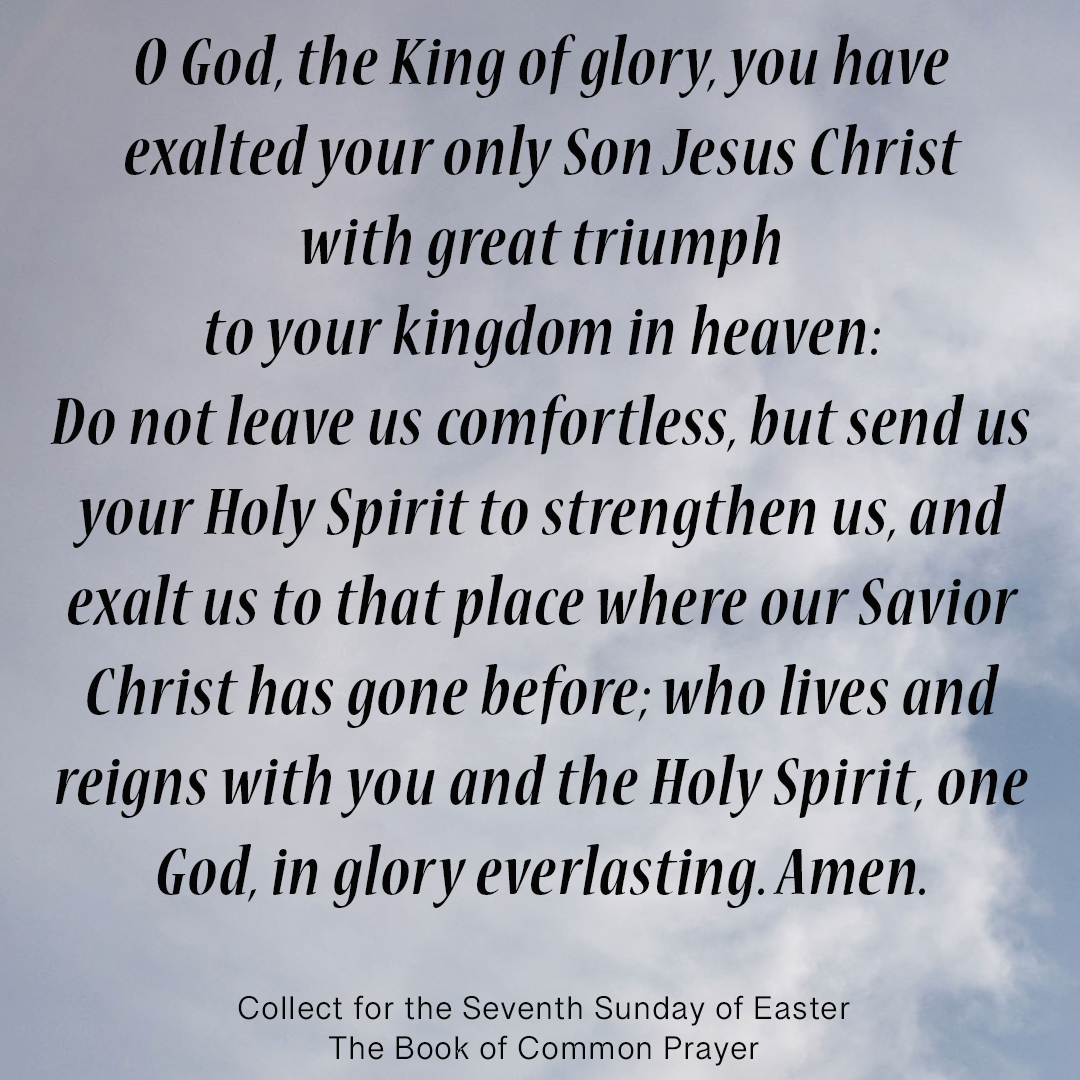
O God, the King of glory … do not leave us comfortless
On the Seventh Sunday of Easter, we first ask that our God not leave us comfortless. Then we ask for the Holy Spirit to strengthen and exalt us.
Marion Hatchett in his book, Commentary on the American Prayer Book, (New York: The Seabury Press, 1981) tells us that Thomas Cranmer (the author of the precursor of this prayer in English) “translated the word ‘orphans’ [from a more ancient prayer in Latin] with a weaker term ‘comfortless,’ which is used here in what is now an archaic meaning, ‘without strength,’… as well as ‘without consolation.'”
In this week as we prepare to remember and celebrate the coming of the Holy Spirit at Pentecost, consider how the Spirit has strengthened you in your faith journey. In what moments of your journey have you relied upon the strength of the Spirit to sustain you?
Likewise, what experiences in your faith journey have led you to trust that God, the King of glory, is even now exalting us, exalting you, “to that place where our Savior Christ has gone before?”
A Pattern for Prayer by John D. Witvliet posted on Religion Online. The author believes the study of ancient liturgical materials facilitates special insight. He discusses at length the understanding which lies in the structures and patterns of early collects and similar prayers, for preparing such prayers challenges us to draw on nearly the whole range of theological themes and motifs.
About Wind in the Chimes
Wind in the Chimes (renaming and reintroduction of Wind Chimes, 7/21/20)
Before the casting of lots: heartfelt prayer for God’s guidance (Acts 1:24-25)
… and the lot fell to Matthias
Acts of the Apostles 1:23, 26 NRSV
Welcome!
On Wednesday, May 8, 2024, we explored Acts 1:15-17, 21-26, the first reading appointed for the Seventh Sunday of Easter, Year B (May 12, 2024). Our handout included commentaries on the other appointed texts from the First Letter of John (1 John 5:9-13), the Psalms (Psalm 1), and the Gospel according to John (John 17:6-19).
In her commentary on the text from Acts—from a homiletical perspective—Barbara K. Lundblad highlights the two men put forward by the group gathered together after the Ascension but before the Day of Pentecost. We are asked to “acknowledge and celebrate the ordinary people who have carried the extraordinary gospel from one generation to the next.”
Pause, remember, acknowledge, and even celebrate, the ordinary people you have met in your faith journey who have shared the Good News of God in Christ with you.
From a commentary on Acts 1:15-17, 21-26
Matthias becomes part of the inner circle; the other loses the toss of the dice. Even his name seems to be in question: Joseph called Barsabbas, who was also known as Justus. The truth is that we know very little about either one of these men.
Their lack of renown is a wondrous reality. In the next chapter Peter stands with the eleven to preach his Pentecost sermon. That would mean that Matthias must have been there even though he is not named. Where was Justus? Perhaps he was there too, for the narrator tells us that all of them were filled with the Holy Spirit. …
Rather than being disappointed by having so little information, we can be grateful for the witness of those who are so little known. [The sermon this Sunday] can be a time to acknowledge and celebrate the ordinary people who have carried the extraordinary gospel from one generation to the next. Who is Justus in your faith journey?
Source: Barbara K. Lundblad, “Homiletical Perspective on Acts 1:15–17, 21–26,” in Feasting on the Word: Preaching the Revised Common Lectionary: Year B, ed. David L. Bartlett and Barbara Brown Taylor, vol. 2 (Louisville, KY; London: Westminster John Knox Press, 2008).
Most Wednesday mornings a group of us gather online to explore the readings that will be used in worship the following Sunday. Our handout this week features readings, commentaries, and notes for the Seventh Sunday of Easter (May 12, 2024) in Year B of the Revised Common Lectionary. Please: View or download the handoutwe used to guide our discussion and tune our hearts to the Spirit.
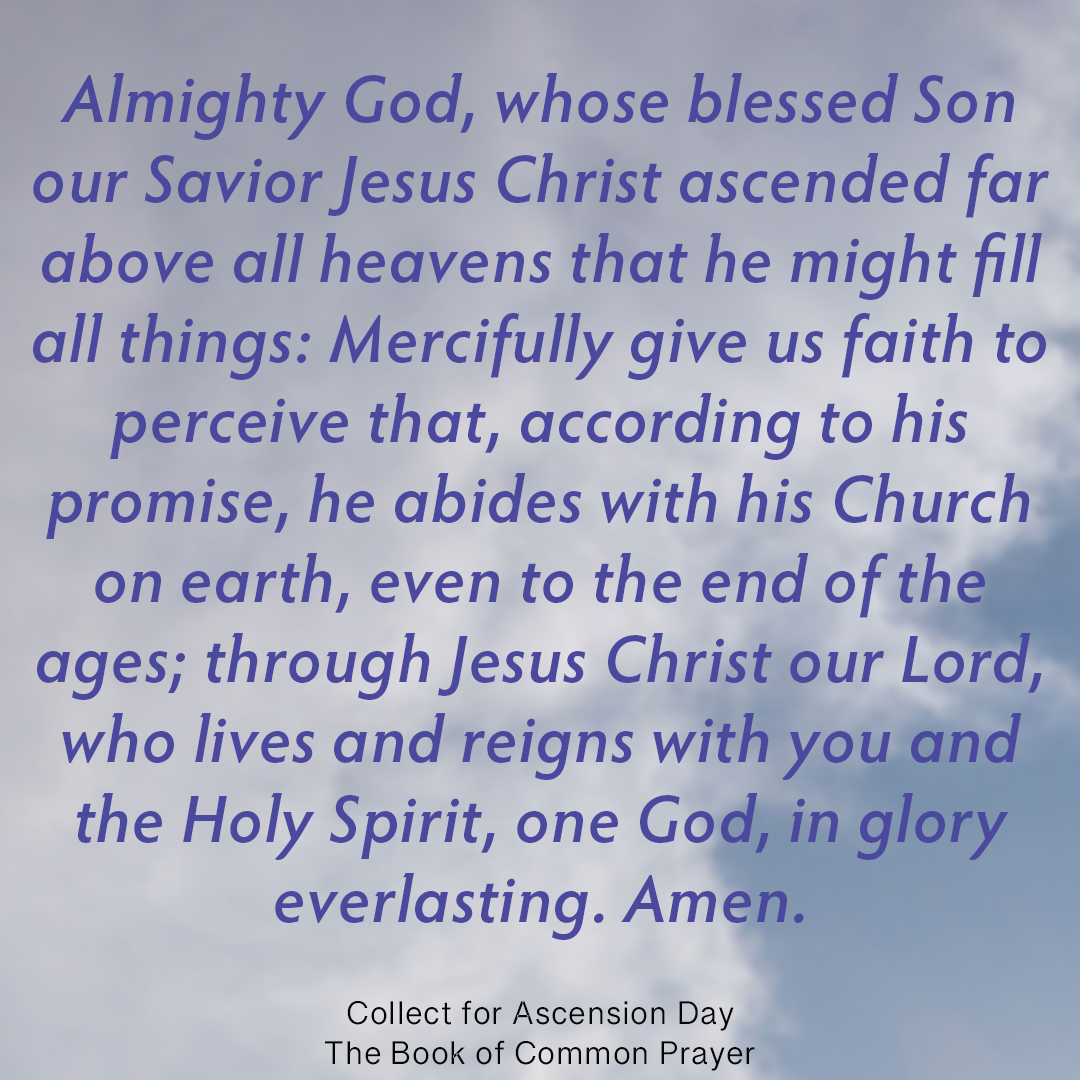
Wind in the Chimes: the Ascension is about presence
The Ascension of Christ (Ascension Day)
The occasion on which the risen Christ is taken into heaven after appearing to his followers for forty days (Acts 1:1-11, Mk 16:19). The Ascension marks the conclusion of Jesus’ post-resurrection appearances. It is the final elevation of his human nature to divine glory and the near presence of God. The Ascension is affirmed by the Nicene and Apostles’ Creeds. The Ascension is celebrated on Ascension Day, the Thursday that is the fortieth day of the Easter season. It is a principal feast of the church year in the Episcopal Church. Reference: “Ascension” in An Episcopal Dictionary of the Church
A Homily on the Feast of the Ascension
… the ascension is about presence, not absence. Jesus has not left us. Rather Christ has filled us. —Michael K. Marsh
A Pattern for Prayer by John D. Witvliet posted on Religion Online. The author believes the study of ancient liturgical materials facilitates special insight. He discusses at length the understanding which lies in the structures and patterns of early collects and similar prayers, for preparing such prayers challenges us to draw on nearly the whole range of theological themes and motifs.
About Wind in the Chimes
Wind in the Chimes (renaming and reintroduction of Wind Chimes, 7/21/20)
Genuine faith is firmly connected with active love.
… that we obey his commandments.
1 John 5:3 NRSV
Welcome!
On Wednesday, May 1, 2024, we explored 1 John 5:1-6, the epistle pericope appointed for the Sixth Sunday of Easter, Year B (May 5, 2024). Our handout included commentaries on the other appointed texts from the Acts of the Apostles (Acts 10:44-48), the Psalms (Psalm 98), and the Gospel according to John (John 15:9-17).
From a commentary on 1 John 5:1-6
1 John reminds its readers that God’s commands are not burdensome. Here again we hear an echo of Jesus, who denounces the religious leaders for loading people down with “heavy burdens hard to bear” (Matthew 23:4). The Greek word that NRSV translates as “heavy” is barus, the same adjective translated as “burdensome” in 1 John 5:3. By contrast, Jesus says, “Come to me, all you that are weary and are carrying heavy burdens … For my yoke is easy, and my burden is light” (Matthew 11:28–30). Like Jesus, 1 John insists that God’s commands are not difficult. In essence, they consist in the call to love, “not in word or speech, but in truth and action” (1 John 3:18). Genuine faith, therefore, is firmly connected with active love.
Most Wednesday mornings a group of us gather online to explore the readings that will be used in worship the following Sunday. Our handout features readings, commentaries, and notes for the Sixth Sunday of Easter (May 5, 2024) in Year B of the Revised Common Lectionary. Please: View or download the handoutwe used to guide our discussion and tune our hearts to the Spirit.
Beloved, since God loved us so much, we also ought to love one another. 1 John 4:11 NRSV
Welcome!
On Wednesday, April 24, 2024, we explored 1 John 4:7-21, the epistle pericope appointed for the Fifth Sunday of Easter, Year B. Our handout included commentaries on the other appointed texts from the Acts of the Apostles (Acts 8:26-40), the Psalms (Psalm 22:25-31), and the Gospel according to John (John 15:1-8).
From a commentary on 1 John 4:7-21
Tucked away in verse 7 is an even more sobering claim. We know God by seeing what God has done, but seeing is not enough. We know God in the fullest and most authentic sense only when the love of God flows through us. God is love; only the one who loves can know this love that is God. Love is not a concept, known abstractly. It is an action, lived concretely. It is not enough to remember Jesus’ self-sacrifice, to think about it, or even to be moved by it. We must live it. To know the God of love is to live the love of God.
Ronald Cole-Turner, “Theological Perspective on 1 John 4:7–21,” in Feasting on the Word: Preaching the Revised Common Lectionary: Year B, ed. David L. Bartlett and Barbara Brown Taylor, vol. 2 (Louisville, KY; London: Westminster John Knox Press, 2008), 468.
Most Wednesday mornings a group of us gather online to explore the readings that will be used in worship the following Sunday. Our handout features readings, commentaries, and notes for the Fifth Sunday of Easter (April 28, 2024) in Year B of the Revised Common Lectionary. Please: View or download the handoutwe used to guide our discussion and tune our hearts to the Spirit.
On the Fourth Sunday of Easter, Year B, all the readings lead us to see Jesus as the Good Shepherd. The qualities of the Good Shepherd were learned, taught, and lived by his disciples to all who would listen and receive the love of God in Jesus Christ. This Sunday the quality of living and acting from a selfless love is highlighted in 1 John 3:16-24
Ronald Cole-Turner opens up the words of 1 John 3:16:
Love is known in action. How do we know God’s love? It is through God’s action in sending Jesus Christ into the world, and through Christ’s action of laying down his life for us. The actions of God show us what God is like.
The same test applies to our love. How do others know what is in our heart? It is by our actions. Just as God’s love is known to us through the visible action of Christ, so our love is known to others through concrete actions that mirror Christ’s own. Christ lays down his life, and we are to lay down our lives. […]
For Christians, self-sacrifice should be ordinary, not extraordinary. We ought to lay down our lives, John writes, not intending to give a grand challenge for heroic Christian but an everyday commandment for ordinary Christians. The Christian life is a life laid down for others, a life built on self-sacrifice.
Sometimes self-sacrifice can mean physical death. […] More often, the stakes are lower. But the principle is the same. Laying down our lives, at its core, can mean any number of ways in which we lay aside our claim to own our lives. We lay down our lives when we put others first. We lay down our lives when we live for the good of others. We lay down our lives when we make time for others. To love others is to lay down our life for them. When we lay down the completely normal human desire to live for ourselves, and when instead we allow the love of God to reorient us toward the needs of others, we are laying down our lives.
Ronald Cole-Turner is the H. Parker Sharp Chair of Theology and Ethics, at Pittsburgh Theological Seminary, Pittsburgh, Pennsylvania. More.
More
A prayer used by Episcopalians: Heavenly Father, whose blessed Son came not to be served but to serve: Bless all who, following in his steps, give themselves to the service of others; that with wisdom, patience, and courage, they may minister in his Name to the suffering, the friendless, and the needy—for the love of him who laid down his life for us, your Son our Savior Jesus Christ, who lives and reigns with you and the Holy Spirit, one God, for ever and ever. Amen. [Book of Common Prayer p. 260 (A Collect for Social Service)]
A prayer suggested for caregivers from the Pocket Prayers Series: Give to my eyes light to see those in need. / Give to my heart compassion and understanding. / Give to my mind knowledge and wisdom. / Give to my hands skill and tenderness. / Give to my ears the ability to listen. / Give to me Lord strength for this selfless service and enable me to bring joy to the lives of those I serve. [Author unknown quoted in Trevor Lloyd, Pocket Prayers for Healing (Pocket Prayers Series). Church House Publishing. Kindle Edition.]
Some people seem to think this is divine retribution for the sins of humanity: Kirk Cameron, former child actor, said in a video on Facebook that Hurricane Harvey and Irma were “a spectacular display of God’s immense power” and were sent so human beings could repent. Earlier, after seeing the devastation of Hurricane Harvey, conservative Christian pastor John McTernan had noted that “God is systematically destroying America” out of anger over “the homosexual agenda.”
Others disagreed over the reasons for God’s anger, but not necessarily with the assumption that God can be wrathful. Jennifer Lawrence suggested that Irma was “mother nature’s rage and wrath” at America for electing Donald Trump.
It is true that many religious traditions, including Judaism and Christianity, have seen natural disasters as divine punishment. But, as a scholar of religion, I would argue that things aren’t that simple.
The Genesis flood
Some of the earliest narratives of divine retribution go back to 2000 B.C. The Sumerian Epic of Gilgamesh tells the story of a catastrophic flood.
The gods decide to bring rain down to end the “uproar” of humankind. But the god of the waters, Enki, warns the righteous man, Utnapishtim, about the impending disaster.
Utnapishtim saves himself and his family by constructing a boat.
Elements of this story are later echoed in the Hebrew Bible’s Book of Genesis. God is angry because the Earth is filled with violence caused by human beings and vows to “destroy both them and the Earth.”
Noah is a “blameless” man, and God tells him to build an ark that would be large enough to hold his family and “two of all living creatures.” Although humanity perishes in a deluge, Noah preserves life on Earth.
It might seem straightforward to say that natural disasters in the Bible are associated with God’s anger, but that means missing the complexity of the text.
“Never again will I destroy all living creatures.”
This promise not to destroy humankind is also referred to in the Book of Isaiah, the Israelite prophet and seer. In a vision, God says that just as he vowed to Noah that water “would never again cover the Earth,” so too he promises not “to be angry.”
Biblical approaches to suffering
The question of God’s anger is intimately connected to the problem of human suffering. After all, how can a loving God cause indiscriminate human misery?
We first need to look at how suffering is portrayed in the texts. For example, it is also in the Book of Isaiah that we find the story of the “Man of Sorrows” – a man who takes on the sufferings of others and is an image of piety.
While the Bible does speak of humans suffering because of their sins, some of the most moving passages speak about how innocent people suffer as well.
The Hebrew Bible recognizes that people suffer often through no fault of their own. Most famously, Psalm 42 is an extended lament about suffering that nonetheless concludes by praising God.
The Hebrew Bible’s views on suffering cannot be encapsulated by a single message. Sometimes suffering is caused by God, sometimes by Satan and sometimes by other human beings. But sometimes the purpose behind suffering remains hidden.
The Christian tradition also provides diverse answers to the issue of suffering.
The New Testament does refer to the Genesis flood when talking about God punishing human beings. For example, Paul the Apostle observes that God brought the flood on “the ungodly” people of the world. Earthquakes are also mentioned as signs of the end of time in the Bible’s Book of Revelation.
But the Epistle of James, a letter in the New Testament often attributed to Jesus’ brother or stepbrother, says that God tests no one. In fact, those who endure trials are eventually rewarded. The early Christian philosopher Origen argued that through suffering we can understand our own weaknesses and dependence on God.
In these views, suffering is not punishment but something that draws human beings to closer God and to one another.
Believing that hurricanes, floods, and earthquakes are “God’s punishment” reduces the divine to human terms.
God is merciful
Some theologians totally reject the idea of suffering as divine retribution because such an act would be unworthy of a merciful God. From a Christian perspective, God also suffered by being crucified on the cross as Jesus Christ.
And so, as a Roman Catholic scholar, I would argue that God suffers with people in Texas and Florida – as well as with those in India,Nepal, Bangladesh, parts of Africa and Mexico.
“God heals the sicknesses and the griefs by making the sicknesses and the griefs his suffering and his grief.”
So, instead of dwelling on God’s wrath, we need to understand God’s kindness and mercy. And that, in times of crises and distress, it is kindness and mercy that require us to reach out to those who need comfort and assistance.
This is an updated version of a piece originally published on Sept. 6, 2017.
Next to the Word of God,
the noble art of music
is the greatest treasure in the world.
Attributed to Martin Luther
Music continues to shape us, inspire us, humble us, thrill us, and so much more as humans and as Christ-followers. Music is a treasure we carry with us and share. “Sacred” music is everywhere, not just in church. Many of us in the Sunday Morning Forum (in the meeting room and online) meet God, dance with God, enjoy God, share God in ‘the noble art of music.’
Here is a recent discovery we share with you. Enjoy:
Continue the conversation, please share a comment. And, if you know the source of the Martin Luther quotation, I/we would like to be informed via your comment. Thanks.
Then the Lord said,
“I have observed the misery of my people who are in Egypt;
I have heard their cry on account of their taskmasters.
Indeed, I know their sufferings, and
I have come down to deliver them from the Egyptians,
and to bring them up out of that land
to a good and broad land,
a land flowing with milk and honey…
Exodus 3:7-8 NRSV
Friendly and intimate sounds come from the chimes today. What do you hear?
A God who is friend
On Sunday (3/3/13) we heard a lesson from Exodus 3:1-15 and we discussed this further in the Sunday Morning Forum. Believing that the scriptures reveal all that we need to know “for salvation” we focused on the truth of the intimate involvement of God with a whole People and by extension with individuals like you and me. Oscar Romero understood this and opens it further:
This is the beauty of prayer and of Christian life: coming to understand that a God who converses with humans has created them and has lifted them up, with the capacity of saying “I” and “you.” What would we give to have such power as to create a friend to our taste and with a breath of our own life to make that friend able to understand us and be understood by us and converse intimately–to know our friend as truly another self? That is what God has done; human beings are God’s other self. He has lifted us up so that he can talk with us and share his joys, his generosity, his grandeur. He is the God who converses with us.
Ruth said [to Naomi], “Do not press me to leave you or to turn back from following you! Where you go, I will go; where you lodge, I will lodge; your people shall be my people, and your God my God. Where you die, I will die—there will I be buried. May the Lord do thus and so to me, and more as well, if even death parts me from you!”
Ruth 1:16-17 NRSV
The next two Sundays offer readings from the Book of Ruth. One commentator sets us on a deeper understanding of one of the treasures found in the Book: “Near the end of the book, the Bethlehemite women will articulate to Naomi what has been evident all along, that Ruth’s love is worth more than seven sons. Grace is walking right beside Naomi, unseen, yet refusing to leave her.” Let’s explore “being present.” ~dan
Persistent, pleasant, reminding us of the graces we receive through no effort of our own, the chimes sound. What do you hear?
Being Present
Being present in the spiritual life always has a double meaning. There’s present, as in here, in attendance. And there’s present, as in now, a moment of time. What is the spiritual practice of being present? Being here now.
The world’s religions all recommend living in the moment with full awareness. Zen Buddhism especially is known for its emphasis on “nowness.” Hindu, Taoist, Jewish, Moslem, Christian, and other teachers urge us to make the most of every day as an opportunity that will not come to us again.
Also under the rubric of being present is the traditional spiritual exercise called practicing the presence of God. This means recognizing that God is here now moving through our everyday activities, no matter how trivial they might seem.
“The last debate of the presidential season belongs to Mother Nature. Uninvited, unmentioned throughout the political debates on this most important of election seasons, Mother Nature, incarnated by Guabancex, Caribbean deity of weather systems, invites herself.” Read more on Indian Country Today Media Network
This understanding of Nature and the Creator is remarkably like the discovery of Job (see God’s ‘speech’ in Job 38 and Job’s response in Job 42). ~dan
One great thing about growing old is that nothing is going to lead to anything. Everything is of the moment.
Joseph Campbell in A Joseph Campbell Companion edited by Diane Osbon and quoted on Spirituality & Practice (Quotations for the Spiritual Practice of Being Present)
Commentary by Patricia Tull A.B. Rhodes Professor Emerita of Old Testament Louisville Presbyterian Seminary (Jeffersonville, IN) on WorkingPreacher.org









 This is an updated version of a piece originally published on Sept. 6, 2017.


 Hear what the Spirit is saying