
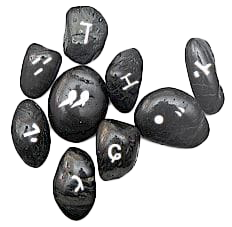
They proposed two, Joseph called Barsabbas, who was also known as Justus, and Matthias.…

Before the casting of lots: heartfelt prayer for God’s guidance (Acts 1:24-25)

… and the lot fell to Matthias

Acts of the Apostles 1:23, 26 NRSV

Welcome!

On Wednesday, May 8, 2024, we explored Acts 1:15-17, 21-26, the first reading appointed for the Seventh Sunday of Easter, Year B (May 12, 2024). Our handout included commentaries on the other appointed texts from the First Letter of John (1 John 5:9-13), the Psalms (Psalm 1), and the Gospel according to John (John 17:6-19).

In her commentary on the text from Acts—from a homiletical perspective—Barbara K. Lundblad highlights the two men put forward by the group gathered together after the Ascension but before the Day of Pentecost. We are asked to “acknowledge and celebrate the ordinary people who have carried the extraordinary gospel from one generation to the next.”

Pause, remember, acknowledge, and even celebrate, the ordinary people you have met in your faith journey who have shared the Good News of God in Christ with you.

From a commentary on Acts 1:15-17, 21-26

Matthias becomes part of the inner circle; the other loses the toss of the dice. Even his name seems to be in question: Joseph called Barsabbas, who was also known as Justus. The truth is that we know very little about either one of these men.

Their lack of renown is a wondrous reality. In the next chapter Peter stands with the eleven to preach his Pentecost sermon. That would mean that Matthias must have been there even though he is not named. Where was Justus? Perhaps he was there too, for the narrator tells us that all of them were filled with the Holy Spirit. …

Rather than being disappointed by having so little information, we can be grateful for the witness of those who are so little known. [The sermon this Sunday] can be a time to acknowledge and celebrate the ordinary people who have carried the extraordinary gospel from one generation to the next. Who is Justus in your faith journey?

Source: Barbara K. Lundblad, “Homiletical Perspective on Acts 1:15–17, 21–26,” in Feasting on the Word: Preaching the Revised Common Lectionary: Year B, ed. David L. Bartlett and Barbara Brown Taylor, vol. 2 (Louisville, KY; London: Westminster John Knox Press, 2008).

The Rev. Dr. Barbara K. Lundblad is the former Joe R. Engle Professor of Preaching Emerita at Union Theological Seminary.

divider line

Most Wednesday mornings a group of us gather online to explore the readings that will be used in worship the following Sunday. Our handout this week features readings, commentaries, and notes for the Seventh Sunday of Easter (May 12, 2024) in Year B of the Revised Common Lectionary. Please: View or download the handout we used to guide our discussion and tune our hearts to the Spirit.

View the Revised Common Lectionary readings appointed for Sunday, May 12, 2024, on the Revised Common Lectionary site curated by the Vanderbilt Divinity Library.

Please return to this site throughout the week to keep learning.

divider line

About casting lots

Be well. Do good. Pay attention. Keep learning.

Collect: Saint Matthias

Apostle (Feb 24)

Most of the symbols of the 12 Apostles include a depiction of the instrument of their martyrdom.

Matthias is named only once in the Acts of the Apostles (Acts 1:21-26). The rest of his story is obscure and sometimes fanciful in the Christian tradition. Nonetheless, it is important to note that he apparently fit Peter’s requirements that to become an apostle with the remaining 11 the man should “have accompanied us (the apostles) during all the time that the Lord Jesus went in and out among us, beginning from the baptism of John until the day when he was taken up from us—one of these men must become with us a witness to his resurrection” Acts 1:21-22A

After acknowledging the hand of God in selecting and blessing Matthias to be an apostle, we ask that we—the people of God—may always be guided and governed by faithful and true pastors.

What role do we play in supporting and encouraging and caring for the faithful and true pastors by whom we are guided and governed as God answers our prayer?

The Collect for the Commemoration

Almighty God, who in the place of Judas chose your faithful servant Matthias to be numbered among the Twelve: Grant that your Church, being delivered from false apostles, may always be guided and governed by faithful and true pastors; through Jesus Christ our Lord, who lives and reigns with you, in the unity of the Holy Spirit, one God, now and for ever. Amen.

Learn more

In the nine days of waiting between Jesus’ Ascension and the Day of Pentecost, the disciples remained together in prayer. During this time, Peter reminded them that the defection and death of Judas had left the fellowship of the Twelve with a vacancy. The Acts of the Apostles records Peter’s proposal that “one of the men who have accompanied us during all the time that the Lord Jesus went in and out among us, beginning from the baptism of John until the day when he was taken up from us—one of these men must become with us a witness to his resurrection” (Acts 1:21–22). Two men were nominated, Joseph called Barsabbas who was surnamed Justus, and Matthias. After prayer, the disciples cast lots, and the lot fell to Matthias, who was then enrolled with the eleven. (See Acts 1:21-26)

Scripture does not relate anything further about Matthias, but gives him as an example to Christians of one whose faithful companionship with Jesus qualifies him to be a suitable witness to the resurrection, and whose service is unheralded and unsung.

There are, however, several early Christian accounts of his mission and ministry, such as the second century text The Acts of Andrew and Matthias in Cannibal City. According to this account, immediately after the selection of Matthias, the apostles cast lots to determine which of them would take responsibility for which part of the world, and the unlucky Matthias was dispatched to a city of cannibals! Although an unabashedly fictionalized account, it is nevertheless an inspiring tale that shows Matthias being dealt the worst possible lot, and yet nevertheless responding to his call with equanimity, competence, and grace, which are the same qualities we see reflected in the canonical account that is given by Scripture.

Saint Matthias The Apostle in Lesser Feasts and Fasts, Revision 2018

Lots in the Ancient World

Ancient peoples used lot-casting as a form of cleromancy—a type of divination in which the random outcome was believed to reflect divine will. Ancients commonly used small stones labeled to reflect the possible outcomes of the decision (Lindblom, “Lot-casting,” 168). The Bible contains no description of the specific procedure for casting lots, undoubtedly due to the commonplace nature of the practice. Based on etymology, Kitz suggests the Israelites likely placed marked stones into a container, which was then shaken in such a way as to “cast” out a deciding stone (Kitz, “Terminology,” 207–14). Hittite and Akkadian texts also indicate that the casting of stones was used to determine an oracular answer to a series of questions (Kitz, “Urim and Thumim,” 401–10).

Usage in the New Testament

The New Testament contains few references to the use of lots. However, the attested uses reflect the Hebrew mindset regarding divine involvement with the decision:

  • Zechariah was chosen by lot for a rotation in the temple service (Luke 1:9)
  • Peter used lots and prayer to determine a replacement for Judas (Acts 1:15–26).
  • Soldiers cast lots to divide Jesus’ garments after His crucifixion (John 19:24). This is perhaps the most secular use of lots in the Bible.

Source: Rob Fleenor, “Lots,” in The Lexham Bible Dictionary, ed. John D. Barry et al. (Bellingham, WA: Lexham Press, 2016).

Be well. Do good. Pay attention. Keep learning.

Image used here, but original source unknown.

Epiphany +7 Year C

Put your trust in the Lord and do good; dwell in the land and feed on its riches. –Psalm 37:3

Welcome. Our handout features the readings for the Seventh Sunday after the Epiphany (Feb. 20 in 2022) in Year C of our Lectionary.

Forgiveness is a prominent theme of the Gospel passage this week. I invite you to explore The Work of Forgiveness a Lectionary Essay by Debie Thomas on the Journey with Jesus webzine.

If forgiveness isn’t denial or a detour, if forgiveness isn’t quick — then what is it?  What is Jesus asking of us when he invites us to love, bless, pray, give, lend, do good, withhold judgment, extend mercy, and turn the other cheek?

The Work of Forgiveness by Debie Thomas

Check out, too, what our Church remembers about Saint Matthias The Apostle and Photini, The Samaritan Woman (at the Well). She is widely honored in the Orthodox traditions and our Episcopal Church joins them in commemorating her. Through this week, read the stories of others who studied, prayed and worked for God’s glory. Let their stories invite you to do the same.

Pay attention. Keep learning.

View or download the Handout for Epiphany +7C including short biographies for Saint Matthias The Apostle and Photini, The Samaritan Woman (at the Well).

View or download an exploration of classicism and romanticism in art by Hovak Najarian.

View or download Art for Epiphany +7C. “Joseph recognized by brothers” by Francois Gerard with commentary by Hovak Najarian.

Please come back to this site throughout the week in order to keep learning.

B Easter 7, Art for May 20,2012

MASOLINO da Panicale
(b. 1383, Panicale, d. 1447, Firenze)
Click to open Web Gallery of Art Artist Biography and to explore other works by this artist.

Pope Gregory the Great (?) and St Matthias
1428-29
Tempera and oil on poplar transferred to fibreboard, 126 x 59 cm
National Gallery, London
Click to open Web Gallery of Art commentary page. Click image for large view.

Click to open Wikipedia article of St. Matthias.

Related art commentary by Hovak Najarian.