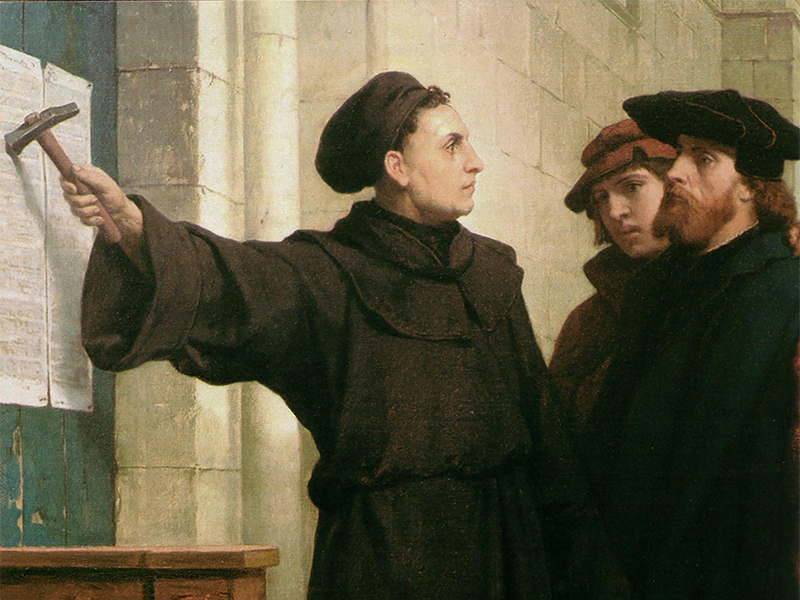
But Grace Awaits – Bishop’s Blog

Bishop Prior is the Episcopal Bishop of Minnesota. I commend his Advent meditation to you.

The Advent season invites us, dare I say challenges us, to NOT fill our waiting space. I know that sounds incredibly inefficient at best and uncomfortable at worst. However, when we allow our waiting space to be an empty place, in my experience, God’s grace begins to seep into our souls.

Source: But Grace Awaits – Bishop’s Blog

Black clergy encouraged to reclaim Jesus and his movement

[Episcopal News Service – Houston, Texas] Black clergy from across the Episcopal Church and parts of the Anglican Communion are spending more than four days here exploring how to reclaim the Episco…

A call to, an inspiration for all Episcopalians.

Source: Black clergy encouraged to reclaim Jesus and his movement

Is Israel’s Big New Find for Real?

A look at the difficulties of assessing the authenticity of ancient artifacts.

A piece of recently found papyrus is said to prove that Jerusalem was the center of a kingdom thousands of years ago. But the timing of its discovery has cast some doubt on it.

Source: Is Israel’s Big New Find for Real? – The Daily Beast

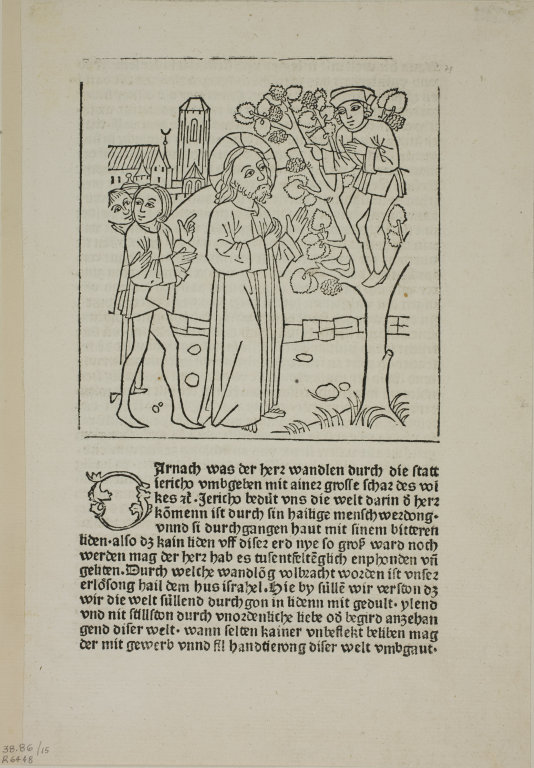
Jesus calling Zacchaeus | Art for Proper 26C

Luke 19:5 When Jesus came to the place, he looked up and said to him, “Zacchaeus, hurry and come down; for I must stay at your house today.”
 

2016-1030-prop-26c-jesus-zacchaeus

Jesus Calling Zacchaeus
a woodcut made by and unknown artist

Click the image for more information

Commentary by Hovak Najarian

In the early 1450s, Johannes Gutenberg of Mainz, Germany, developed a successful printing press with moveable type. The technology spread rapidly and within a few decades Gutenberg’s invention was being used at other cities in Europe. In Ulm, (about 135 miles from Mainz), Johann Zainer set up a press to publish both sacred and secular books. Among them was, The Spiritual Interpretation of the Life of Christ, c. 1485.

With the invention of moveable type, it was no longer necessary to hand-letter a text but readers of the day were accustomed to seeing illustrations in a book. Publishers met this expectation with woodcuts. An image, carved in relief on a block of wood and set in place, could be inked and printed together with the text. The time of hand-painted illustrations, as in a codex, had passed. For special editions, however, woodcuts often were colored by hand after being printed.

Included in Zainer’s illustrated book about Christ’s life is, Jesus Calling Zacchaeus. It is a composition that may have been based on a contour drawing made originally as a study for stained glass. This image depicts an occurrence at the time Jesus was passing through Jericho while on his way to Jerusalem. Because of the crowd, Zacchaeus, a wealthy tax collector and a man of short stature, was unable to see Jesus. In order to have a higher vantage point he climbed a nearby sycamore tree. Jesus saw Zacchaeus and spoke to him by name.

In this woodcut, Christ is the central figure and is greater in size in keeping with the practice of depicting important people to be larger than others in a composition. Two people follow Jesus but the crowd that is noted in the Bible, is not shown. Instead, attention is on Jesus at the moment he arrives at the tree where Zacchaeus is perched. One of the figures behind Jesus spots Zacchaeus and turns to a person next to him and points, perhaps saying, “Look, there is a man in that tree!” Jesus’ left hand is raised to greet Zacchaeus, while his right hand motions for him to come down. “Zacchaeus, come down immediately,” Jesus said, “I must stay at your house today.” Zacchaeus welcomed Jesus to his home but the crowd was dismayed that Christ would choose to stay with a tax collector.

While with Jesus, Zacchaeus was repentant and offered to give half his possessions to the poor. If he had cheated anyone, he said, he would repay them four times the amount. Jesus responded, “Today salvation has come to this house…”

Note: The sycamore tree mentioned in the Bible is related botanically to fig trees. It is not of the same specie as the familiar sycamore in America or the maple-related tree in England. This tree, often called, “sycamore fig,” has edible fruit and has been cultivated in the Holy Land since ancient times. The above woodcut is unusual in that clusters of figs have been included among the leaves of the tree.

Hovak Najarian © 2016

 

The ‘Splainer: What is ‘Reformation Day’? | Religion News Service

webrns-splainer-reformation-102816(RNS) Reformation Day is mainly marked by Lutherans and members of the Reformed Church, and in some churches it has developed into a holiday meant to rival Halloween. But does it? Let us ‘Splain . . .

Source: The ‘Splainer: What is ‘Reformation Day’? | Religion News Service

The Pharisee and the Publican | Art for Proper 25C

Luke 18:13 “…the tax collector, standing far off, would not even look up to heaven, but was beating his breast and saying, ‘God, be merciful to me, a sinner!'”

The Pharisee and the Publican, wood engraving, 1864, John Everett Millais, 1829 – 1896
Click the image for more information

In mid nineteenth century France, Neoclassicism continued to be the style taught in academies, and Romanticism was receiving a great deal of attention. Realism (paintings of everyday activities of common folks) also had followers, and other artists were painting landscapes in the open air. To varying degrees, English artists were influenced by these styles but they tended to remain independent.

Three young English artists – John Everett Millais, William Holman Hunt, and Dante Gabriel Rossetti – were not enamored with French styles or with contemporary painting in England. They also were not pleased with the direction art had taken in the centuries following the Renaissance. In 1848, they formed a brotherhood and called themselves, “Pre-Raphaelites.” Other artists joined them. As a group, they found inspiration in nature and in the art of the middle ages – a time before the painter Raphael and the Renaissance – hence the name, “Pre-Raphaelites.”

Within a few years, Millais’ outlook expanded and he moved away from Pre-Raphaelite principles. He did, however, continue his interest in the spiritual aspects of art. Among his many works are drawings that illustrate parables found in the Bible; these were reproduced as wood engravings by the noted Dalziel Brothers and published in 1864 under the title, “The Parables of Our Lord.” The Pharisee and the Publican is an illustration from this book.

In a typical illustration of this parable, the Pharisee is at a temple, standing in the foreground with arms raised pretentiously in prayer. The publican is often on his knees in the background. In Millais’ composition, the positions have been reversed and the contrast between the two is made even greater by the use of light and shadow. The tax collector is standing in the dark area of the foreground and is the immediate focus of our attention. It is the Pharisee who is now in the background. He and the other men are secondary figures and light in value.

There are differences in body language as well. The publican’s weight is on one leg as he slumps over and leans against a Solomon’s column for support. There is a sense that his mind in burdened and even the twist of the column suggests swirling thoughts. His hands are “beating his breast” and his head is downcast as he is saying, “God be merciful to me, a sinner.” By contrast, the self-satisfied Pharisee is standing among other worshipers and is leaning back in pride. His chin is thrust forward as he strokes his beard.

Note: “Solomon’s column,” is one of the terms given to pillars that have a corkscrew-like shaft. Constantine brought a set of these columns to Rome (for St. Peter’s Basilica) and it was said they were from Solomon’s Temple. This source is unlikely but the descriptive term, “Solomon’s column,” continues to be used.

Hovak Najarian © 2016

Mission to Seafarers

Screenshot 2016-08-08 13.40.31

Though Sea Sunday (July 10, 2016) has passed it is always the right time to reflect on the work others (like seafarers) do for the common good. Want to get an idea of how dependent we are on the sea, ships, and seafarers? Start with this article from Vox.com: This is an incredible visualization of the world’s shipping routes. The article features an interactive map that helps you visualize the extent of shipping traffic.

As a church we seek to minister to those who labor on ships and in ports throughout the world (including our own Port of San Diego). Here is more about the Mission to Seafarers (MtS):

Belonging by Kaze

As we put our faith into action (see James 1:22) pause to consider this reflection by Kaze Gadway. Pay attention to her experience-filled words as you seek to do good.

kazestories's avatarkazegadway

Belonging by Kaze Gadway

     Recently a Ted Talk used the Maslow’s hierarchy of needs as a subject. I appreciate the talk, especially as it relates to the homeless.

     The physiological need is obvious. The homeless do not have consistent food, water, housing, clothing or sanitary facilities. That’s obvious.

     Physical and Economic safety are also missing. Violence, trauma, accidents are common. They are treated poorly when they go to emergency rooms. One look at their uncleanliness and poor clothes places them at the bottom of the job selection pool.

    The next three categories are not as obvious but powerful.

     One of the homeless women admits to me, “They gave me an apartment but I hate it. I take a shower there and maybe keep some food but at night, I go back on the streets and sleep at my camp with my friends. I hate being…

View original post 164 more words

A Bible Study Opportunity

Here is yet another way to join a group Bible Study

The Archbishop of Canterbury was joined by thousands of Christians around the world today [5/19/2016] for his first live Bible study on Facebook. Archbishop Justin Welby discussed John 1:35-42 with the Revd Chris Russell, the archbishop’s advisor for evengalism and witness, and answered questions from viewers.

Read the entire post on Anglican Communion News Service

Maybe this is just what you were looking for.

Image: ACNS


What do hear?

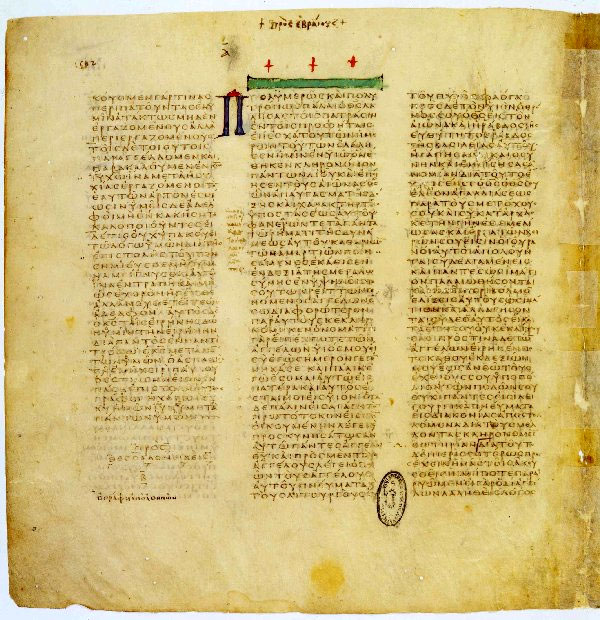
codex_vaticanus_b2c_2thess-_32c11-182c_hebr-_12c1-22c2

Catholic scholars drive a new wave on the New Testament (via Crux)

A new generation of scholars—many of them Catholic—are at last coming at the subject of New Testament scholarship with some humility and common sense.

The turning point in the scholarship has been the increased understanding of the relevance of the first century Jewish context  of the New Testament. As scholars and archeologists have uncovered an increasing amount of information about first century Jewish culture, beliefs and writings, they have come to understand more deeply the meaning and historicity of the gospels.

Put simply, a deeper understanding of first century Judaism has illuminated the New Testament, not only revealing new depths of meaning, but also affirming its early date and historical authenticity.

I encourage you to read the whole post on the Crux website. Let it inspire you to continue to do your own research and decision-making as you keep learning. ~Dan

Image: Page from Codex Vaticanus; ending of 2 Thes and beginning of Heb on Wikipedia