Unless I see the marks « Unfolding Light

“Unless I see the mark of the nails in his hands,and put my finger in the mark of the nailsand my hand in his side, I will not believe.” —John 20.25

Just before we leave the Second Week of Easter let us take one more look at Thomas. Steve Garnaas-Holmes is a United Methodist minister who writes daily. I am grateful for his insights and his willingness to share.

Here, I have excerpted his meditation  “Unless I see the marks.” You will want to read the entire meditation (more than once). It has opened my eyes to see Thomas in a different light.

Oh, Thomas was no doubter.…

”Oh, more, not less than all the rest,
Thomas believed in love, and how it bled. …

He didn’t ask to see his smiling face,
[his] famous, radiant eyes;
he didn’t hope to see him break the bread
the way he always did.
No, he asked to see his wounds,
the marks of love, the wounds of one
who weeps with those who weep,
who has walked with us through the valley
of the shadow of death.

Oh, Thomas, I’m with you: …

Read the entire meditation: Unless I see the marks « Unfolding Light.

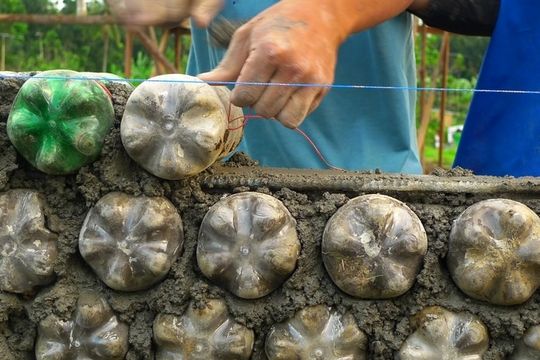
What good is that plastic bottle? You might be surprised.

Episcopal Public Policy Network (EPPN) shared this article via Twitter. From Development Marketplace comes news of community building, gaining hope, and caring for the environment. Plastic bottles, as you will see, can do more than take up space in a landfill.

Building with plastic bottles

“In the Philippines and Guatemala, local groups have taken the mantra ‘Reduce, Re-use, Recycle’ to a whole new level.” See for yourself: Transforming Plastic Bottles into Classrooms

______________
Image: First Bottle School in Asia 

Expanding and refining our vision

Earlier this month I introduced you to Hovak Najarian who will expand our vision as we view Stan’s offerings in art each week. Not only will Hovak expand our vision but he will offer an experienced and educated eye to help us refine our vision as we enter the world of art. On the Third Sunday in Lent Stan directed our eyes to Rembrandt’s painting of Christ driving the Money-Changers out of the Temple. Hovak presents this additional information to help us into the art. ~dan

Comments on Rembrandt’s Christ Driving the Money-Changers from the Temple by Hovak Najarian

Rembrandt’s painting, Christ Driving the Money-Changers from the Temple was painted only a year after his earliest dated work but it already shows his interest and ability to create paintings of emotional depth.  Like his teacher, Pieter Lastman, Rembrandt was particularly interested in faces and in “Money-Changers,” each face, figure, and gesture is a focal point of deep expression.

The art of the Italian Renaissance grew out of a rebirth of classicism (the art of the Greeks in particular). The Greek gods were sculpted with idealized human proportions and this idealization and refinement carried over into Renaissance painting and into the works commissioned by the Roman Catholic Church and wealthy families.  The art of Protestant Northern Europe of the seventeenth century, however, did not reflect the classic ideal and their paintings were less likely to be of Mary and child, the crucifixion, or one of the saints. Their figures were more like everyday people, not idealized images.

Dutch businesses thrived during Rembrandts time and he earned a very good income from painting portraits of his patrons.  Rembrandt also painted Biblical subjects of deep emotional content. There is realism in the faces of the people in “Money-Changers.” They are not men with classic profiles set in place for a lovely picture.  The money-changers’ faces show furrowed brows, mouths agape, and surprised reactions as Jesus moves into action. Jesus is not centrally located in the scene as is often the case but rather he is at the upper left side as though he just entered the scene and caused the money-changers to scramble.  He is not a handsome man with a sweet beatific expression.  He looks tough, serious, and his eyes are focused and intense.  The money-changers seem like real people in a real situation; the painting does not give the effect of a scene that is staged.

The facial expressions and sense of activity of the figures seen in Rembrandt’s earlier paintings gradually changed in focus as he became older.  Instead of movement, his figures tend to remain still with a sense of heavy emotional weight and feeling concentrated in facial expressions.

______________
© 2012 Hovak Najarian

We are brothers and sisters…

ONE Episcopalian buys a brick
Another EPISCOPALIAN finds hope

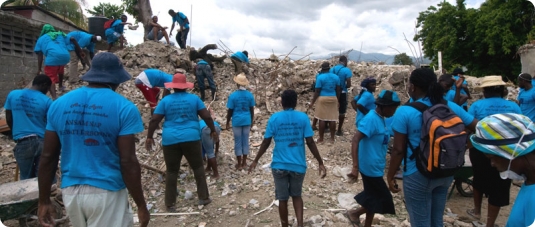
With the entire Episcopal Church—brothers and sisters in Christ, though separated by thousands of miles—the people of St. Margaret’s are giving to help in the rebuilding of Haiti. In particular we are giving to assist in the rebuilding of the cathedral in Port-au-Prince. Our Presiding Bishop, Katherine Jefferts Schori gives us perspective:

The Episcopal Church as a whole is partnering to help the Diocese of Haiti rebuild the cathedral complex in Port-au-Prince. Before the earthquake, that complex included not only the cathedral with its world famous murals (three have been conserved), but a music school and philharmonic orchestral, a vocational school, a convent, and diocesan offices. Partnerships have helped to provide necessary infrastructure for strategizing and planning the redevelopment work. Read her complete statement.

Bishop Jean Zaché Duracin of the Diocese of Haiti narrates a powerful video about the conditions in Haiti, images of rebuilding, and offers his thoughts and reflections on the second anniversary: WE ARE ONE

Be aware. Do good. International Women’s Day 2012

March 8th is “International Women’s Day, a day of remembrance and reflection celebrated around the world since 1913,” according to Episcopal News Service.

Here are a few of the posts on our blog that have sought to increase awareness of the needs and issues of women and girls throughout our world and right in our own neighborhoods. As always, my hope and prayer is that with increased awareness of need and the whisper of the Holy Spirit, individual and collective action to meet these needs will result. Blessings on this International Women’s Day. ~dan

Episcopal Women’s Caucus and Anglican Women’s Empowerment – introduced on the Seventh Day of Christmas, this post includes links to other organizations by and for women and girls

Two Against Gender Violence – introduced in our Advent Calendar Day 14, this post links to ECS Julian’s Housing Program for Women and Children and Shelter from the Storm

Anglican Women gather in New York to consider Communion’s Advocacy Efforts – a post linked to an Anglican Communion News release in January. The post indicates how the Anglican Communion is addressing the issue of empowering women in rural settings.

charity: water – posted in our Advent Calendar, Day 24, this post raises awareness about how women and girls are adversely impacted by doing the work of obtaining water for the household (“women’s work”) and how charity: water by bringing water to a village (via wells, or filtration and storage systems) positively impacts the lives of these women and girls (Recommended: Water Changes Everything video)

______________
Image 1 from the International Women’s Day website | Image 2 from 3 inspiring french women

Observing a holy Lent: giving alms

Are you ready for a challenge? I am. Here we go.

Go to the Haiti Response Page for more information
Image from the ERD Haiti Earthquake Response Page

On Sunday, March 4th, over a dozen Forum participants gathered with other parishioners to hear Sandra Swan talk about Haiti, about Episcopal Relief and Development, and about the efforts of every diocese and parish within the Episcopal Church—including St. Margaret’s—to learn about and “give alms” for the rebuilding of Haiti. Lane and Chet, the Vestry and its Outreach Commission, have made this our charitable effort in Lent 2012 (you can see the bricks in the Narthex every Sunday to remind you of this project).

Today, I challenge our Sunday Morning Forum (you and me) to contribute $1,000 to this Lenten alms giving. This seems like a modest goal for us who seek to be “doers of the word.” (James 1:22)

We are averaging over 20 folks in our Sunday morning gathering on campus. With just the Sunday morning crowd and a donation of $50 each we can make this goal. Reaching out to our friends and family and online Forum members we may exceed this goal for the glory of God and the relief of his people in Haiti.

If you have already given to the Haiti effort, let me know and we’ll add that to our total. Today Carol and I have donated $100 for the rebuilding of Haiti. Let’s do this as part of our effort to put our faith into action. Thank you. ~father dan

Donate Now as a doer of the word

  1. Use ParishPay (a secure website used by the church). Under One-Time Donations designate Rebuild Haiti to make your donation. (The option Carol and I used)
  2. Use the Episcopal Relief and Development secure website to make your donation; designate “Haiti Earthquake Response” to make your donation
  3. Write a check to St. Margaret’s Episcopal Church and indicate “Rebuild Haiti” on the Memo Line. Send check to: St. Margaret’s Episcopal Church | 47535 Highway 74 | Palm Desert, CA 92260 or drop the check into the Sunday collection at worship.

All contributions to St. Margaret’s for Haiti Relief will be sent to Episcopal Relief and Development whose workers and whose aid arrived in Haiti within hours of the January 12th earthquake in 2010 and whose commitment is to continue “its support throughout the recovery and rehabilitation process” (no matter how long it takes).

Additional information about how donations to ERD are used:

Additional information about how ERD is joined in a cooperative effort with other charitable organizations:

Visit the InterAction Haiti Aid Map for an interactive look at where Episcopal Relief & Development is active. Use this link to view the combined efforts of all Non-Govermental Organizations (NGOs) in Haiti.

Additional information about our parish efforts to contribute to the rebuilding of Haiti:

  • Sherry Wollenberg, our Forum member, (on Sundays in Lent you will find her near the bricks and the wheelbarrow in the Narthex or on the patio)
  • Deacon Cherry (seemingly everywhere on Sundays in Lent and via email: Deacon Cherry)

About Hovak Najarian

College of the Desert Professor Emeritus (Art) Hovak Najarian

Updated: May 14, 2024

If you are new to this blog, I am pleased to introduce you to (Dr.) Hovak Najarian. Since 2011 Hovak has introduced us to artists, art techniques, and art history to keep us growing in the knowledge and love of the Lord.

After receiving his MA in Art at Columbia University Hovak and his wife, Margie, spent 3 years in Normal, IL on the art faculty of Illinois State University. In his own words, “We soon found that natives of Florida and California were no match for winters in Illinois.”

In 1966 Hovak and Margie relocated to Southern California when Hovak accepted a teaching position at College of the Desert in Palm Desert. He retired in 1994 and was honored with the title Professor Emeritus (Art) by the College of the Desert. Again, Hovak: “During that time [1966-1994], I was Chair of the Art Department for many years, returned to Columbia University and completed my doctorate, and with Margie, raised three wonderful sons.”

In his retirement, Hovak continues his own creative work, and, has been an active participant in the Sunday Morning Forum and a regular contributor to this blog. Hovak is active in St. Margaret’s Episcopal Church and in the Armenian community in the Coachella Valley which gives him a unique perspective to share. 

As we journey together I expect to learn more about art, art history, art as an expression of faith, and art as a shaper of faith. Together, let us hear what the Spirit is saying. ~Fr. Dan

Come into the wilderness a place of promise and hope

FROM THE ARCHIVES…

Note: From 1999-2003 Stan Hirsch facilitated the Sunday Morning Forum. He collected a wealth of information. To my delight he archived the material. In the weeks to come we’ll mine this archived material for Supplemental information on our work in the Year B Lectionary. Since space is not restricted, I may add to the original material from time to time. I encourage you to follow the links when given. Come back often, go exploring, keep learning. ~dan

Mark 1:9-13

Quote . . .Lent is a season of great hope, a season of movement into the loving embrace of our Father.

Lent is a time when we are put in mind that we live today in the Kingdom of God, as we shed the distractions in order to see the reality of God’s presence with us. But Lent also is the season that is most usually symbolized by the word “wilderness.” Wilderness always comes across as an unpleasant place, but it is a very frequent setting in Scripture…

The good news about Lent and the wilderness is that it is a time for formation and reformation. It is a time when we can be formed as a people of God and it is a time when we can be renewed in our commitment to Christ…

We are reminded too in the Gospel today that Jesus was not driven into the wilderness by Satan, he was driven there by the Holy Spirit. And at the end we are told that angels ministered to him. The wilderness is not a bad place. It is a place of great promise and hope. It is a place for stripping away of all the old dependencies that tear us down and coming to grips with total reliance on God—a God who loves us and wants for us freedom and prosperity, a God of plenty, a God of love. The route through the wilderness leads us from an unsatisfying life to a life of abundance. But if you are like me, you would just as soon avoid the wilderness because leaving the familiar, leaving the known, leaving the predictable, for unpleasant thoughts, wrestling with what we fear is an altogether inadequate faith to guide us through. We want to avoid the wilderness because it means we have to struggle with hard choices. Choices of temptation. It would be so much easier if we were simply animals of instinct and did not have to make choices. But if we were, we would never be able to embrace each other in love. Nor would we be able to embrace our God with love.

…The wilderness is a place of movement to good. When we go there in the Lenten season, we face the demons of insecurity and time pressures. We face our own demons of hypertension and self-doubt. We also know that we are moving towards Easter, the resurrection and the presence with God. [1]


[1] February 21, 1999, Lent — A Season of Hope, The Rev. Dr. Robert G. Certain

 Image: From the internet–http://travelerstrails.com

Make room (and time) for Lent

Lenten Meditations from the desert

“A traditional view of Lent is that it’s a time of restriction, sacrifice, and giving up things. But it can also be a time for expansion, rededication, and connection with others. Many people take on special devotional practices during Lent; others also make more time during this season to be in conversation with their spiritual communities.”Spirtuality & Practice email dated Feb. 18, 2012

Expand your mind and heart with the folks of St. Margaret’s this Lent, rededicate yourself to following Jesus Christ, find a connection with those you work with, socialize with and with whom you worship. Forty members of St. Margaret’s have each written a meditation for one of the days of Lent. We invite you “to observe a holy Lent” with us:

Three ways to receive the daily Lenten Meditations

  1. Go daily to the St. Margaret’s website and click the image to see the meditation of the day. This banner will be visible throughout Lent.
  2. “Follow” the Lenten Meditations blog (on WordPress) by using the Follow button in the right side bar (or at the bottom of blog page).
  3. Bookmark the Lenten Meditations blog in your browser and, in the 40 days of Lent, use the bookmark to go back to the blog where you will find a new meditation each day.

divider line

About the image: a close up of Ocotillo flowers taken in the Santa Rosa Mountains above Palm Desert in March 2005 by Stan Shebs and posted on Wikimedia Commons.

Candlemas Day is about … ?

On February 2nd we annually recall the Prestation of our Lord in the Temple. Here is an excellent summary of the commemoration (with some additional links).

Painting of Simeon meeting Mary and the Baby Jesus in the Temple.

Counting forward from December 25 as Day One, we find that Day Forty is February 2. A Jewish woman is in semi-seclusion for 40 days after giving birth to a son, and accordingly it is on February 2 that we celebrate the coming of Mary and Joseph with the infantJesus to the Temple at Jerusalem to offer sacrifice, both on behalf of Mary and on behalf of Jesus as a first-born male. As they did so, they were greeted by the aged Simeon.

In a Sunday-School pageant I once saw, the narrator said, “And now Simeon bursts into a spontaneous song of praise, assisted by the Temple Choir.” His song, called the Nunc Dimittis, has always had a prominent role in Christian worship. It has often been rendered in verse. [ … ]

On the other hand, Groundhog Day (“If the groundhog (or woodchuck, a kind of marmot, which burrows and hibernates) sees his shadow on 2 February, there will be six more weeks of winter.”) is strictly a secular holiday, confined, as far as I know, to the United States.

written by James Kiefer for Daily Prayer

A short history of Candlemas Day (also from Daily Prayer for Feb 2nd)

By the seventh century it had become the custom to begin the worship service on February 2 with candlelighting by the congregation gathered outside the worship area followed by a procession into the Church with all carrying their lighted candles. This was to relive Simeon’s experience of meeting the “light of nations” at the temple. The pastor Sophronius wrote in that century

Everyone should be eager to join the procession and to carry a light.

Our lighted candles are a sign of the divine splendor of the one who came to expel the dark shadows of evil and to make the whole universe radiant with the brilliance of his eternal light. Our candles also show how bright our souls should be when we go to meet Christ.

So let us hasten to meet our God.

The custom of beginning the worship on this festival with a candlelight procession is the origin of the day’s other name, “Candlemas.”

The festival day’s position at midwinterexactly midway between the winter solstice December 21 or 22 each year in the Northern Hemisphere, and June 20 or 21 in the Southern Hemisphere. and the spring equinox the day when daylight lasts for exactly 12 hourscaused it to be a time for taking inventory of one’s winter supplies. One English poem goes:

The provident farmer on Candlemas Day,

Hath half of his fires and half of his hay.

The day’s emphasis on light and life at midwinter gave rise to many superstitions and legends. Some believed that “if the day be clear and sunshiny, it portends a hard weather to come; if cloudy and lowing, mild and gentle season ensuing.” From that piece of weather folklore it is not too difficult to understand how our Pennsylvania Dutch descendants of Germanic peoples who emigrated to the United States (primarily to Pennsylvania), from Germany, Switzerland and The Low Countries prior to 1800 legend of Groundhog Day began.

By the seventeenth century the Presentation of Our Lord was understood to be the absolute end of the Christmas season. Indeed, Ash Wednesday the first day in the season of Lent can follow as early as just two days later on February 4. As the end of the Christmas festivities, it was the day to complete the removal of all the holiday decorations. This, too, became the cause of superstition:

Down with Rosemary, and so

Down with Bays and Mistletoe;

Down with Holly, Ivy, all

Where with ye drest the Christmas Hall;

That to the superstitious find

Not one least Branch there left behind

For look, how many leaves there be

Neglected there, maids, trust to me,

So many goblins you shall see.

(sheet music and links to audio)

via Morning Prayer.