Wind Chimes: 8 Feb 2013

“Listen carefully to my instructions …
With the good gifts which are in us,
we must obey God.”

From the Prologue in the Rule of St. Benedict and quoted in The Monastery of the Heart:
An Invitation to a Meaningful Life
(p. 3) by Joan Chittister

The chimes invite us to listen today. Pause and listen. What do you hear?

Walking another day with Anne Hutchinson

As I do understand it, laws, commands, rules and edicts are for those who have not the light which makes plain the pathway. He who has God’s grace in his heart cannot go astray.

Anne Hutchinson as quoted in Little Journeys to the Homes of Great Reformers (1907) by Elbert Hubbard (“Anne Hutchinson” on Wikiquote)

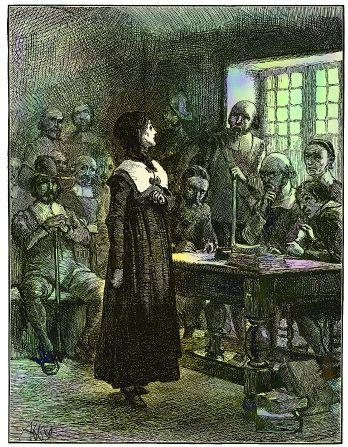
Anne Hutchinson on TrialAs shared yesterday: on February 6, 2013, in the “Spiritual Day Hike” (which wanders far and wide in the world without actually leaving St. Margaret’s in Palm Desert, CA) we walked with Anne Hutchinson for a time. Anne is now remembered by The Episcopal Church annually on February 5th.

Born and raised in the faith of the Church of England Anne accepted the teachings of the Puritans and added her own touch.

As you read the excerpt from the Prologue in the Rule of St. Benedict you can easily understand that Anne would have been right at home in the Rule of St. Benedict. Her ‘touch’ added to her Puritan faith was to listen with the “ear of her heart” for the voice and the wisdom of God.

Confident that God was constantly in dialogue with her, confident that she could hear and understand God within her own heart, Anne chose to follow the One who called to her, spoke to her, and led her in Love. She continues to offer her witness to us—listen, listen carefully, trust what you hear in your heart: “You are my beloved child. Always. Everywhere. In every circumstance. Beloved.”

Anne has left quite a legacy. Allow yourself to be amazed by her courage and her confidence in God as you read her story:

Image: Wikimedia Commons and JSS Gallery

Wind Chimes: 7 Feb 2013

You must be holy in every aspect of your lives,
just as the one who called you is holy.
It is written, “You will be holy, because I am holy.”

1 Peter 1:15-16 which quotes Leviticus 19:2 CEB

The chimes seem to be sounding a song of joy and freedom. What do you hear?

The grace of God

As I do understand it, laws, commands, rules and edicts are for those who have not the light which makes plain the pathway. He who has God’s grace in his heart cannot go astray.

Anne Hutchinson as quoted in Little Journeys to the Homes of Great Reformers (1907) by Elbert Hubbard (“Anne Hutchinson” on Wikiquote)

Anne Hutchinson on TrialIn the “Spiritual Day Hike” (which wanders far and wide in the world without actually leaving St. Margaret’s in Palm Desert, CA) on February 6, 2013 we walked with Anne Hutchinson for a time. Anne is now remembered by The Episcopal Church annually on February 5th.

Some 450 years after her death she continues to have a profound impact on us as we listen for the Spirit within our hearts. Our group, as we walked with Anne, was affirmed in actively forming and following a conscience illumined by the light of Christ and emboldened by the Holy Spirit. Anne has left quite a legacy. Allow yourself to be amazed by her courage and her confidence in God as you read her story:

Image: Wikimedia Commons and JSS Gallery

Wind Chimes: 10 Jan 2013

Gracious Father, we pray for thy holy Catholic Church. Fill it with all truth, in all truth with all peace. Where it is corrupt, purify it; where it is in error, direct it; where in any thing it is amiss, reform it. Where it is right, strengthen it; where it is in want, provide for it; where it is divided, reunite it; for the sake of Jesus Christ thy Son our Savior. Amen.

A prayer (updated) of William Laud (see The Book of Common Prayer, p. 816)

The chimes produce a mixed sound today: sometimes a violent crashing sound, sometimes a soft peaceful sound. What do you hear?

William Laud, Archbishop of Canterbury, d. 1645

Today (January 10th) the Episcopal Church remembers William Laud, Archbishop of Canterbury (1633-1645). Laud’s short biography in Holy Women, Holy Men tells the truth, “Laud’s reputation has remained controversial to this day. [He is] [h]onored as a martyr and condemned as an intolerant bigot ….”

Given the current concern among some in England about “The Succession to the Crown Bill” it is informative to remember today that, “Laud believed the Church of England to be in direct continuity with the medieval Church, and he stressed the unity of Church and State, exalting the role of the king as the supreme governor.” (“William Laud” on Holy Women, Holy Men).

Wind Chimes: 03 Jan 2013

On that day: The deaf will hear the words of a scroll and, freed from dimness and darkness, the eyes of the blind will see. The poor will again find joy in the Lord, and the neediest of people will rejoice in the holy one of Israel.

Isaiah 29:18-19 CEB

Today, January 3rd, the Episcopal Church remembers William Passavant (October 9, 1821 – January 3, 1894).

William Passavant was a Pennsylvania Lutheran pastor who left an uncommonly rich legacy of service. He was driven by a desire to see the consequences of the Gospel worked out in practical ways in the lives of people in need. For Passavant, the church’s commitment to the Gospel must not be spiritual only. It must be visible. For him, it was essential that Gospel principles were worked out in clear missionary actions.

Learn more about William Passavant on Holy Women, Holy Men

In the Collect we ask God, the Compassionate, to “inspire us by his example, that we may be tireless to address the wants of all who are sick and friendless….”

One of the goals of the Sunday Morning Forum is to hear the Spirit calling us to such service and gracing us to serve to the welfare of others and the glory of God. The chimes sound, “you are called to serve.” What do you hear?

Additional information about William Passavant on Wikipedia

Wind Chimes: 29 Sep 2012

You never enjoy the world aright,
till the Sea itself floweth in your veins,
till you are clothed with the heavens,
and crowned with the stars:
and perceive yourself to be
the sole heir of the whole world.

Thomas Traherne
First Century, Sec. 29

Here is today’s sampling of the music made by the Spirit in the Wind Chimes.
What do you hear?

Thomas Traherne; Priest, 1674 [1]

“Though not as well known as John Donne or George Herbert, Thomas Traherne was one of the seventeenth century’s most searching, inventive poets and theologians.”

We ask God in the Collect we pray as we gather to “help us to know you in your creation and in our neighbors, and to understand our obligations to both, that we may ever grow into the people you have created us to be….”  God will surely answer such a prayer:

Creator of wonder and majesty, you inspired your poet Thomas Traherne with mystical insight to see your glory in the natural world and in the faces of men and women around us: Help us to know you in your creation and in our neighbors, and to understand our obligations to both, that we may ever grow into the people you have created us to be; through our Savior Jesus Christ, who with you and the Holy Spirit lives and reigns, one God, in everlasting light. Amen.
Collect from Holy Women, Holy Men

St. Michael and All Angels

Today (September 29) the church remembers Saint Michael and All Angels.

… Despite the best efforts of greeting card companies to make angels into cute babies, the Bible has other ideas. In the Bible, angels are almost universally terrifying. There is a reason that angels usually begin their encounters with humans by saying, “Do not be afraid.” … Mentioned in Daniel and Revelation, Michael the Archangel protects people against evil and leads the righteous armies against Satan. The word angel comes from the Greek angelos, and it means, literally, “messenger.” Throughout the scriptures, angels are sent by God to deliver messages. In the created order, angels exist in the heavenly realm along with cherubim and seraphim. There is no hint in the Bible that people become angels, though popular culture sometimes holds this view. On this feast day, we remember God’s heavenly messengers. And we give thanks that we are able to join with them at each celebration of Holy Eucharist as we sing, “Holy, holy, holy, Lord God of power and might.” Angels remind us of our place in the created order, and they sometimes bear messages for us from God.
Daily Prayer: a resource of Forward Movement

Walking with Children [2]

Quote . . .Children in Kid’s Word brainstormed who Jesus is to them earlier today [9/16]. They raised some critical messages:

  • He’s someone you don’t need to see to believe in;
  • He loves me and everybody.
  • They named Jesus as protector, comforter, lover of their soul, hope for the future, sweet, soothing voice.
  • A child once told me she would be able to recognize Jesus because she could tell from the love in his eyes. || Posted 9/19/12

Wendy asks wonderful questions of children and adults on her blog, Walking with Children. I encourage you to read her posts.

________________________
[1] The Episcopal Church has a Liturgical Calendar in which holy women and holy men are annually commemorated. Their faith and example is remembered by the Church as we gather and give thanks in prayer and worship. On September 27th we remember Thomas Traherne, a priest, often considered to be one of the Metaphysical Poets.

Holy Women, Holy Men is a “Trial Use” Calendar at the moment. Thomas Traherne is remembered in this Calendar.

[2] Walking with Children is a blog written by Wendy Sanders, a member of this Sunday Morning Forum at St. Margaret’s Episcopal Church in Palm Desert, CA. This year she is leading Kids Word at 10am every Sunday Morning. In Kids Word ‘Miss Wendy’ assists the children and youth to go deeper into the story sharing their understanding with the her and the adults with her. Each generation teaching and learning from the others. I encourage you to follow her blog.

Matthew, Apostle and Evangelist

As Jesus continued on from there,
he saw a man named Matthew
sitting at a kiosk for collecting taxes.
He said to him, “Follow me,”
and he got up and followed him.

Matthew 9:9, CEB

Collect commemorating Matthew, Apostle and Evangelist

We thank you, heavenly Father, for the witness of your apostle and evangelist Matthew to the Gospel of your Son our Savior; and we pray that, after his example, we may with ready wills and hearts obey the calling of our Lord to follow him; through Jesus Christ our Lord, who lives and reigns with you and the Holy Spirit, one God, now and for ever. Amen.

Come wander with me. Hear what the Spirit is saying, as you listen to what we ask (and what we say about ourselves and our God) in the Collect we pray as we commemorate Saint Matthew, Apostle and Evangelist.

We thank you, heavenly Father

  • Only one other Collect (Saturday in Easter Week) begins with the words “we thank you.” My personal prayers often begin with the words, “thank you.” Other collects contain thanksgiving, but this prayer on Matthew’s Feast Day and the prayer on Saturday in Easter Week mark the only 2 times our communal prayer in worship begins with thanksgiving.

we pray that, after [Matthew’s] example, we may with ready wills and hearts obey the calling of our Lord to follow him

  • Wow. That is some request. It intrigues me that our request is that we imitate the example of Matthew, that we hear and then obey (with ready wills and hearts no less) the calling of our Lord to follow. We don’t ask for graces to prepare ourselves to be sent (an apostle is one who is sent by another) or even to proclaim ‘good news’ (what Matthew ultimately did, what an evangelist does); we ask to be able to hear and obey and follow. We ask God for grace (and good-will) to hang out with Jesus.
  • If you are reading this. chances are you have indeed heard this call and have followed Jesus.
    • Into what adventure have you followed him?
    • Were you able, like Matthew, to follow immediately?
    • Were you more like me (and so many others I have met along the way) and hesitated, wondered, asked questions, started, stopped, sat down and didn’t move, and, you get the idea … well?
    • My following has hardly been immediate or perfect, but here I am. I do thank God for that grace; I thank God that I have so many traveling with me who have similar stories. I thank God for the example of Matthew, who just got up and followed.

What are your thoughts as you listen to this prayer, especially the notion of “call”? And, by the way, have you noticed how often “call” is part of our prayers? What are your experiences, your hopes, your beliefs, given voice in this prayer? Please continue the conversation in the Comment section. Be well. Do good. Pay attention. Keep learning.

John Coleridge Patteson

A Collect commemorating John Coleridge Patteson and his Companions; Bishop of Melanesia, Martyrs, 1871

Almighty God, you called your faithful servant John Coleridge Patteson and his companions to be witnesses and martyrs in the islands of Melanesia, and by their labors and sufferings raised up a people for your own possession: Pour out your Holy Spirit upon your Church in every land, that by the service and sacrifice of many, your holy Name may be glorified and your kingdom enlarged; through Jesus Christ our Lord, who lives and reigns with you and the Holy Spirit, one God, for ever and ever. Amen.
(Collect for the Commemoration of John Coleridge Patteson, in Holy Women, Holy Men)

Inspired by offline encouragement, I find myself wandering through the Collects (prayers used by many churches including the Episcopal Church at the start of worship). Come wander with me. Hear what the Spirit is saying, as you listen to what we ask (and what we say about ourselves and our God) in the Collect we pray as we commemorate John Coleridge Patteson and his companions.

“you called” (let’s consider this one element of the Collect)

Once again we acknowledge a characteristic of God: Almighty God (One so beyond us) is also One who calls (a very personal, very intimate activity).

If God speaks anywhere, it is into our personal lives that he speaks. Someone we love dies, say. Some unforeseen act of kindness or cruelty touches the heart or makes the blood run cold. We fail a friend, or a friend fails us, and we are appalled at the capacity we all of us have for estranging the very people in our lives we need the most.

“If God speaks anywhere,
it is into our personal lives”

Or maybe nothing extraordinary happens at all—just one day following another, helter-skelter, in the manner of days. We sleep and dream. We wake. We work. We remember and forget. We have fun and are depressed. And into the thick of it, or out of the thick of it, at moments of even the most humdrum of our days, God speaks.
Buechner, Frederick (2009-10-13). Listening to Your Life: Daily Meditations with Frederick Buechne (pp. 2-3). Harper Collins, Inc.. Kindle Edition.

I believe (with Buechner and many others) that God speaks (“calls”) through persons and events in our lives. It is a very personal communication if we are paying attention. By paying attention I mean listening and wondering in prayer, in study, in quiet, in action (as we do what we believe God is “calling” us to do). In each of these moments we gain information. When what we “hear” is confirmed by others in our faith community, we can definitely go forward with boldness (like John Coleridge Patteson and his companions).

What are your thoughts as you listen to this prayer, especially the notion of “call”? What are your experiences, your hopes, your beliefs, given voice in this prayer? Please continue the conversation in the Comment section. Be well. Do good. Pay attention. Keep learning.

Theodore of Tarsus, Archbishop of Canterbury, 690

A Collect commemorating Theodore of Tarsus

Almighty God, you called your servant Theodore of Tarsus from Rome to the see of Canterbury, and gave him gifts of grace and wisdom to establish unity where there had been division, and order where there had been chaos: Create in your Church, by the operation of the Holy Spirit, such godly union and concord that it may proclaim, both by word and example, the Gospel of the Prince of Peace; who lives and reigns with you and the Holy Spirit, one God, for ever and ever. Amen.
(Collect for the Commemoration of Theodore of Tarsus, Archbishop of Canterbury, 690 in Holy Women, Holy Men)

Inspired by offline encouragement, I find myself wandering through the Collects (prayers used by many churches including the Episcopal Church at the start of worship). Come wander with me. Hear what the Spirit is saying, as you listen to what we ask (and what we say about ourselves and our God) in the Collect we pray as we commemorate Theodore of Tarsus:

Almighty God

In this Collect we address God as “Almighty God.” In other Collects we use different terms of address (and we’ll take them up as they appear).

  • What images come to your mind and heart when you hear “Almighty God”? (Asked another way, what images come to your mind and heart when you call out “Almighty God”?)
  • Leaving your feelings out of it (for the moment) what scriptural and theological “truth” is being spoken when we use this form of address? (That is, what truth—rooted in scripture, tradition, and reason—do we perpetuate, do we pass along, in speaking this way?)
  • What feelings/emotions are stirred up by using this form of addressing God?

you called your servant Theodore of Tarsus from Rome to the see of Canterbury

  • Is everyone “called” by God to some ministry, work, place, or adventure by “Almighty God”?
  • What evidence do you have for your answer?
  • Have you ever felt called by God?
  • If yes, how did you know it was a “call” originating in God?
  • If no, explore what you understand by the word “call” and what “measures” you will use to determine that you are being engaged in a divine dialogue (or not).

and gave him gifts of grace and wisdom to establish unity where there had been division, and order where there had been chaos

A pretty substantial calling (to establish unity and order) to be sure. A noble calling, requiring “gifts of grace and wisdom.”

  • What is a call of God to which you have responded (or are responding)?
  • What gifts of God helped you (or are helping you) fulfill your role in God’s call?

Create in your Church, by the operation of the Holy Spirit, such godly union and concord [that it may proclaim, both by word and example, the Gospel of the Prince of Peace]

There are 2 pieces to this part of the Collect: our petition (that God create anew) and our aspiration in receiving what we ask “that it (the Church) may proclaim….”

  • On a scale of 1-5 (1 = don’t believe at all to 5 = confidently believe), how firmly do you believe that God continues to create new things? Explain.
  • What “operation of the Holy Spirit” is required in order to help us (the Church) create a “godly union and concord”?
  • What is our role in helping God (by the operation of the Holy Spirit) create “godly union and concord” in the Church (that is, among ourselves)?

[Create in your Church, by the operation of the Holy Spirit, such godly union and concord] that it may proclaim, both by word and example, the Gospel of the Prince of Peace

To reiterate, in many of our Collects we ask God’s grace and blessing so that we may do (or do better), live (or live better) the will of God in our world. This is one of those Collects. After asking God to continue in us the creative activity of bringing us together and helping us live in harmony we speak our aspiration: “that [we] (the Church) may proclaim, both by word and example, the Gospel of the Prince of Peace.”

  • Who is the Prince of Peace?
  • How do you know this?
  • How does (y)our church “proclaim … by word and example, the Gospel of the Prince of Peace”?
  • Can you list 5 such “proclamations”? Can you list 10? 20? Make and share your list.
  • What are some “proclamations” (y)our church might make better? might make for the first time?

If you are able to pray a Collect slowly, with serious (not cursory) reflection, with honest challenges to yourself and your church, you will find a rich and wonderful universe (a godly universe) of possibility, promise, and challenge.

In this and succeeding posts I will share my questions for reflection. I am certain that other questions will occur to you and I encourage you to ask them in the Comments section. I journal regularly. More than ask questions of you, I ask them of myself; my answers are written in my journal. My answers do indeed influence who I am and how I behave. My hope is that you, too, will find direction, encouragement, wisdom, challenge, comfort, as you ask and answer questions raised by the words we use in our Collects.

What are your thoughts as you listen to this prayer? What are your experiences, your hopes, your beliefs, given voice in this prayer? Please continue the conversation in the Comment section. Be well. Do good. Pay attention. Keep learning.

That we may know your presence

Grant, O God, that in all time of our testing we may know your presence and obey your will; that, following the example of your servant Edward Bouverie Pusey, we may with integrity and courage accomplish what you give us to do, and endure what you give us to bear; through Jesus Christ our Lord, who lives and reigns with you and the Holy Spirit, one God, for ever and ever. Amen. (Collect for the Commemoration of Edward Bouverie Pusey, Priest 1882 in Holy Women, Holy Men)

The Collect is a prayer regularly used in our worship. Its form was settled early in our history. After addressing God (and often acknowledging, even praising, divine attributes that thrill, or comfort, or challenge us) we ask God to meet our needs with grace for the moment, and grace for the future. Often we ask for this grace so that we may accomplish God’s will “on earth as in heaven.” We make this prayer, always, “through Jesus Christ our Lord.”

Every year on September 18 we remember Edward Bouverie Pusey, a priest, an educator, and a leader of church reform in 19th century England (with John Keble and John Henry Newman). From the Collect for this day, a Collect prayed for “the Church” (that is. for you and me and all members of the Church), consider what is asked for you/us and open your eyes to see how this prayer is being answered in you, in the Church, in our world.

Hear what the Spirit is saying, as you listen to what we ask (and what we say about ourselves and our God) in the Collect we pray as we commemorate Edward Bouverie Pusey:

  • “in all time of our testing” — we who know and love and seek to follow Jesus understand that we will be tested in body and mind and spirit; we do not shrink from these tests, these trials;
  • AND we ask that God grant sufficient grace in order that “we may know your presence and obey your will,” — to feel the presence of God even in the midst of great trials and tests is a true joy (I speak from experience, I have been there, I have encountered God in the midst of darkness and the threat of destruction and found both peace and joy in that encounter)
  • AND we ask this grace for a purpose; we ask so that
    • “following the example of your servant Edward Bouverie Pusey”— we are connected to all those who have gone before us and who have lived, like Edward, through challenges, trials, and “tests” giving us confidence that we, too, can find our way;
    • “we may with integrity and courage accomplish what you give us to do,” — following the example of those who have gone before puts “flesh” on concepts like integrity and courage and gives us hope that we may accomplish the work we have been given to do in the Reign of God (and yes, we believe that God has indeed given us work to do);
    • “and, endure what you give us to bear” — again, knowing that Edward was able to endure with integrity and courage in his day, gives us the audacity to ask God to grant us grace, in our day, to “endure” even when we would like to give up.

What are your thoughts as you listen to this prayer? What are your experiences, your hopes, your beliefs, given voice in this prayer? Please continue the conversation in the Comment section. Be well. Do good. Pay attention. Keep learning.

Hildegard

Creator God, your whole creation, in all its varied and related parts, shows forth your verdant and life-giving power: Grant that we your people, illumined by the visions recorded by your servant Hildegard, may know, and make known, the joy and jubilation of being part of this cycle of creation, and may manifest your glory in all virtuous and godly living; through Jesus Christ whom you sent, and who lives and reigns with you and the Holy Spirit, one God, for ever and ever. Amen. (Collect for the Commemoration of Hildegard in Holy Women, Holy Men)

As you read the biographical note about Hildegard on Holy Women, Holy Men I draw your attention to 2 items and share a video meditation featuring Hildegard’s Spiritus Sanctus, the “second Antiphone (sic) and Psalm 110/111 from the vesper of Hildegard von Bingen.”

First, from the Collect, we hear how Hildegard clearly loved all of creation and rejoiced in its complex beauty and interrelatedness, praying that we would do the same: “Grant that we your people … may know, and make known, the joy and jubilation of being part of this cycle of creation ….”

Second, from the biographical notes, we hear how for Hildegard “music was essential to worship. Her liturgical compositions, unusual in structure and tonality, were described by contemporaries as ‘chant of surpassing sweet melody’ and ‘strange and unheard-of music.’”

Enjoy Spiritus Sanctus