
Hear what the Spirit is saying … to you … to us.

Posts containing prayers and meditations on prayer.
As you prepare yourself to vote, be sure to open your heart to the Spirit’s guidance.
Hear what the Spirit is saying … to you … to us.
Readings and supplemental resources for Proper 22A in the RCL
October 4, 2020 | Pentecost +18
Collect for Proper 22
Almighty and everlasting God, you are always more ready to hear than we to pray, and to give more than we either desire or deserve: Pour upon us the abundance of your mercy, forgiving us those things of which our conscience is afraid, and giving us those good things for which we are not worthy to ask, except through the merits and mediation of Jesus Christ our Savior; who lives and reigns with you and the Holy Spirit, one God, for ever and ever. Amen.~BCP 234
In our opening lesson the prophet sings a sad parable about God’s vineyard, Israel, and the destruction that must now come upon it.
1 Let me sing for my beloved my love-song concerning his vineyard: My beloved had a vineyard on a very fertile hill. 2 He dug it and cleared it of stones, and planted it with choice vines; he built a watchtower in the midst of it, and hewed out a wine vat in it; he expected it to yield grapes, but it yielded wild grapes. 3 And now, inhabitants of Jerusalem and people of Judah, judge between me and my vineyard. 4 What more was there to do for my vineyard that I have not done in it? When I expected it to yield grapes, why did it yield wild grapes? 5 And now I will tell you what I will do to my vineyard. I will remove its hedge, and it shall be devoured; I will break down its wall, and it shall be trampled down. 6 I will make it a waste; it shall not be pruned or hoed, and it shall be overgrown with briers and thorns; I will also command the clouds that they rain no rain upon it. 7 For the vineyard of the Lord of hosts is the house of Israel, and the people of Judah are his pleasant planting; he expected justice, but saw bloodshed; righteousness, but heard a cry!
Paul reminds the new Christians at Philippi that if any have reason to brag because of heritage, lineage, or zeal, it is he. Yet all human achievements are to be counted as rubbish next to the joy and privilege of knowing God in Christ
4b If anyone else has reason to be confident in the flesh, I have more: 5 circumcised on the eighth day, a member of the people of Israel, of the tribe of Benjamin, a Hebrew born of Hebrews; as to the law, a Pharisee; 6 as to zeal, a persecutor of the church; as to righteousness under the law, blameless.
7 Yet whatever gains I had, these I have come to regard as loss because of Christ. 8 More than that, I regard everything as loss because of the surpassing value of knowing Christ Jesus my Lord. For his sake I have suffered the loss of all things, and I regard them as rubbish, in order that I may gain Christ 9 and be found in him, not having a righteousness of my own that comes from the law, but one that comes through faith in Christ, the righteousness from God based on faith. 10 I want to know Christ and the power of his resurrection and the sharing of his sufferings by becoming like him in his death, 11 if somehow I may attain the resurrection from the dead.
12 Not that I have already obtained this or have already reached the goal; but I press on to make it my own, because Christ Jesus has made me his own. 13 Beloved, I do not consider that I have made it my own; but this one thing I do: forgetting what lies behind and straining forward to what lies ahead, 14 I press on toward the goal for the prize of the heavenly call of God in Christ Jesus.
Our gospel is the story of the wicked and disloyal tenants who are cast out of the vineyard.
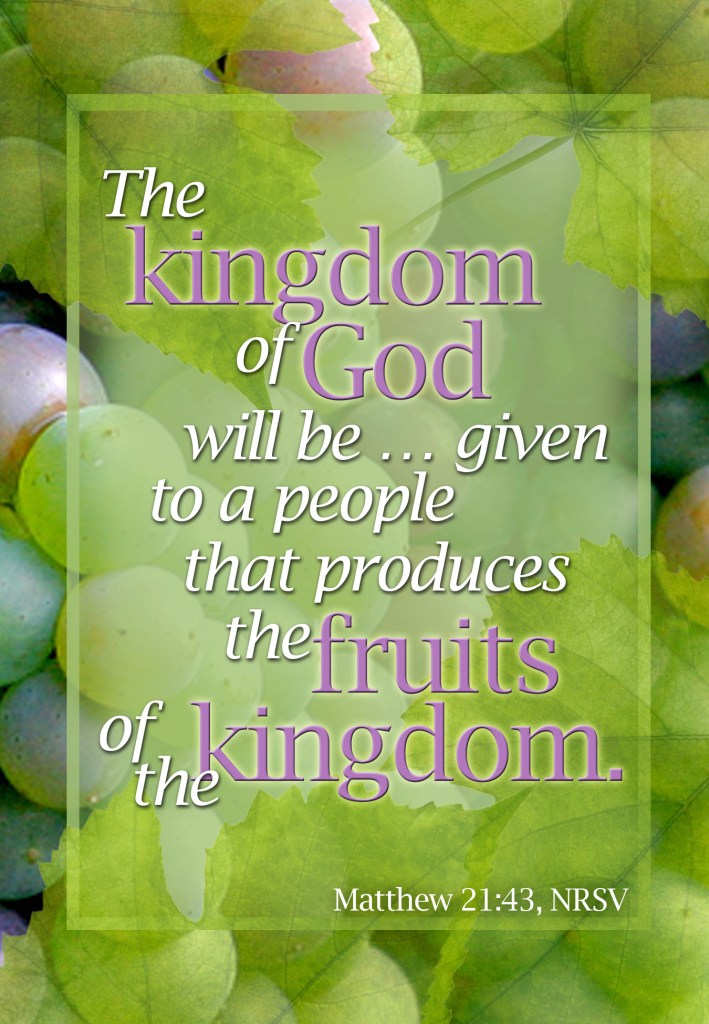
33 [Jesus said], “Listen to another parable. There was a landowner who planted a vineyard, put a fence around it, dug a wine press in it, and built a watchtower. Then he leased it to tenants and went to another country. 34 When the harvest time had come, he sent his slaves to the tenants to collect his produce. 35 But the tenants seized his slaves and beat one, killed another, and stoned another. 36 Again he sent other slaves, more than the first; and they treated them in the same way. 37 Finally he sent his son to them, saying, ‘They will respect my son.’ 38 But when the tenants saw the son, they said to themselves, ‘This is the heir; come, let us kill him and get his inheritance.’ 39 So they seized him, threw him out of the vineyard, and killed him. 40 Now when the owner of the vineyard comes, what will he do to those tenants?” 41 They said to him, “He will put those wretches to a miserable death, and lease the vineyard to other tenants who will give him the produce at the harvest time.” 42 Jesus said to them, “Have you never read in the scriptures: ‘The stone that the builders rejected has become the cornerstone; this was the Lord’s doing, and it is amazing in our eyes’? 43 Therefore I tell you, the kingdom of God will be taken away from you and given to a people that produces the fruits of the kingdom. 44 The one who falls on this stone will be broken to pieces; and it will crush anyone on whom it falls.” 45 When the chief priests and the Pharisees heard his parables, they realized that he was speaking about them. 46 They wanted to arrest him, but they feared the crowds, because they regarded him as a prophet.
Our Psalm Response is a lament and a plea to the Lord, the shepherd of Israel, that the Lord will restore God’s ravaged vineyard.
7 Restore us, O God of hosts; * show the light of your countenance, and we shall be saved.
8 You have brought a vine out of Egypt; * you cast out the nations and planted it.
9 You prepared the ground for it; * it took root and filled the land.
10 The mountains were covered by its shadow * and the towering cedar trees by its boughs.
11 You stretched out its tendrils to the Sea * and its branches to the River.
12 Why have you broken down its wall, * so that all who pass by pluck off its grapes?
13 The wild boar of the forest has ravaged it, * and the beasts of the field have grazed upon it.
14 Turn now, O God of hosts, look down from heaven; behold and tend this vine; * preserve what your right hand has planted.

I regard everything as loss because of the surpassing value
of knowing Christ Jesus my Lord.
Philippians 3:8 NRSV
I regard everything as loss because of the surpassing value of knowing Christ Jesus my Lord. Philippians 3:8
Lord Jesus, you know everything:
you know that I love you.
How could it be otherwise?
For it was you who first loved me,
the unlovely and unlovable,
and died for me, pardoned me
and welcomed me into your family.
Lord, you know everything:
you know that I love you.1
1 Frank Colquhoun, Prayers for today, The Society For Promoting Christian Knowledge (January 1, 1989)
By Jill Y. Crainshaw, Associate Professor and Academic Dean, Wake Forest University Divinity School, Winston-Salem, North Carolina
Nearly two thousand years and incalculable kilobytes of technological innovation stand between Paul’s first-century writings and contemporary readers. People in the United States today are more likely to communicate with friends, relatives, and coworkers, even with people across the globe, by way of blogs, e-mails, or text messages than through hand-scripted, envelope-sealed letters delivered by couriers. Despite differences in communication techniques, however, contemporary believers share with Paul a common goal. We, like Paul, want others to be persuaded when we express the beliefs and values most important to us.
Paul uses a first-century rhetorical form to communicate with Christians in the diverse and busy town of Philippi. Rhetoric is an ancient Greco-Roman art of argumentation and discourse. Paul was a rhetorical artist, crafting letters imprinted with his unique language and distinctive theological ideas. Philippians 3:4b–14 exemplifies Paul’s artistry.
According to biblical scholar Cynthia Briggs Kittredge, the epistle, read as a unified whole, imitates a four-part style common to Greco-Roman letter writing. The exordium (1:1–26) opens the correspondence, introducing the letter’s main themes. Paul expresses gratitude for the community (1:3–5) and speaks poignantly about his current imprisonment and suffering (1:12–14). He also encourages believers at Philippi to continue their gospel work (1:27–28). The narratio (1:27–30) summarizes historical events that prompted Paul to write the letter. The probatio (2:1–3:21), including 3:4b–14, gives examples to support Paul’s call to action. The final part of the letter, the peroratio (4:1–23), recaps the main points and passionately invites readers to say yes to Paul’s challenge.1
In the initial verses of the probatio (2:1–3:4a), Paul features Timothy, Epaphroditus, and Jesus as examples of how to live a gospel-worthy life. Then, in 3:4b–14, Paul uses himself as an example. Following an ancient rhetorical principle, he gives a personal testimony.
Contemporary ears sometimes hear Paul’s autobiographical speech making as arrogance. However, autobiographical arguments were common to the rhetoric of Paul’s time. A speaker’s personal character was considered a valid, even powerful, tool of persuasion. Paul wants readers to know that he has experienced firsthand God’s love in Christ. Paul also wants readers to know that he himself strives to live out the message he preaches. In the minds of first-century readers, Paul’s personal story authenticated his message and gave his voice authority.
Preachers today are sometimes reluctant to follow Paul’s autobiographical example. Perhaps too many know firsthand the pitfalls of being too personally vulnerable in the pulpit. Also, today’s rhetorical milieu differs greatly from that of first-century Philippi. Philippians 3:4b–14 nevertheless stands as a reminder. The proclaimer’s authenticity enlivens and gives credibility to the proclamation. Biblical scholar James W. Thompson puts it this way: “In an era when preaching cannot compete in the communications revolution, the essential quality that is unique to preaching is the authenticity of the preacher.”2
Paul uses personal testimony and other examples to authenticate and energize his call to action. What is that call? Paul encourages the believers at Philippi to hold on to and live out core Christian values. The primary goal of faith, in Paul’s view, is to know or experience Christ. Communal life is to be centered on attaining this ultimate prize. None of the identity markers that say we are people of faith is more important than a community’s heart-centered desire to know and to be like Christ.
Paul skillfully capitalizes on the rhetorical style of his day to communicate gospel values. This is not a new practice. Preachers and faith communities since antiquity have innovatively employed popular communication techniques to proclaim the gospel.
The same is true today. A June 1, 2009 issue of Time magazine tantalized readers with this article headline: “Twittering in Church. Why Some Pastors Are Turning to Microblogging to Bring Congregants Closer to God and One Another.” After appearing on the technological scene in 2006 as a computer designer’s side project, Twitter has transformed the landscape of Internet communication. What makes Twitter unique is that chatters, or “tweeters,” are allowed only 140 characters to speak their minds, share a joke, comment on the news, or report their morning breakfast choices (all of which happen simultaneously on Twitter). People who “tweet” have to make every word count.
A Charlotte, North Carolina, pastor, Todd Hahn, was interviewed for the Time magazine article. Hahn encouraged churchgoers to “tweet” during his Easter Sunday sermon. He wanted worshipers to tell others—coworshipers in the sanctuary and others tweeting across town or in another state—about their experiences with God. He wanted them to tweet their personal testimonies, using 140 characters or less, of course. “It’s a huge responsibility of a church,” Hahn says, “to leverage whatever’s going on in the broader culture to connect people to God and to each other.”
Versions of Hahn’s words can be heard in myriad contemporary discussions about worship practices, preaching techniques, and pastoral leadership styles. What communication practices are most effective for sharing the gospel? Which are most appropriate? How do we decide? Though ancient, Paul’s style and message in Philippians 3:4b–14 may contribute wisdom to these discussions.
Paul makes use of communication techniques familiar to his audience. His letter-writing style both mirrors and expands upon the Greco-Roman forms of his day. Paul’s rhetorical choices, however, take a backseat to what he considers the heart of his message. The primary aim of the life of faith, Paul insists in this letter, is to know Christ. Believers are called first and foremost to pursue and share that “prize” with personal and communal authenticity.
As to whether or not Twitter belongs in worship—about that, we can blog.
1 Cynthia Briggs Kittredge, Community and Authority: The Rhetoric of Obedience in the Pauline Tradition (Harrisburg, PA: Trinity Press Int., 1998), 65–66.
2 James W. Thompson, Preaching Like Paul: Homiletical Wisdom for Today (Louisville, KY: Westminster John Knox Press, 2001), 146.
Source: Feasting on the Word: Preaching the Revised Common Lectionary: Year A, ed. David L. Bartlett and Barbara Brown Taylor, vol. 4 (Louisville, KY: Westminster John Knox Press, 2011).

View or Download the Proper 22A Study Handout
NRSV: Bible Gateway website
Book of Common Prayer (BCP): justus.anglican.org
Introductions to the Readings are from the book Introducing the Lessons of the Church Year, 3rd Ed. (Kindle Edition) by Frederick Borsch and George Woodward.
Image: Communications Resources
Readings and supplemental resources for Proper 21A in the RCL
September 27, 2020 | Pentecost ++17

Collect for Proper 21
O God, you declare your almighty power chiefly in showing mercy and pity: Grant us the fullness of your grace, that we, running to obtain your promises, may become partakers of your heavenly treasure; through Jesus Christ our Lord, who lives and reigns with you and the Holy Spirit, one God, for ever and ever. Amen.~BCP 234
In the Hebrew scripture lesson the Lord insists that individuals are responsible for their own sins and that the people must now repent, no longer blaming their troubles on the sins of their parents
1 The word of the Lord came to me: 2 What do you mean by repeating this proverb concerning the land of Israel, “The parents have eaten sour grapes, and the children’s teeth are set on edge”? 3 As I live, says the Lord God, this proverb shall no more be used by you in Israel. 4 Know that all lives are mine; the life of the parent as well as the life of the child is mine: it is only the person who sins that shall die.
25 Yet you say, “The way of the Lord is unfair.” Hear now, O house of Israel: Is my way unfair? Is it not your ways that are unfair? 26 When the righteous turn away from their righteousness and commit iniquity, they shall die for it; for the iniquity that they have committed they shall die. 27 Again, when the wicked turn away from the wickedness they have committed and do what is lawful and right, they shall save their life. 28 Because they considered and turned away from all the transgressions that they had committed, they shall surely live; they shall not die. 29 Yet the house of Israel says, “The way of the Lord is unfair.” O house of Israel, are my ways unfair? Is it not your ways that are unfair?
30 Therefore I will judge you, O house of Israel, all of you according to your ways, says the Lord God. Repent and turn from all your transgressions; otherwise iniquity will be your ruin.31 Cast away from you all the transgressions that you have committed against me, and get yourselves a new heart and a new spirit! Why will you die, O house of Israel? 32 For I have no pleasure in the death of anyone, says the Lord God. Turn, then, and live.
Paul bids the new disciples to be of one mind in love, knowing how Christ Jesus accepted the condition of a servant and was obedient to the point of death. We now confess him as Lord and are called to an obedient working out of our faith.
1 If then there is any encouragement in Christ, any consolation from love, any sharing in the Spirit, any compassion and sympathy, 2 make my joy complete: be of the same mind, having the same love, being in full accord and of one mind. 3 Do nothing from selfish ambition or conceit, but in humility regard others as better than yourselves. 4 Let each of you look not to your own interests, but to the interests of others. 5 Let the same mind be in you that was in Christ Jesus.
6 who, though he was in the form of God, did not regard equality with God as something to be exploited, 7 but emptied himself, taking the form of a slave, being born in human likeness. And being found in human form,
8 he humbled himself and became obedient to the point of death — even death on a cross
9 Therefore God also highly exalted him and gave him the name that is above every name, 10 so that at the name of Jesus every knee should bend, in heaven and on earth and under the earth, 11 and every tongue should confess that Jesus Christ is Lord, to the glory of God the Father
12 Therefore, my beloved, just as you have always obeyed me, not only in my presence, but much more now in my absence, work out your own salvation with fear and trembling; 13 for it is God who is at work in you, enabling you both to will and to work for his good pleasure.
In a response to a question about authority, Jesus tells a parable of two sons who obeyed their father differently, and he indicates that it is the same with those who are apparently obedient and disobedient in this age.
23 When he entered the temple, the chief priests and the elders of the people came to him as he was teaching, and said, “By what authority are you doing these things, and who gave you this authority?” 24 Jesus said to them, “I will also ask you one question; if you tell me the answer, then I will also tell you by what authority I do these things. 25 Did the baptism of John come from heaven, or was it of human origin?” And they argued with one another, “If we say, ‘From heaven,’ he will say to us, ‘Why then did you not believe him?’ 26 But if we say, ‘Of human origin,’ we are afraid of the crowd; for all regard John as a prophet.” 27 So they answered Jesus, “We do not know.” And he said to them, “Neither will I tell you by what authority I am doing these things.
28 “What do you think? A man had two sons; he went to the first and said, ‘Son, go and work in the vineyard today.’ 29 He answered, ‘I will not’; but later he changed his mind and went. 30 The father went to the second and said the same; and he answered, ‘I go, sir’; but he did not go. 31 Which of the two did the will of his father?” They said, “The first.” Jesus said to them, “Truly I tell you, the tax collectors and the prostitutes are going into the kingdom of God ahead of you. 32 For John came to you in the way of righteousness and you did not believe him, but the tax collectors and the prostitutes believed him; and even after you saw it, you did not change your minds and believe him.”
Our Psalm Response is a prayer for forgiveness and guidance and an expression of trust in the Lord.
1 To you, O Lord, I lift up my soul; my God, I put my trust in you; *
let me not be humiliated, nor let my enemies triumph over me.
2 Let none who look to you be put to shame; *
let the treacherous be disappointed in their schemes.
3 Show me your ways, O Lord, * and teach me your paths.
4 Lead me in your truth and teach me, * for you are the God of my salvation; in you have I trusted all the day long.
5 Remember, O Lord, your compassion and love, *
for they are from everlasting.
6 Remember not the sins of my youth and my transgressions; * remember me according to your love
and for the sake of your goodness, O Lord.
7 Gracious and upright is the Lord; *
therefore he teaches sinners in his way.
8 He guides the humble in doing right *
and teaches his way to the lowly.
Let the same mind be in you that was in Christ Jesus.
Philippians 2:6 NRSV
Eternal God, the light of the minds that know thee, the joy of the hearts that love thee, the strength of the wills that serve thee; grant us, so to know thee that we may truly love thee, so to love thee that we may freely serve thee, whose service is perfect freedom, through Jesus Christ our Lord. Gelasian Sacramentary (7th century)
O gracious and holy Father, give us wisdom to perceive thee, intelligence to understand thee, diligence to seek thee, patience to wait for thee, eyes to behold thee, a heart to meditate upon thee and a life to proclaim thee: through the power of the spirit of Jesus Christ our Lord. Attributed to St Benedict (480–543)
Source: Christopher Herbert, Pocket Prayers: The Classic Collection
(Pocket Prayers Series). Hymns Ancient and Modern Ltd. Kindle Edition.
By Gilberto Collazo, Vice President for Missional Development and Operations, Christian Church (Disciples of Christ), Indianapolis, Indiana
The celebrated pacifist Mohandas Gandhi is reported to have said, “I like your Christ, I do not like your Christians. Your Christians are so unlike your Christ.” He made this observation in the midst of his struggle for justice for a people in the face of the occupation of his native India.
We are called to be imitators of Christ, to live in a way that allows other people to see Christ in us. What is an imitator? There is a great difference between an impersonator and an imitator. Impersonators take great pains to make people believe they are who they are not. On the other hand, imitators are clearly aware that they strive to live up to the challenge of being a reflection of the person they look up to. It is so hard to walk in the footsteps of others. Many younger siblings for years wither in the shadow of an overachieving older sibling, who sets the standard so high that it is a constant frustration to try to be like him or her. We look up to those people in church whom we consider spiritual giants and wonder if we will ever be as spiritual as they appear. At work there is always that coworker who is the top salesperson, who makes us wonder if we really have what it takes to live up to those high standards, no matter how hard we try.
Deep down inside, many of us have the clear understanding that we will fall short of a perfect imitation. That is all right. Ultimately Paul’s admonition is not about impersonating Christ, but about adopting Christlike attitudes in all aspects of our life. When we try to live up to God’s standards on our own, we become impersonators. That is a tall order and an unrealistic expectation on our part, and it is not what God expects of us.
So then, what does it mean to be called a reflection of Christ? This is not a call to perfection but, rather, an invitation to be honest with ourselves and to understand that God is doing something unique and special in each and every one of us. This is God’s challenge for us to live in a manner that is counter-cultural. For example, when we face a national crisis such as a severe economic downturn, do we run around like Chicken Little screaming, “The sky is falling,” or do we reflect Christ by remaining calm and believing God’s promises of provision for our lives? When bad news reaches our ears, do we respond like those who live without faith, or do we reflect Christ by our reactions to the bad news?
For years as a pastor I accompanied many people through their death processes and then helped their families deal with grief and loss. Then it was my turn. I had just turned forty when I suffered my first significant loss. My father had terminal cancer and less than two months to live. The time for my test had come. Would I be a reflection of Christ and face this crisis with faith and peace, or would I give into the ranting, raving accusations against God that I had seen in so many of the individuals that I had accompanied through the loss process?
I did rant and rave. It is one thing to be on the outside looking in, and a completely different experience to find yourself directly impacted by the situation. In the midst of it all, I was able to recognize that God understood that I was human and was losing a father. Through the two final months of my father’s life, God worked in my life, as I allowed the divine presence to do so.
People saw my struggle. Even the members of my church understood I was working through something that was new and painful for me. I could have put on a happy face and hidden my sorrow, but that would have made me an impersonator of Christ. Rather, I admitted that I needed God’s presence in my life in a way I had not known before. I sought God’s presence in ways I had never done before. Some days, like Job, I sparred with God. Other days, I held a negotiation session. There were days when I had nothing to say, because I was so angry at a God who was taking my father, when there were so many others who really should have been called from this world. In the end, I was able to give my father over to God’s presence with tears in my eyes, but with peace in my heart. People would later comment on how I had been a source of comfort to them as they came to support my family and me.
Christian living is a process. God’s timeline for each one of us is unique, and only God knows what the final product is going to look like. We do not expect an instantaneous transformation of our life’s attitudes and actions, but rather an ongoing process of change that results from the ever-growing awareness of our need to be at a different place if we are to be true Christ followers. The process begins with our conscious decision to become reflections of Christ in our actions and reactions to life.
Can the world see Christ in us? Our imitation of him is not about being complacent and well behaved. As the United States deals with immigration issues, many churches have once again declared themselves to be sanctuaries for all who need a safe place. I see Christ in the actions of these faith communities. Allowing the world to see Christ in us means that we are willing to step up to our prophetic role in the world. Can people see Christ in you?
When times get difficult, when injustices are prevalent among the people, when a word of hope is needed, let us pray that all can see Christ in us—for that is our calling: to be imitators, and not impersonators, of Christ.
Source: Feasting on the Word: Preaching the Revised Common Lectionary: Year A, ed. David L. Bartlett and Barbara Brown Taylor, vol. 4 (Louisville, KY: Westminster John Knox Press, 2011).
1 If then there is any encouragement in Christ, any consolation from love, any sharing in the Spirit, any compassion and sympathy, 2 make my joy complete: be of the same mind, having the same love, being in full accord and of one mind. 3 Do nothing from selfish ambition or conceit, but in humility regard others as better than yourselves. 4 Let each of you look not to your own interests, but to the interests of others. 5 Let the same mind be in you that was in Christ Jesus. (Philippians 2:1-5)
Q. Who are the ministers of the Church?
A. The ministers of the Church are lay persons, bishops, priests, and deacons.
Q. What is the ministry of the laity?
A. The ministry of lay persons is to represent Christ and his Church; to bear witness to him wherever they may be; and, according to the gifts given them, to carry on Christ’s work of reconciliation in the world; and to take their place in the life, worship, and governance of the Church.
Almighty God our heavenly Father, you declare your glory and show forth your handiwork in the heavens and in the earth: Deliver us in our various occupations from the service of self alone, that we may do the work you give us to do in truth and beauty and for the common good; for the sake of him who came among us as one who serves, your Son Jesus Christ our Lord, who lives and reigns with you and the Holy Spirit, one God, for ever and ever. Amen. ~BCP 261
View or Download the Proper 21A Study Handout
NRSV: Bible Gateway website
Book of Common Prayer (BCP): justus.anglican.org
Introductions to the Readings are from the book Introducing the Lessons of the Church Year, 3rd Ed. (Kindle Edition) by Frederick Borsch and George Woodward.
Image: Communications Resources
This is the online/on-demand service for the Eleventh Sunday After Pentecost (August 16, 2020)
Please join us on the Way (any time and anywhere via the internet) as we hear what the Spirit is saying in the appointed scripture readings, offer prayers for others and for ourselves, and join in singing (at home) for spiritual nurture and for God’s glory.
View or download the Service Bulletin
More of the story is posted on the Wind in the Pines blog maintained by St. Hugh’s Episcopal Church in Idyllwild, CA. View the post.
A Wind in the Chimes meditation
Almighty God, the fountain of all wisdom, you know our necessities before we ask and our ignorance in asking: Have compassion on our weakness, and mercifully give us those things which for our unworthiness we dare not, and for our blindness we cannot ask; through the worthiness of your Son Jesus Christ our Lord, who lives and reigns with you and the Holy Spirit, one God, now and for ever. Amen.
Collect for Proper 11, Book of Common Prayer, 1979, p. 231
This is a short meditation on the Collect for Proper 11 (July 19, 2020). It is my invitation to you to take the names and descriptions of God as your own prayer-starter or meditation. Listen also to our requests of God: “… have compassion on our weakness … mercifully give us (good, useful, helpful, wise gifts) those things which for our unworthiness (what does that admission do to you?) we dare not ask, and for our blindness (what are you not seeing?) cannot ask.”
“The Collect: An Anglican/Episcopal Treasure” is a very fine description of this prayer form by C. Frederick Barbee and Paul F. M. Zahl in their book, The Collects of Thomas Cranmer.
Wind Chimes: September 25 2012 (an introduction)
Wind in the Chimes (renaming and reintroduction Wind Chimes, 7/21/20)
Wind Chimes is being reborn as Wind in the Chimes.
In the time of the coronavirus it seems opportune to revisit and rename Wind Chimes—for a short time it was a regular feature of this Blog.
In the original post I wrote:
When a wind chime catches the wind (even the whisper of a wind) it makes music, it interprets the wind in ways that are always the same and always changing. In regular posts I will share links to news (religion news), reflections and meditations (related to our Sunday readings as often as possible), prayers or prayer starters, resources to help you keep learning and growing (spiritually), and whatever else I come across.
Wind Chimes posted September 25, 2012 on Hear what the Spirit is saying
Renamed “Wind in the Chimes” the intent remains the same: to help us better hear what the Spirit is saying.
Generally acknowledged as Russia’s greatest iconographer, Andrei Rublev was born around 1365 near Moscow. His “writing” persists to this day.

Generally acknowledged as Russia’s greatest iconographer, Andrei Rublev was born around 1365 near Moscow. While very young he entered the monastery of The Holy Trinity and in 1405, with the blessing of his igumen (the Orthodox equivalent of abbot), he transferred to the Spaso-Andronikov monastery where he received the tonsure and studied iconography with Theophanes the Greek and the monk Daniel. Among his most revered works are those in the Dormition Cathedral in Vladimir.
The icon (“image” in Greek) is central to Orthodox spirituality. It finds its place in liturgy and in personal devotion. An icon is two dimensional and despite being an image of someone it is not a physical portrait. Western art, especially since the Renaissance, has sought to represent figures or events so that the viewer might better imagine them. A western crucifix seeks to enable us to imagine what Golgotha was like. Icons seek to provide immediate access to the spiritual and the divine unmediated by the human, historical imagination. Read more
Holy Women, Holy Men
Holy God, we bless you for the gift of your monk and icon writer Andrei Rublev, who, inspired by the Holy Spirit, provided a window into heaven for generations to come, revealing the majesty and mystery of the holy and blessed Trinity; who lives and reigns through ages of ages. Amen.
Today’s Collect simply give thanks for “the gift of …monk and icon writer Andrei Rublev.” As we view his writing, and the writings of others in icons throughout the Church, let us always give thanks for the gift of individuals with a wonderful talent to open the heavens for us. ~Fr. Dan
A prayer for guidance in the work we do. Promoting the common good.

Remembering our story

In the late sixteenth century, Sir Walter Raleigh established three colonies along the northeastern coast of what is now the state of North Carolina. In July 1587, the third and final settlement, consisting of 120 men, women, and children under the leadership of John White, landed on Roanoke Island, near the present-day community of Nags Head.
With the colonists was Manteo, a Native American of the Algonquian nation and resident of Croatoan who had traveled to London in an earlier expedition to become a liaison between the English and the Native Americans. On August 13, 1587, Manteo was baptized, the first recorded baptism of the Church of England in the American colonies and the first recorded baptism of a Native American person in the Church of England. Read more
Holy Women, Holy Men
O God, you have created every human being in your image and each one is precious in your sight: Grant that in remembering the baptisms of Manteo and Virginia Dare, we may grow in honoring your gift of diversity in human life; become stronger in living out our baptismal vow to respect the dignity of every human being; and bring into the fellowship of the risen Christ those who come to him in faith, baptizing them in the name of the Father, and of the Son, and of the Holy Spirit. Amen.
As God answers our prayer may we well and truly “become stronger in living out our baptismal vow to respect the dignity of every human life.” ~Fr. Dan

 Hear what the Spirit is saying