What have you learned by “seeing” the Gospel?

Several weeks ago Hovak talked about the Good Shepherd (Tiffany) Window that fascinated him growing up. Grace Episcopal Church in Port Orange, FL has maintained the window over the years. We are awaiting some pictures of the 2 Tiffany Windows in their original church. As if our conversation was overheard this article appeared recently in the Episcopal News Service:

[Diocese of Southern Ohio] Four rare Tiffany stained glass windows have a new home: the Cincinnati Art Museum will unveil them this month as part of a new and permanent exhibit.The windows, badly in need of repair and conservation, were removed in 2010 from the former St. Michaels & All Angels church in urban Cincinnati and sold to the art museum. Proceeds supported the founding of a community ministry that is now housed at the Avondale facility. Gabriel’s Place seeks to encourage community-based enterprise. The urban center operates a community garden and kitchen, as well as a hoop house that provides fish and fresh produce for local businesses and residents.

via New life, light for Tiffany windows.

Read the whole article to find “Poor Man’s Bible.” Again, to reinforce what we have said, and part of the reason for our posts in the Art & Music category we read:

“While colored glass dates to ancient times, stained glass as a form of art and storytelling became prominent in the Middle Ages. A largely illiterate population could learn about the stories of the Bible from the illustrations in the stained glass windows. Some have called these windows the “Poor Man’s Bible,” because they, along with carvings, paintings and mosaics, could translate the narratives of the Bible to a population that couldn’t read.”

Again, your are invited to read the whole article, including this instructional piece: New life, light for Tiffany windows.

Your comments are always welcome. Have you ever seen a Tiffany Window up-close? Do you have a sculpture, carving, painting, or mosaic that has sustained or inspired your faith? Please share.

The Feast Of The Annunciation, March 25 (celebrated March 26, 2012)

VASARI, Giorgio
(b. 1511, Arezzo, d. 1574, Firenze)
Click to open Web Gallery of Art Artist Biography and to explore other works by this artist.

Annunciation
1570-71
Oil on poplar panel, diameter 157 cm
Móra Ferenc Múzeum, Szeged
Click to open Web Gallery of Art commentary page. Click image again for extra large view.


Annunciation
1570-71
Pen and wash, squared with black chalk, diameter 133 mm
Pierpont Morgan Library, New York Click to open Web Gallery of Art commentary page. Click image again for extra large view.

Separated, misidentified and now united by scholarship.

Annunciation, oil on panel (1570-71), Giorgio Vasari (1511-1574)

by Hovak Najarian

During the High Renaissance of the late fifteenth century, men such as Leonardo da Vinci and Michelangelo had what seemed to be unlimited skills.  The term Renaissance man is used even today to designate a person with knowledge and impressive skills in several disciplines.  Although Giorgio Vasari was born in the early sixteenth century and missed being a part of the High Renaissance he was a person with a wide range of interests and skills.  In that respect he was very much like the generation before him.  Today, however, he is remembered primarily for his architecture and the biographies he wrote about Italian artists; his paintings have lost favor.

The art between the High Renaissance and the Baroque period – starting near the end of the sixteenth century – is not clearly defined; for lack of a better term, historians have called it “Mannerism.” Artists of this period painted in a variety of styles; some of it expanding on or “in the manner” of Renaissance ideas and others tending toward an anti-classicism.  Often there would be exaggerated perspective, dramatic lighting, and an absence of the statuesque poses that were part of Renaissance painting.  Vasari’s Annunciation was painted during the latter part of the Mannerist period and like the work of Raphael, his figures are classical both in the carefully delineated contours and in their faces.  Yet, Mary’s pose and that of the angel Gabriel are in keeping with the theatrical presentation found in Mannerist painting.

In Vasari’s preparatory ink and wash study we can see he modified his original idea when he made his painting.  In the study, Mary is at a reading table (at the bottom center of the drawing) with her finger on a book and there is surprise on her face as though this is the moment when she looked up and realized she had a visitor.  In the painting, the book has been shifted out of the way to a stand on the far left side (Mary’s right side) and her extended left hand is now simply making a graceful gesture.  Her face is slightly downward and her eyes are downcast to indicate she is within herself in this serene moment.  In both the study and the painting, her right hand is on her heart.  Gabriel is hovering nearby with arms folded.  In his hand he is holding a lily, the symbol of purity.

Symbols were used widely in the art of ancient cultures and many of them were carried over into Christianity.  Halos (or a comparable glow) and wings were incorporated into Christian art as early as the third century.  The Bible does not say angels had wings but artists added them; now they are standard identifying features.  Unlike the large gold-leafed halos of the fourteenth century, Vasari’s Mary is given a delicate transparent circle.  She is dressed in the colors blue and red; both are muted in tone.  Blue represents heavenly grace and red symbolizes the Holy Spirit.  In paintings, Mary often is dressed in blue.  Gabriel is clothed in yellow and white; yellow represents light and white represents purity, innocence, and virginity.

In Christian art, figures in a painting often exist in a different reality where the source of illumination is not sunlight or artificial light but rather a light that emanates from a holy figure such as Christ.  In Vasari’s Annunciation, the light source is the dove representing the Holy Spirit.

Vasari worked consistently for wealthy patrons and a painting such as the Annunciation was not made for working class people.  Like much of the art of the High Renaissance and the Mannerist period, it was painted to be “fine art” for a sophisticated audience.

______________
© 2012 Hovak Najarian

The mural and the fresco

Editor’s Note: Hovak Najarian, Art History Professor Emeritus from College of the Desert, will begin to help us understand the art that informs our faith and understand the faith that informs our art. In our lectionary on Sunday we read from Numbers 21:4-9. Michelangelo’s fresco the Brazen Serpent, from the ceiling of the Sistine Chapel, opens up this scene from the Exodus. Enjoy the art, enjoy this background to the art. Keep learning.

Become more familiar with often encountered terms:

Mural:  A mural is a large work of art that is usually created directly on a large architectural surface.  The murals on the ceiling of the Sistine Chapel often are referred to as “ceiling frescos” because the fresco process was used to paint them.  In the same manner, critics often refer to an oil painting simply by its medium, “oil,” but all paintings are not oils and all murals are not frescos  The terms mural and fresco are not synonymous.  Mural identifies a work’s category (the type of work that it is) and fresco refers to its medium (the material that is used to make it).

Fresco: In the fresco process, an artist paints directly on wet plaster with water based pigments.  Before painting begins, a plasterer covers an area of a wall (or ceiling) according to an estimate of how much the artist believes can be painted before the plaster sets.  While the plaster is still moist, the pigment is absorbed into its surface and when it is set the pigment becomes an integral part of it.  The pigment is not on the wall or ceiling, it is within its surface.

If a plastered area has set before it can be painted it is no longer capable of absorbing pigment and must be chipped off.  A fresh area of plaster is spread on the wall before work continues.  The removal of plaster is done along a contour of a figure in order that a seam is not apparent.  This procedure is repeated until the mural is completed.  It is a time consuming and messy process and is seldom used now unless a particular effect is desired.  Michelangelo worked on the ceiling frescos of the Sistine Chapel from 1508 to 1512 AD.

Sistine Chapel: This chapel is named “Sistine” because it was Pope Sixtus who had it restored in the latter part of the fifteenth century.

______________
© 2012 Hovak Najarian

Come into the wilderness a place of promise and hope

FROM THE ARCHIVES…

Note: From 1999-2003 Stan Hirsch facilitated the Sunday Morning Forum. He collected a wealth of information. To my delight he archived the material. In the weeks to come we’ll mine this archived material for Supplemental information on our work in the Year B Lectionary. Since space is not restricted, I may add to the original material from time to time. I encourage you to follow the links when given. Come back often, go exploring, keep learning. ~dan

Mark 1:9-13

Quote . . .Lent is a season of great hope, a season of movement into the loving embrace of our Father.

Lent is a time when we are put in mind that we live today in the Kingdom of God, as we shed the distractions in order to see the reality of God’s presence with us. But Lent also is the season that is most usually symbolized by the word “wilderness.” Wilderness always comes across as an unpleasant place, but it is a very frequent setting in Scripture…

The good news about Lent and the wilderness is that it is a time for formation and reformation. It is a time when we can be formed as a people of God and it is a time when we can be renewed in our commitment to Christ…

We are reminded too in the Gospel today that Jesus was not driven into the wilderness by Satan, he was driven there by the Holy Spirit. And at the end we are told that angels ministered to him. The wilderness is not a bad place. It is a place of great promise and hope. It is a place for stripping away of all the old dependencies that tear us down and coming to grips with total reliance on God—a God who loves us and wants for us freedom and prosperity, a God of plenty, a God of love. The route through the wilderness leads us from an unsatisfying life to a life of abundance. But if you are like me, you would just as soon avoid the wilderness because leaving the familiar, leaving the known, leaving the predictable, for unpleasant thoughts, wrestling with what we fear is an altogether inadequate faith to guide us through. We want to avoid the wilderness because it means we have to struggle with hard choices. Choices of temptation. It would be so much easier if we were simply animals of instinct and did not have to make choices. But if we were, we would never be able to embrace each other in love. Nor would we be able to embrace our God with love.

…The wilderness is a place of movement to good. When we go there in the Lenten season, we face the demons of insecurity and time pressures. We face our own demons of hypertension and self-doubt. We also know that we are moving towards Easter, the resurrection and the presence with God. [1]


[1] February 21, 1999, Lent — A Season of Hope, The Rev. Dr. Robert G. Certain

 Image: From the internet–http://travelerstrails.com

Make room (and time) for Lent

Lenten Meditations from the desert

“A traditional view of Lent is that it’s a time of restriction, sacrifice, and giving up things. But it can also be a time for expansion, rededication, and connection with others. Many people take on special devotional practices during Lent; others also make more time during this season to be in conversation with their spiritual communities.”Spirtuality & Practice email dated Feb. 18, 2012

Expand your mind and heart with the folks of St. Margaret’s this Lent, rededicate yourself to following Jesus Christ, find a connection with those you work with, socialize with and with whom you worship. Forty members of St. Margaret’s have each written a meditation for one of the days of Lent. We invite you “to observe a holy Lent” with us:

Three ways to receive the daily Lenten Meditations

  1. Go daily to the St. Margaret’s website and click the image to see the meditation of the day. This banner will be visible throughout Lent.
  2. “Follow” the Lenten Meditations blog (on WordPress) by using the Follow button in the right side bar (or at the bottom of blog page).
  3. Bookmark the Lenten Meditations blog in your browser and, in the 40 days of Lent, use the bookmark to go back to the blog where you will find a new meditation each day.

divider line

About the image: a close up of Ocotillo flowers taken in the Santa Rosa Mountains above Palm Desert in March 2005 by Stan Shebs and posted on Wikimedia Commons.

Candlemas Day is about … ?

On February 2nd we annually recall the Prestation of our Lord in the Temple. Here is an excellent summary of the commemoration (with some additional links).

Painting of Simeon meeting Mary and the Baby Jesus in the Temple.

Counting forward from December 25 as Day One, we find that Day Forty is February 2. A Jewish woman is in semi-seclusion for 40 days after giving birth to a son, and accordingly it is on February 2 that we celebrate the coming of Mary and Joseph with the infantJesus to the Temple at Jerusalem to offer sacrifice, both on behalf of Mary and on behalf of Jesus as a first-born male. As they did so, they were greeted by the aged Simeon.

In a Sunday-School pageant I once saw, the narrator said, “And now Simeon bursts into a spontaneous song of praise, assisted by the Temple Choir.” His song, called the Nunc Dimittis, has always had a prominent role in Christian worship. It has often been rendered in verse. [ … ]

On the other hand, Groundhog Day (“If the groundhog (or woodchuck, a kind of marmot, which burrows and hibernates) sees his shadow on 2 February, there will be six more weeks of winter.”) is strictly a secular holiday, confined, as far as I know, to the United States.

written by James Kiefer for Daily Prayer

A short history of Candlemas Day (also from Daily Prayer for Feb 2nd)

By the seventh century it had become the custom to begin the worship service on February 2 with candlelighting by the congregation gathered outside the worship area followed by a procession into the Church with all carrying their lighted candles. This was to relive Simeon’s experience of meeting the “light of nations” at the temple. The pastor Sophronius wrote in that century

Everyone should be eager to join the procession and to carry a light.

Our lighted candles are a sign of the divine splendor of the one who came to expel the dark shadows of evil and to make the whole universe radiant with the brilliance of his eternal light. Our candles also show how bright our souls should be when we go to meet Christ.

So let us hasten to meet our God.

The custom of beginning the worship on this festival with a candlelight procession is the origin of the day’s other name, “Candlemas.”

The festival day’s position at midwinterexactly midway between the winter solstice December 21 or 22 each year in the Northern Hemisphere, and June 20 or 21 in the Southern Hemisphere. and the spring equinox the day when daylight lasts for exactly 12 hourscaused it to be a time for taking inventory of one’s winter supplies. One English poem goes:

The provident farmer on Candlemas Day,

Hath half of his fires and half of his hay.

The day’s emphasis on light and life at midwinter gave rise to many superstitions and legends. Some believed that “if the day be clear and sunshiny, it portends a hard weather to come; if cloudy and lowing, mild and gentle season ensuing.” From that piece of weather folklore it is not too difficult to understand how our Pennsylvania Dutch descendants of Germanic peoples who emigrated to the United States (primarily to Pennsylvania), from Germany, Switzerland and The Low Countries prior to 1800 legend of Groundhog Day began.

By the seventeenth century the Presentation of Our Lord was understood to be the absolute end of the Christmas season. Indeed, Ash Wednesday the first day in the season of Lent can follow as early as just two days later on February 4. As the end of the Christmas festivities, it was the day to complete the removal of all the holiday decorations. This, too, became the cause of superstition:

Down with Rosemary, and so

Down with Bays and Mistletoe;

Down with Holly, Ivy, all

Where with ye drest the Christmas Hall;

That to the superstitious find

Not one least Branch there left behind

For look, how many leaves there be

Neglected there, maids, trust to me,

So many goblins you shall see.

(sheet music and links to audio)

via Morning Prayer.

Teaching with humor

FROM THE ARCHIVES…

Note: From 1999-2003 Stan Hirsch facilitated the Sunday Morning Forum. He collected a wealth of information. To my delight he archived the material. In the weeks to come we’ll mine this archived material for Supplemental information on our work in the Year B Lectionary. Since space is not restricted, I may add to the original material from time to time. I encourage you to follow the links when given. Come back often, go exploring, keep learning. ~dan

Jonah is unique among the prophetic books. No kidding.

Quote . . .Jonah is unique among the prophetic books. Jonah himself is never called a prophet in the text. The book contains no collections of oracles in verse against Israel and foreign nations but presents a prose narrative about the prophet himself. Instead of portraying a prophet who is an obedient servant of the LORD, calling people to repentance, it features a recalcitrant prophet who tries to flee from God and his mission and sulks when his hearers repent.

The principal figure of this deceptively simple story is presumably based on an obscure Galilean prophet from Gath‐hepher who counseled Jeroboam II (788–747 BCE) in a successful conflict with the Syrians (2 Kings 14.25 ). The author of the book of Jonah apparently drew upon legends that had collected about this prophet and put them to new use in a brief story that contains elements of folktale, fable, satire, and allegory. The two parts of the story, chs 1–2 and 3–4 , are united by their central character (Jonah), a similar plot (the ironical conversion of foreigners to faith in the LORD), and an identical theme (the breadth of God’s saving love). The influence of Jeremiah and Second Isaiah in the text suggests that the author probably lived in the postexilic period. Although the linguistic evidence is indecisive, a date in the fifth or fourth century BCE is plausible.

The book of Jonah is also uncharacteristic, when compared to other writings in the prophetic tradition, in its use of humor to make its points. Humorous qualities, such as exaggerated behavior (running away from God, 1.3 ); inappropriate actions (sleeping through a violent storm, 1.5 ); outlandish situations (offering a prayer of thanksgiving from inside a fish’s belly, 2.1 ); ludicrous commands (animals must fast and wear sackcloth, 3.7–8 ); and emotions either contrary to expectation (anger at mercy, 4.1–2 ) or out of proportion (being angry enough to die because a plant has withered, 4.9 ) appear throughout the story. But all of these qualities serve to underline the book’s themes. (Pointer added by dan)

Repentance and deliverance are the dominant themes in the story of Jonah, reflected in its use in the New Testament (Mt 12.38–41; Lk 11.29–32 ) and as the afternoon Prophetic Bible reading on the Jewish holy day of Yom Kippur (the Day of Atonement). With skill and finesse this little book calls Israel to repentance and reminds it of God’s extravagant mercy and forgiveness (Ex 34.6; Joel 2.13 ). In spirit, therefore, the book justifies its place in the Book of the Twelve Prophets. 

Coogan, Michael D. . “Jonah.” In The New Oxford Annotated Bible. Oxford Biblical Studies Online, accessed (anew) 23 Jan 2012

 Image: From the internet–http://travelerstrails.com

What can happen when the prophet is heard…

From Sunday’s (1/22/12) Forum handout:

Quote . . .Jonah is a prophet, but he is unlike any other for whom a book is named in the Old Testament. Some (e.g. Jeremiah) heard the word reluctantly but then fully embraced the ministry to which God called them, but Jonah tries his best (and his worst!) to avoid doing God’s will: he is a caricature of a prophet. The book opens with God’s call to Jonah: “Go at once to Nineveh … and cry out against it; for their wickedness has come up before me.” Jonah’s reaction is to try to escape God’s presence. When called a second time, he does travel to the capital of Assyria, and its residents repent of their waywardness. A message of this book is that God does care about other peoples, even those who are Israel’s enemies.

Obviously this is a story, but it is one that teaches; it is a parable. It illuminates an issue of its time, the waywardness of Israel. God is central and powerful. He can favour whomever he chooses, even hated enemies of the past.

Chris Haslam, Revised Common Lectionary Commentary
http://montreal.anglican.org/comments/bpr03m.shtml

Note: a link to this Commentary is provided on our Blog (click on “Commentaries” in the right sidebar). Both Stan and I have made and continue to make use of this resource in our Bible studies; thank you Chris Haslam.

3 nuggets to enrich your reading of Mark’s Gospel. Are they golden?

FROM THE ARCHIVES…

Note: From 1999-2003 Stan Hirsch facilitated the Sunday Morning Forum. He collected a wealth of information. To my delight he archived the material. In the weeks to come we’ll mine this archived material for Supplemental information on our work in the Year B Lectionary. Since space is not restricted, I may add to the original material from time to time. I encourage you to follow the links when given. Come back often, go exploring, keep learning. ~dan

Nugget 1. Rend, rent, rending … consider this:

“…‘O that you would rend the heavens and come down!’ These words of Isaiah 64:1 may have influenced Mark’s choice of language here: Jesus ‘saw the heavens rent open’ (1:10). This a very graphic way of doing christology. In Jesus there is a meeting of the God sphere and the human sphere…”

“First Thoughts on Year B Gospel Passages in the Lectionary: The Baptism of Jesus,”  by William Loader, Murdoch University, Uniting Church in Australia, 1999. http://wwwstaff.murdoch.edu.au/~loader/MkBaptism.htm (Checked 7 Jan 2012)

Nugget 2. A literary device used by the author of Mark?
“The Heavenly Veil Torn: Mark’s Cosmic ‘Inclusio’ ”

Mark did indeed imagine a link between the tearing of the heavens and the tearing of the temple veil– since we can now see that in fact in both cases the heavens were torn–and that he intentionally inserted the motif of the “tearing of the heavenly veil” at both the precise beginning and at the precise end of the earthly career of Jesus, in order to create a powerful and intriguing symbolic inclusio…”

by David Ulansey. [Originally published in Journal of Biblical Literature 110:1 (Spring 1991) pp. 123-25] http://www.well.com/user/davidu/veil.html (Updated 7 Jan 2012)

Nugget 3. One answer (disputed, we’re Episcopalians after all) to the question of the authorship of the Gospel according to Mark (the Gospel account of Year B in the Revised Common Lectionary)

Note: Eusebius wrote c. 320-330 CE. Scholars writing today have to take into account this work from our church history. Agreeing or disagreeing, they must account for this testimony of Eusebius (who is quoting the Presbyter John and Papias and more on that in a later post).

Quote . . .Papias gives also in his own work other accounts of the words of the Lord on the authority of Aristion who was mentioned above, and traditions as handed down by the presbyter John; to which we refer those who are fond of learning. …

“This also the presbyter said: Mark having become the interpreter of Peter, wrote down accurately, though not in order, whatsoever he remembered of the things said or done by Christ. For he neither heard the Lord nor followed him, but afterward, as I said, he followed Peter, who adapted his teaching to the needs of his hearers, but with no intention of giving a connected account of the Lord’s discourses, so that Mark committed no error while he thus wrote some things as he remembered them. For he was careful of one thing, not to omit any of the things which he had heard, and not to state any of them falsely.” These things are related by Papias concerning Mark.

The Church History of Eusebius. Fourth Century Book III Chapter XXXIX nn 14-15. The Writings of Papias. http://www.ccel.org/ccel/schaff/npnf201.iii.viii.xxxix.html (Updated 7 Jan 2012)

 Image: From the internet–http://travelerstrails.com

More importantly, what does it mean to you?

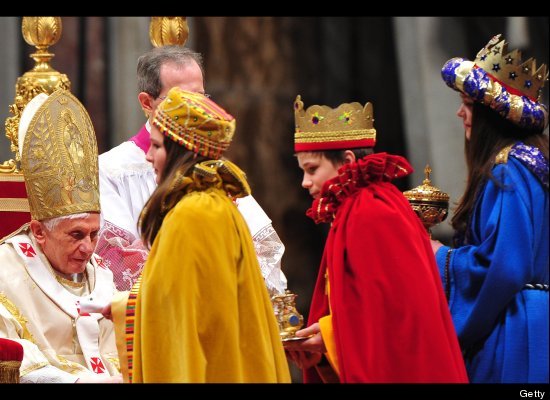
Youths dressed as the three Kings greet Pope Benedict XVI as celebrates the solemnity of Mary the Mother of God mass and the 45th World Day of Peace on Jan. 1, 2012 at the Vatican basilica.

Epiphany. Well, what does it mean to you? What’s the big deal about Epiphany? Decide for yourself.

Here is the “official” description of Epiphany shared by our Episcopal Church in its book Holy Women, Holy Men:

The name “Epiphany” is derived from a Greek word meaning “manifestation” or “appearing.” Anglican Prayer Books interpret the word with an alternative title, “The Manifestation of Christ to the Gentiles.” The last phrase, of course, is a reference to the story of the Wise Men from the East.

A Christian observance on January 6 is found as early as the end of the second century in Egypt. The feast combined commemorations of the visit of the Magi, led by the star of Bethlehem; the Baptism of Jesus in the waters of the River Jordan; and Jesus’ first recorded miracle, the changing of water into wine at the marriage of Cana of Galilee—all thought of as manifestations of the incarnate Lord.

The Epiphany is still the primary Feast of the Incarnation in Eastern Churches, and the three-fold emphasis is still prominent. In the West, however, including Anglican Churches, the story of the Wise Men has tended to overshadow the other two events. Modern lectionary reform, reflected in the 1979 Prayer Book, has recovered the primitive trilogy, by setting the event of the Baptism as the theme of the First Sunday after the Epiphany in all three years, and by providing the story of the Miracle at Cana as the Gospel for the Second Sunday after the Epiphany in Year C.  Page 158

Here is another write up that we can discuss in the Sunday Morning Forum. As you will see, I/we might dispute some of what is written here:

Epiphany — which is variously known as Theophany, Three Kings Day and El Dia de los Tres Reyes — is a Christian celebration of the revelation of the birth of Jesus to the wider world. This is embodied most in the story of three wise men visiting a newborn Jesus with gifts, found in the Gospel of Matthew 2:1-12. Read the article and view more images of Epiphany.

I encourage you to view the pictures that accompany the article (above) about Epiphany. There is no disputing that the Feast is observed and celebrated these thousand of years later in ways to capture the imagination and the heart.