Trinity Sunday Year A

Art and Faith on Trinity Sunday

The Creation of Adam

The Creation of Adam (detail from the Sistine Chapel ceiling),
fresco, 1508-12, Michelangelo, 1475-1564

Commentary by Hovak Najarian

“A picture is worth a thousand words,” is a much-quoted statement that sometimes is attributed to Confucius, but this observation is neither completely true nor oriental in origin. The quote originated in America and gained attention from commercial advertising in the 1920s. In some instances a picture or schematic image may be clearer than a complex verbal description, but there are times also when ideas found in words are impossible to illustrate by means of art. The creation story in the Book of Geneses is far less than a thousand words, yet a single painting cannot depict adequately all of the events contained in the narrative.

When artists depict subject matter from the creation, they tend to select the more dramatic events. Michelangelo’s ceiling of the Sistine Chapel excludes the third day when grass, herbs and trees were created, and omits the fish and fowl that were created on the fifth day. The frescos begin with God separating light from darkness and is followed by the separation of water from the land. In the third panel God is shown creating the sun, moon and planets. The well-known fourth panel depicts the moment God gave life to Adam.

In, The Creation of Adam, Adam is reclining on the earth in the relaxed manner of Roman river gods. His left forearm is resting on a knee and his hand is extended as God reaches into the empty space that separates them. They do not touch but there is a sense that in the small space between their fingers, the spark of life, like an electrical arc, has been passed from God to Adam.

An oval shaped cloak serves as a backdrop for God and he is surrounded by figures. It is in our nature as humans to make connections and project meaning onto things we see. A long-standing belief is that the woman in the crook of God’s left arm is Eve. Because God’s hand is touching a child that is next to the woman, however, it has been suggested recently that she may be the future Virgin Mary and the child is Jesus.

Much has been written about what Michelangelo was attempting to communicate in this painting and most of it is speculation. When an imaginative medical student saw, The Creation of Adam, the cloak and figures around God, brought to mind the shape of a human brain. From this, he thought it was possible that Michelangelo was intending to indicate symbolically that while life was being given to Adam, the gift of intellect also was being bestowed. This interpretation has captured the fancy of people who look for secret meanings. The suggestion that intellect was being given to Adam is repeated now even by tour guides at the Sistine Chapel. There is no incontrovertible evidence that a cryptic message was placed in this painting.

Hovak Najarian © 2017

“He ascended into heaven…”

Visualizing the Ascension of Jesus.

While Jesus was going and [the apostles] were gazing up toward heaven, suddenly two men in white robes stood by them. They said, “Men of Galilee, why do you stand looking up toward heaven? This Jesus, who has been taken up from you into heaven, will come in the same way as you saw him go into heaven.” Acts 1:10-11 NRSV

Master of the Rabbula Gospels, The Ascension, 586

The Ascension of Christ, illumination on parchment, 6th century,
Master of the Rabbula Gospels.

Commentary by Hovak Najarian

During the sixth century, artists were approximately eight hundred years away from being able to create pictorial depth through linear perspective. In addition to technical limitations, artists faced decisions about how Jesus would be depicted and how angels would fly. How would a person’s inner light be represented? Creating a composition required decisions as well; how was it to be organized?

Pictorial depth in, The Ascension of Christ, an illuminated Syriac Gospel Book, is limited. The figures are standing at ground level like relief sculpture and the composition is balanced in bilateral symmetry. The right and left side of the painting balance each other equally and Mary with a halo and blue robe is at the center. Her arms are uplifted in prayer. Byzantine royalty often wore blue robes and by the sixth century, the color blue, representing heavenly grace among other symbolic associations, had been adopted as the color by which Mary, “Queen of Heaven,” would be identified. Uplifted arms while in prayer was a gesture used by early Christians and continues today in some Pentecostal and charismatic churches. Except for the angels and Mary, most of the figures are looking upward at Jesus.

As Christ was ascending, two men in white robes appeared. Each is depicted as an angel with wings and a halo. Angels in the Bible were not assigned wings but artists reasoned they would need them in order to fly. The angel on the left of Mary is looking at Paul (identified by a long dark beard and bald forehead) and is pointing upward at the ascending Jesus. Paul was not a follower of Jesus at the time of the ascension but was brought in by way of, “artist’s license.” The angel on the right is talking to the white-bearded Peter. They, and the others, are being told Jesus “…will come in the same way as you saw him go into heaven.”

In the sixth century, Christ’s ascension was depicted in various ways; one was not to have his body in the picture at all. Only his feet and the hem of his robe would be shown as he entered clouds above. Sometimes only his feet remained in the picture. In another approach, Jesus would move upward by climbing a mountain.

In his journey heavenward, Jesus is surrounded usually by a glowing light or is encompassed, as here, by a full body halo known as a mandorla. In the above depiction, two angels are holding the mandorla to assist Jesus in his ascent while two other angels are moving upward bearing crowns. Jesus is standing within the mandorla with his hand raised in a final blessing to those who have gathered below. The biblical account of Ezekiel ascending to heaven on a chariot was familiar to people at this time and, as seen here, a depiction of the ascension in early Christian art often included chariot wheels beneath the mandorla.

Hovak Najarian © 2017

Hail to the Lord’s Anointed, great David’s greater Son!

The changeless Name of Love.

Now who will harm you if you are eager to do what is good? But even if you do suffer for doing what is right, you are blessed. Do not fear what they fear, and do not be intimidated, but in your hearts sanctify Christ as Lord. 1 Peter 3:13-15 NRSV

Hail to the Lord’s Anointed! (Hymn 616 in Hymnal 1982)

In Sunday’s Epistle (5/21/17), Peter writes that it is noble “to suffer for doing good.” At St. Hugh’s we were emboldened to go out as those protected by the One who “comes with succor speedy to those who suffer wrong” (s. 2)—for “O’er every foe victorious …his Name shall stand for ever, his changeless Name of Love.” We seek to always dwell in that Love.

1
Hail to the Lord’s Anointed, great David’s greater Son!
Hail, in the time appointed, his reign on earth begun!
He comes to break oppression, to set the captive free;
to take away transgression, and rule in equity.

2
He comes with succor speedy to those who suffer wrong,
to help the poor and needy, and bid the weak be strong;
to give them songs for sighing, their darkness turn to light,
whose souls, condemned and dying, were precious in his sight.

3
He shall come down like showers upon the fruitful earth,
and love, joy, hope, like flowers, spring in his path to birth:
before him on the mountains shall peace, the herald, go;
and righteousness in fountains from hill to valley flow.

4
Kings shall bown before him, and gold and incense bring;
all nations shall adore him, his praise all people sing;
to him shall prayer unceasing and daily vows ascend;
his kingdom still increasing, a kingdom without end.

5
O’er every foe victorious, he on his throne shall rest;
from age to age more glorious, all-blessing and all-blest:
the tide of time shall never his covenant remove;
his Name shall stand for ever, his changeless Name of Love.

James Montgomery

Supper at Emmaus | Art for Easter 3A

In the breaking of the bread … recognition

When [Jesus] was at the table with them, he took bread, blessed and broke it, and gave it to them. Then their eyes were opened, and they recognized him; and he vanished from their sight.  (Luke 24:30-31)

Supper at Emmaus, 1628, oil on canvas, Rembrandt van Rijn, 1606-1669

Commentary by Hovak Najarian

When Christ was crucified, the disciple’s world was shattered and their future uncertain. Where would they go? What would they do? Two of them were on the road to Emmaus, a village near Jerusalem, and as they walked, their conversation was about Jesus and the harrowing events of the previous week. What were they to make of news received from the women who went to Jesus’ tomb and found it empty? The women said angels told them Jesus was alive. While the disciples were walking, the resurrected Jesus joined them on their journey. They were unable to recognize him, however, and when this stranger (Jesus) asked what they had been discussing, they became still. Their heads were downcast. The disciple, Cleopas, asked incredulously, “Are you the only one visiting Jerusalem who does not know the things that have happened…?” When asked, “What things?” Cleopas, recounted the ministry of Jesus the Messiah and how he was sentenced to death and crucified.

As the travelers approached the village of Emmaus, it was near evening and the disciples invited the man accompanying them to stay instead of continuing on his journey. Jesus stayed, and when they were ready to eat, he gave thanks for the bread and broke it. As bread was given to the disciples, they were shocked when they realized suddenly the man they met on the road, and now was in their presence, was Jesus. After Jesus revealed himself, he disappeared.

As a youth, Rembrandt’s schooling was in Latin and Religion and in addition to his skills in art, he developed a deep interest in the Bible. In his drawings, paintings, and etchings, he returned to biblical themes throughout his life. Rembrandt was still a young man when he painted the Supper at Emmaus, and it is a subject he returned to later. His earlier painting, shown here, depicts the exact moment Christ revealed himself to the two disciples.

The light source in a painting establishes highlights, shadows, reflections, and it gives definition to three dimensional forms. Often the light is provided by a candle, lamp, or window, and at times more than one source is included. In addition to natural and artificial sources, light emanating from Jesus has been depicted in paintings since the early Renaissance. In Rembrandt’s Supper at Emmaus, the primary source of light comes from Jesus and much of the painting is in shadow. In the background is a dim light surrounding a servant who is unaware that Christ has revealed himself to the disciples.

Upon realizing they had been walking with Jesus on their journey, and that he was now with them at the table, the two disciples were overcome. One disciple fell to his knees at Jesus’ feet. [He is in deep shadow in the central foreground.] The disciple seated across from Jesus is recoiling in awe and is overwhelmed. Perhaps fright is being experienced as well. Rembrandt made dramatic use of light and dark tones to suggest something extraordinary was taking place.

Hovak Najarian © 2017

Image on the Web Gallery of Art

“Sleeper, awake! Rise from the dead, and Christ will shine on you.”

Christ is our light.

For once you were darkness, but now in the Lord you are light.
Live as children of light, for the fruit of the light
is found in all that is good and right and true.
Ephesians 5:8-9

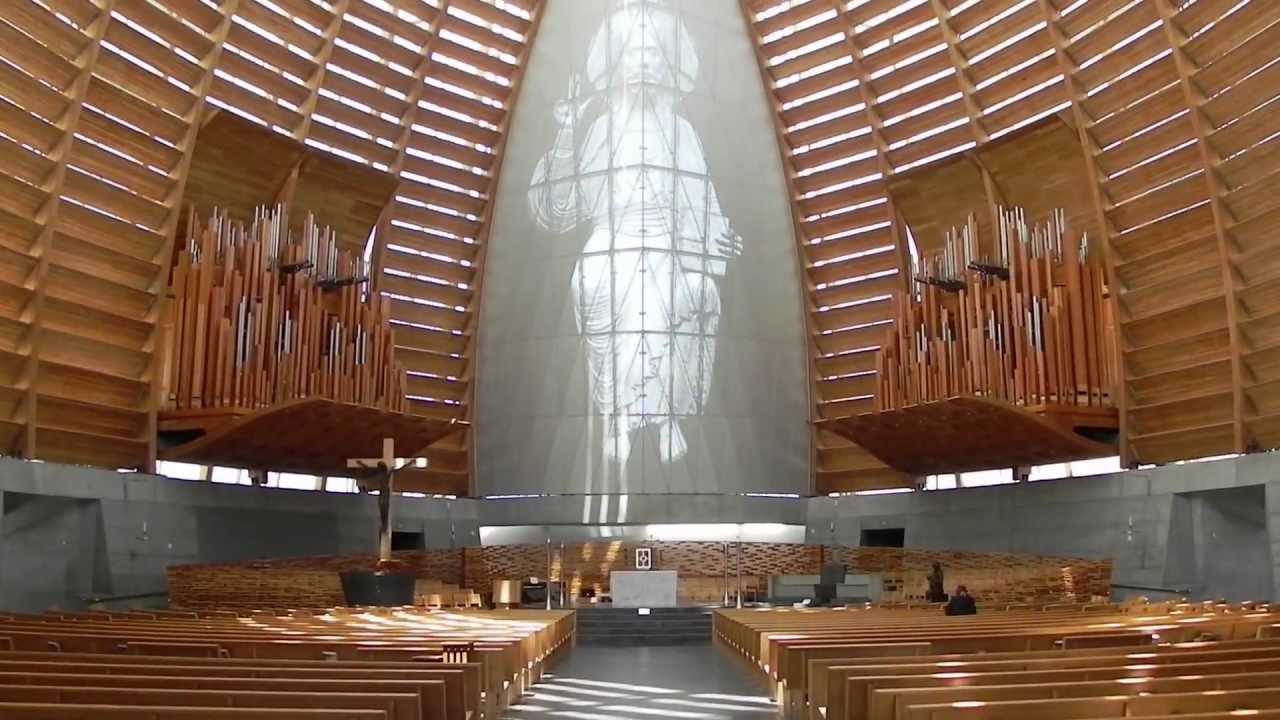
Interior view. Christ the Light Cathedral. Oakland, CA

Interior view of Christ the Light Cathedral in Oakland, CA

Begin quote

When Christ was transfigured, appearing in radiant glory with Moses and Elijah, the disciples wanted to build booths for them. When we build churches today, such as the strikingly transcendent interior of the Cathedral of Christ the Light, are we trying to “build a booth” to contain God? Or are we transformed ourselves when worshiping in a church of great beauty?

The Cathedral, located on the shores of Lake Merritt in Oakland, is designed with the symbolic representation of Jesus Christ at its core. The 58-foot high image within the Omega window (pictured here) is created by natural light passing through aluminum panels that have been pierced with 94,000 holes. This image is a depiction of Christ in Majesty, borrowed from the sculpture of Christ in the central doorway of the west entrance to Chartres Cathedral in France. The use of natural light in the Oakland Cathedral symbolizes the movement of salvation history, climaxing with the tangible, powerful, presence of Christ.[1] As the sun moves across the sky, the movement of light transforms the worship space.

The intentional design of this sanctuary, active in its beauty and its theological meaning, reveals the reciprocal exchange of love between God and humanity. As humans, we offer our humble devotion, and God’s presence is strongly felt. In a place of such beauty, natural and human-made, there are possibilities of transformation — transformation and devotion are brought to life in an exchange of heavenly and earthly love.

[1] Adult Formation Committee, Cathedral of Christ the Light.

Source: Art in the Christian Tradition (Vanderbilt Divinity Library)

Be well. Do good. Pay attention. Keep learning.

Image: Library of Congress

Collect: The Annunciation (Mar 25)

Behold the Lord’s Servant.

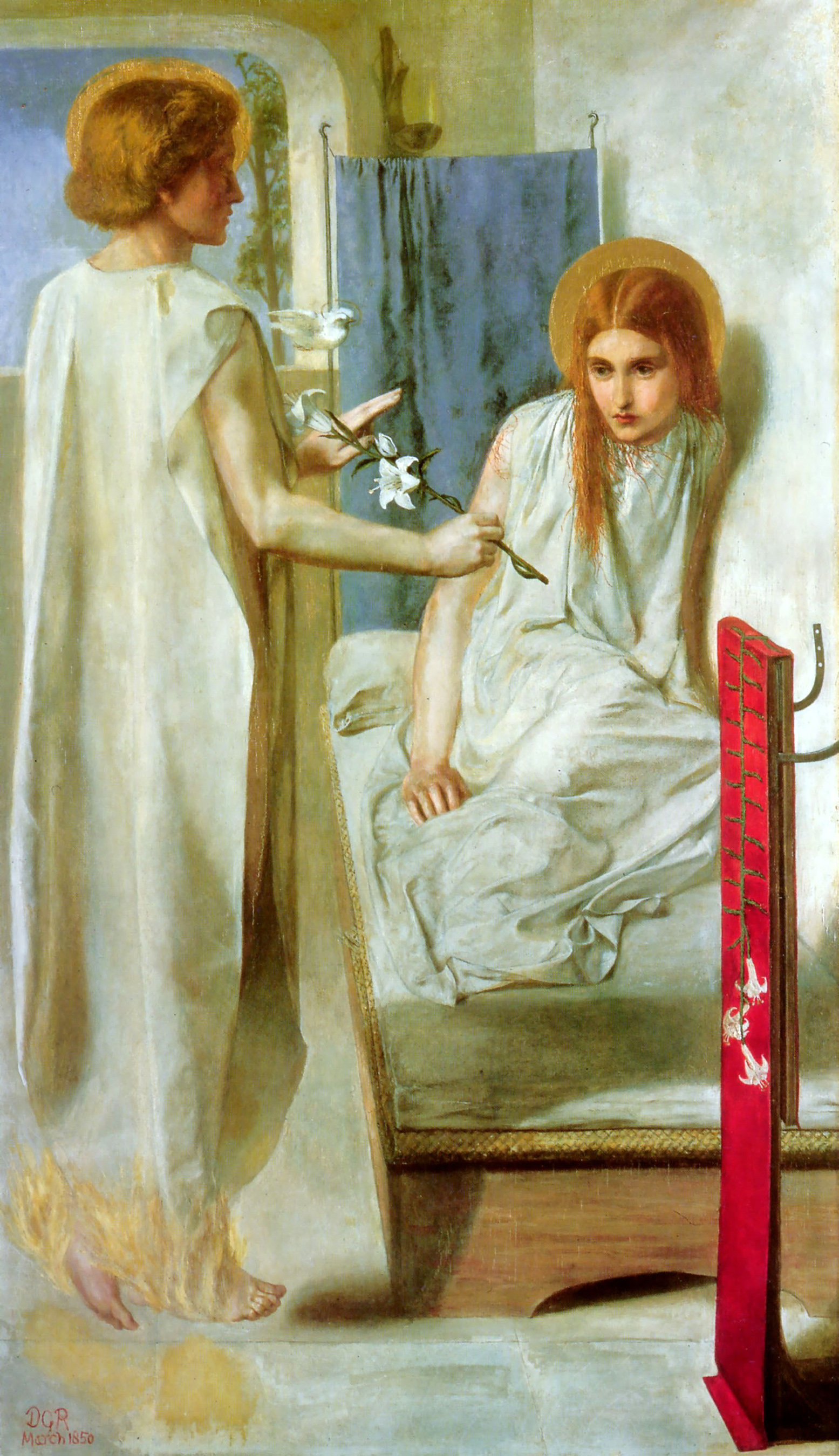
The Annunciation by Rossetti

Ecce Ancilla Domini! (Behold the Lord’s Servant)
Painting, 1849-1850
Rossetti, Dante Gabriel, 1828-1882

Pour your grace into our hearts, O Lord, that we who have known the incarnation of your Son Jesus Christ, announced by an angel to the Virgin Mary, may by his cross and passion be brought to the glory of his resurrection; who lives and reigns with you, in the unity of the Holy Spirit, one God, now and for ever. Amen.

The Book of Common Prayer, 240

As this Collect makes clear: it’s all connected. In the life of Jesus—and ours—their is birth, the cross and passion, death, and “the glory of … resurrection.” Let us live life fully. ~Fr. Dan

Begin quote

The Annunciation (pp. 188 and 240)

In the Gregorian sacramentary this collect is used as a postcommunion prayer for the feast of the Annunciation [….] Cranmer translated it:

We beseech thee, Lord, pour thy grace into our hearts; that, as we have known Christ thy Son’s incarnation by the message of an angel; so by his cross and passion we may be brought into the glory of his resurrection; Through the same Christ our Lord

Both the 1662 revision and this [1979] Book made changes for the sake of clarification, though the substance of the original remains. In an admirable way the collect links the Annunciation and the Incarnation with the themes associated with the time of the year [Lent] in which the feast occurs.

Marion J. Hatchett, Commentary on the American Prayer Book, (New York: The Seabury Press, 1981), p. 200

Be well. Do good. Pay attention. Keep learning.

Image: Art in the Christian Tradition (Vanderbilt Divinity Library)


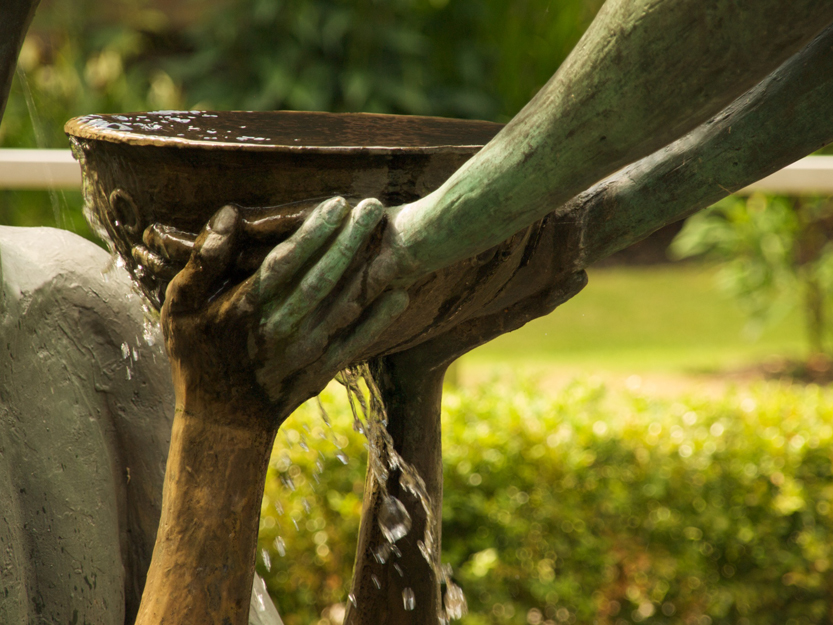
Water of Life | Art for Lent 3A

A visual exploration of John 4:14

“Jesus said, ‘ the water that I shall give will be an inner spring always welling up for eternal life” John 4:14

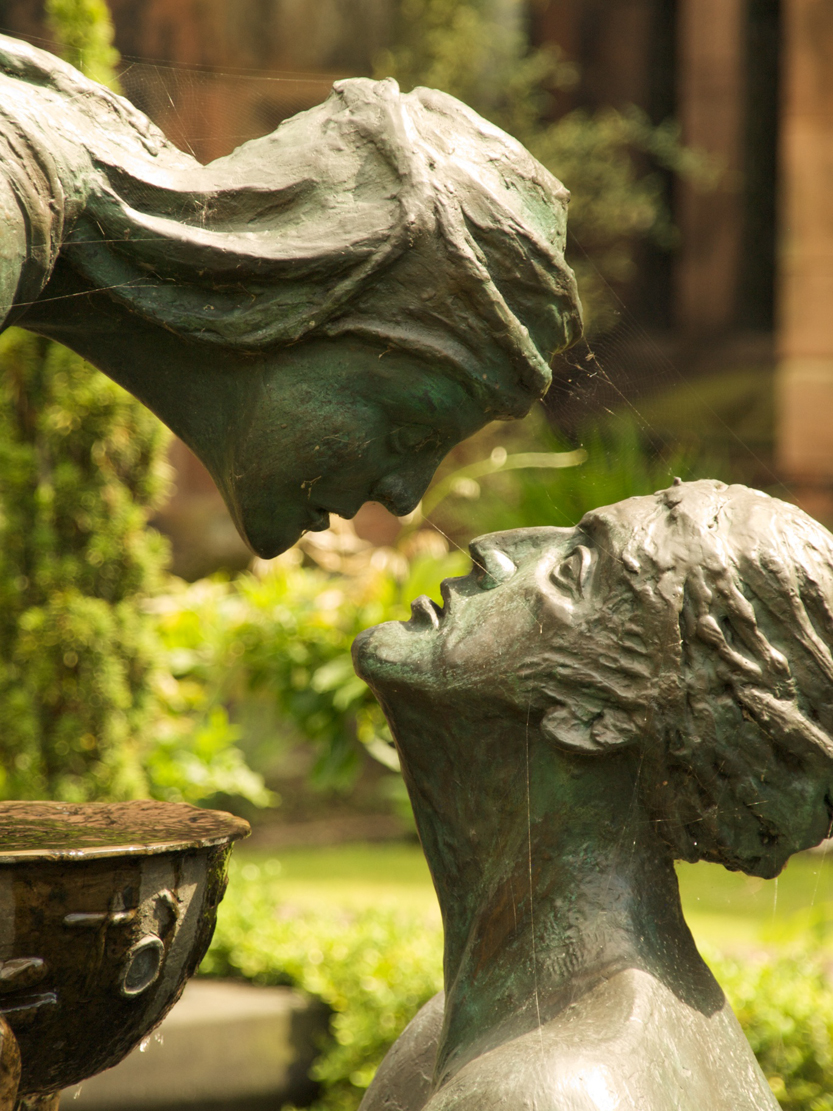
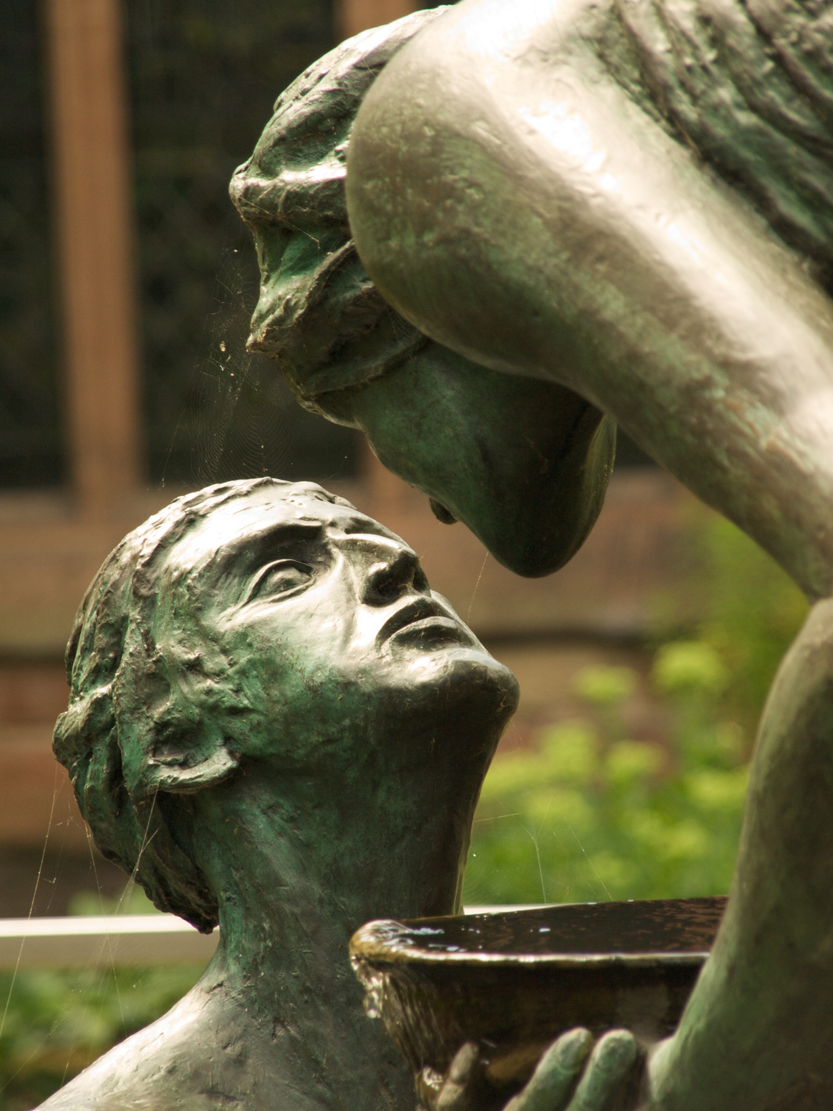
Christ and the Samaritan Woman

Broadbent, Stephen, 1961-
The Water of Life
Sculpture, freestanding, metal
Chester Cathedral
Chester GB
Click image for more information.

Detail Views


A short introduction to John 4:5-42, the Gospel Lesson appointed for Lent 3A in the Revised Common Lectionary:

Our gospel tells the story of Jesus’ meeting with the Samaritan woman by Jacob’s well. The narrative is rich with themes. Jesus is willing to break with custom in order to talk with one who is both a woman and a foreigner. True worship of God is tied to no particular place. He himself offers living water which wells up to eternal life. The woman learns that Jesus is the expected Messiah, and later others from the town come to believe that he is the world’s Savior. During an interval in the story, Jesus speaks with his disciples concerning his true food and drink, and tells them that the time of harvesting for eternal life is at hand. Introducing the Lessons of the Church Year

Please follow the Case Study link (below) to learn more about this sculpture in the Garden of the Chester Cathedral. ~Fr. Dan

Be well. Do good. Pay attention. Keep learning.

Christ in the Desert

Wilderness. Temptations. Angels.

Christ in the desert by Ivan Kramskoi

Here is a link to our post of Christ in the Desert (Kramkoi) from March 3, 2014 (Lent 1A). The post features commentary by our Forum Member, Hovak Najarian.


First Sunday in Lent

Exploring our faith through the arts.

Christ in the desert by Ivan Kramskoi

Every year Loyola Press on the web offers Arts & Faith, “celebrating your creative expressions of faith.” Arts & Faith: Lent is among the offerings. Here is the introduction to the Year A presentations of Arts & Faith: Lent…

Enter into a visual prayer experience this Lent with Arts & Faith: Lent. Each week we’ll provide a video commentary about a work of art inspired by the Sunday Scriptures. Use these videos to take a new look at this season of spiritual renewal through the lens of sacred art.

daniella-zsupan-jerome

Commentary is by Daniella Zsupan-Jerome, assistant professor of liturgy, catechesis, and evangelization at Loyola University New Orleans. She holds a bachelor’s degree in theology from the University of Notre Dame, a master’s degree in liturgy from St. John’s University in Collegeville, a master’s degree in religion and the arts from Yale Divinity School, and a Ph.D. in theology and education from Boston College. Her unique background in faith and art brings to life a new way of observing Lent and understanding the season on a more personal level.

Christ in the desert by Ivan Kramkoi is the meditation for the First Sunday in Lent. I encourage you to use this internet resource during your Lenten Journey in 2017. ~Fr. Dan

Read the transcript of this video on Loyola Press.

Be well. Do good. Pay attention. Keep learning.

Image: Pinterst Page for the art of Ivan Kramkoi


Collect: Seventh Sunday after Epiphany

Jesus teaches his disciples (you and me) about love and the Law. Let us respond to God’s teaching and grace.


Matthew 5:43ff


The Collect for the Day

O Lord, you have taught us that without love whatever we do is worth nothing: Send your Holy Spirit and pour into our hearts your greatest gift, which is love, the true bond of peace and of all virtue, without which whoever lives is accounted dead before you. Grant this for the sake of your only Son Jesus Christ, who lives and reigns with you and the Holy Spirit, one God, now and for ever. Amen.

Pull quote for Epiphany 7

If we really listen to Jesus (Matthew 5:1-48) we discover that love is at the heart of the Law. Without love (as Paul later writes), “I am nothing.” (1 Corinthians 13:1-3) Recognizing this, we have the courage to pray that our Lord will send the Holy Spirit, pouring into our hearts his greatest gift, love. Through the week let’s pay attention to God’s answer to our prayer.  ~Fr. Dan

Be well. Do good. Pay attention. Keep learning.