The Angel of Death and the First Passover | Art for Proper 18A

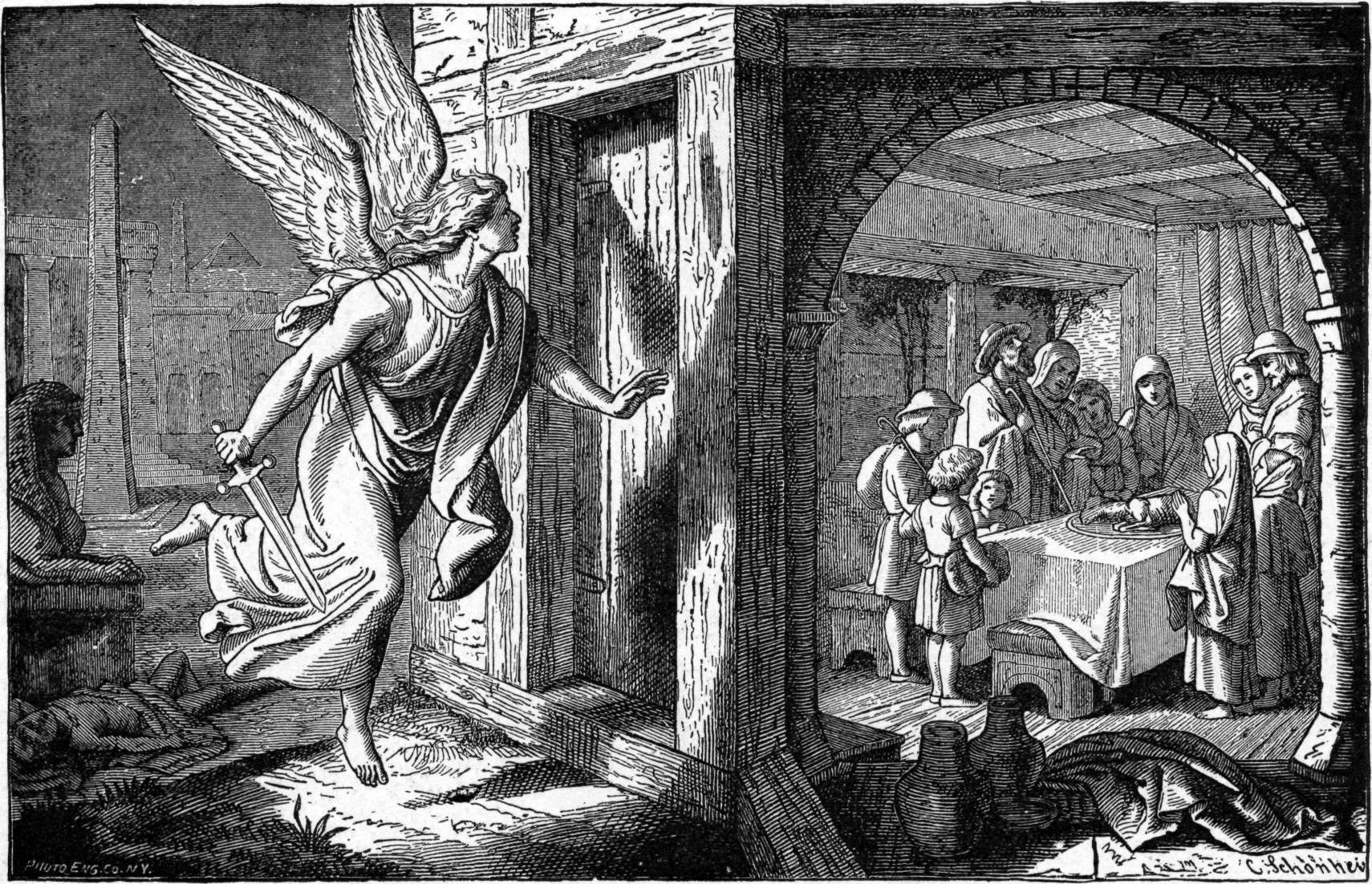
The Angel of Death and the First Passover, was one of four hundred illustrations in Charles Foster’s book, Bible Pictures, and What They Teach Us (1914)

The Angel of Death and the First Passover

The Angel of Death and the First Passover,
engraving, c. 1897, C. Schonhew, 19th century

Commentary by Hovak Najarian

When the time came for the Israelites to leave Egypt and be free from slavery, Moses and Aaron were told about the Passover. God gave them specific instructions with regard to what the people of Israel were to do. A lamb was to be killed, prepared, and then eaten. Blood from the lamb was to be placed on the lintel and door posts of each home. If doors were not marked, the firstborn child and animal of the home would be struck down. C. Schonhew’s engraving depicts the angel of death casting an ominous shadow as it glances at a door to see if it has been marked. Within the home, a Hebrew family is preparing to partake of the Passover meal.

In this engraving, we are attracted first to the activity of an angel patterned after a classical goddess. If she were without wings, had a bow and quiver, and in a wooded area, she could pass easily for the Roman goddess, Diana. To the left, a sphinx seems to be observing the angel as it passes by with sword in hand. The dead figure near its base indicates the person’s doorway was not marked. In addition to the sphinx, references to Egypt are in the background. An obelisk and a wall with marks suggesting hieroglyphics inform us of the culture in which the Passover took place. The tip of a pyramid is beyond the wall.

To the right of the angel is a less active scene. Through an arched opening we see a family gathered solemnly around a table. A tray with a roasted lamb is in the center and the head of the family is leading them in their first Passover meal. They seem to be unaware that the angel of death is passing by their home at the very moment. In order to present separate activities simultaneously, Schonhew divided the engraving into two contrasting areas. On the left, the angel is in motion. There is a sense of urgency about her movements and she is surrounded by dramatic lighting. In contrast, figures on the right are standing still with heads bowed.

The architecture of the interior is in keeping with the exterior but in order to present a direct view of the family, Schonhew departed from two point perspective by aligning the arched wall with the picture plane. This frames the scene and separates it to focus attention on the family. At first glance it may seem we are viewing the interior through a “picture window” but plate glass was not available until the seventeenth century. During the time of Moses, windows would have been simple openings in the wall with no glass.

Note: The Angel of Death and the First Passover, was one of four hundred illustrations in Charles Foster’s book, Bible Pictures, and What They Teach Us (1914). Many of the artists responsible for the work published in Foster’s book were not identified. Schonhew’s name is known only because he signed the above work. Efforts to locate biographical information about Schonhew have not been successful.

Hovak Najarian © 2017

Be well. Do good. Pay attention. Keep learning.

David Playing the Harp before Saul, 1530, Engraving, Lucas van Leyden (1494-1533). In a note attached to this post, Hovak describes the process of engraving.

A Labor Day Prayer

A prayer for guidance in the work we do. Promoting the common good.

Labor Day 00

Be well. Do good. Pay attention. Keep learning.

Gospel Commentary in Latin found after 1500 years …

The earliest Latin commentary on the Gospels, lost for more than 1,500 years, has been rediscovered and made available in English for the first time. The extraordinary find, a work written by a bishop in northern Italy, Fortunatianus of Aquileia, dates back to the middle of the fourth century.

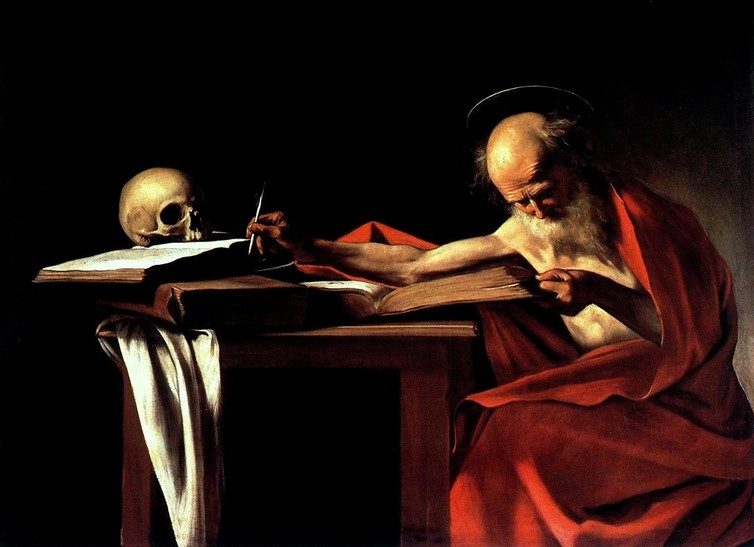
Saint Jerome at work

This article was originally posted by Hugh Houghton on The Conversation, August 23, 2017.

Begin quote

The earliest Latin commentary on the Gospels, lost for more than 1,500 years, has been rediscovered and made available in English for the first time. The extraordinary find, a work written by a bishop in northern Italy, Fortunatianus of Aquileia, dates back to the middle of the fourth century.

The biblical text of the manuscript is of particular significance, as it predates the standard Latin version known as the Vulgate and provides new evidence about the earliest form of the Gospels in Latin.

Despite references to this commentary in other ancient works, no copy was known to survive until Dr Lukas Dorfbauer, a researcher from the University of Salzburg, identified Fortunatianus’ text in an anonymous manuscript copied around the year 800 and held in Cologne Cathedral Library. The manuscripts of Cologne Cathedral Library were made available online in 2002.

Scholars had previously been interested in this ninth-century manuscript as the sole witness to a short letter which claimed to be from the Jewish high priest Annas to the Roman philosopher Seneca. They had dismissed the 100-page anonymous Gospel commentary as one of numerous similar works composed in the court of Charlemagne. But when he visited the library in 2012, Dorfbauer, a specialist in such writings, could see that the commentary was much older than the manuscript itself.

In fact, it was none other than the earliest Latin commentary on the Gospels.

Pearls of wisdom

In his De Viris Illustribus (Lives of Famous Men), written at the end of the fourth century, Saint Jerome, who was also responsible for the revision of the Gospels and the translation of the Hebrew Scriptures known as the Vulgate, included an entry for Fortunatianus – who had been bishop of the northern Italian diocese of Aquileia some 50 years earlier. This prominent cleric had written a Gospel commentary including a series of chapter titles, which Jerome described as “a pearl without price” and had consulted when writing his own commentary on the Gospel of Matthew.

Later Christian authors, such as Rabanus Maurus and Claudius of Turin, searched for it in vain. As with so many works from antiquity, it seemed to have been lost, the remaining copies destroyed in a Vandal raid or eaten by mice in a dusty library.

Among the features which attracted Dorfbauer’s attention was a long list of 160 chapter titles detailing the contents of the commentary, which corresponded to Jerome’s description of Fortunatianus’ work. In addition, the biblical text of the Cologne manuscript did not match the standard version of the Gospels produced by Jerome, but seemed to come from an earlier stage in the history of the Latin bible.

Groundbreaking discovery

This was where the University of Birmingham came in. The university’s Institute for Textual Scholarship and Electronic Editing (ITSEE) is home to long-term projects working on new editions of the Bible in Greek and Latin. As a specialist in the Latin New Testament, I was able to compare the biblical quotations in the Cologne manuscript with our extensive databases. Parallels with texts circulating in northern Italy in the middle of the 4th century offered a perfect fit with the context of Fortunatianus.

Astonishingly, despite being copied four centuries after the last reference to his Gospel commentary, this manuscript seemed to preserve the original form of Fortunatianus’ groundbreaking work.

Such a discovery is of considerable significance to our understanding of the development of Latin biblical interpretation, which went on to play such an important part in the development of Western thought and literature. In this substantial commentary, Fortunatianus is reliant on even earlier writings which formed the link between Greek and Latin Christianity.

This sheds new light on the way the Gospels were read and understood in the early Church, in particular the reading of the text known as “allegorical exegesis” in which elements in the stories are interpreted as symbols. So, for example, when Jesus climbs into a boat on the Sea of Galilee, Fortunatianus explains that the sea which is sometimes rough and dangerous stands for the world, while the boat corresponds to the Church in which Jesus is present and carries people to safety.

There are also moments of insight into the lives of fourth-century Italian Christians, as when the bishop uses a walnut as an image of the four Gospels or holds up a Roman coin as a symbol of the Trinity.

English translation

In the form of a single (no longer anonymous) manuscript, or even a scholarly edition of the Latin text, it will still be some time before this work becomes as widely known as the famous writings of later Christian teachers such as Ambrose, Augustine and Jerome.

For that reason, I have worked closely with Dr Dorfbauer to prepare an English translation of his full Latin edition of the commentary, the first ever to be produced.

This will enable a much wider audience to take account of this rediscovered work. In fact, this English version may be the form in which most people will encounter Fortunatianus’ commentary – as studying languages is now a much smaller component in theological study and online translation tools are beginning to produce more satisfactory results.

But for the fullest appreciation of this work, it will still be necessary to put alternatives to one side and consult the original – which is how the commentary was rediscovered in the first place.

end quote

About the Author: (Hugh Houghton)  Reader in New Testament Textual Scholarship; Deputy Director, Institute for Textual Scholarship and Electronic Editing, University of Birmingham.

US Disaster Program of Episcopal Relief and Development

As you consider donating to the relief of those harmed by wind, rain, and flood after Hurricane Harvey, check out the work of our own Episcopal Relief & Development.

Begin quoteEpiscopal Relief & Development’s US Disaster Program connects, equips and inspires leaders of US dioceses in The Episcopal Church to prepare for hazards that might affect their communities, to mitigate the impact of disasters and to help vulnerable people make a full and sustained recovery.

Notice: Donate to the Hurricane Harvey Response Fund

The US Disaster Program works with diocesan and congregational leadership in areas that have been affected by disasters. We partner with diocesan leaders by providing technical resources and connections to others around the country who have faced similar challenges, as well as access to the Ready to Serve volunteer database. …

Read more from ERD: US Disaster Program

15A: Christ and the Canaanite Woman

Art for Proper 15A in the RCL

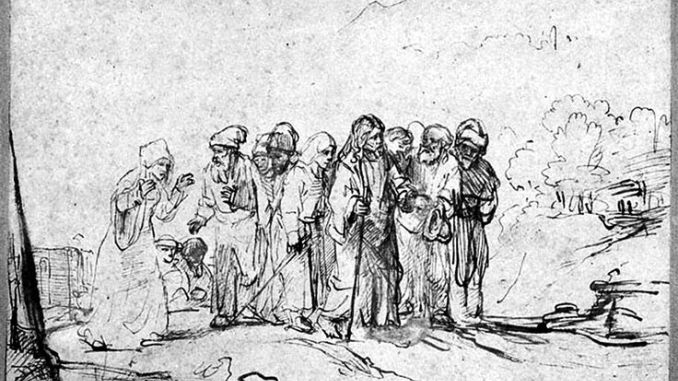
Christ and the Canaanite Woman by Rembrandt

Begin quote

Dutch artist Rembrandt van Rijn, began his career in Amsterdam where a large merchant class appreciated art and had the means to support it.  He gained early success but money management was not a priority with him and during the latter years of his life he struggled financially.  He continued to work steadfastly, however, and produced art of the highest order.

The biblical setting for the drawingChrist and the Canaanite Woman, is in the region of Tyre and Sidon; two ancient cities of Canaan on the Mediterranean Sea.  When Christ was there he was approached by a woman of Syrophoenician origin (far left in the drawing) who begged him to heal her daughter.  It was suggested by the disciples that she be turned away but Christ made it known that his ministry was for everyone and the woman was granted her request.

Read the entire post here: 15A: Christ and the Canaanite Woman – St. Margaret’s News

Be well. Do good. Pay attention. Keep learning.


A Morning of Unity and Justice

Sharing the news from our neighbor, St. Margaret’s Episcopal Church in Palm Desert, CA

Rabbis David Lazar of Temple Isaiah in Palm Springs and Richard Zionts of the Har-El Institute for Study and Worship in the Reform Tradition joined us for worship Sunday Morning, August 20 to celebrate a Morning of Unity and Justice at St. Margaret’s. The day offered a celebration of our unity and God’s grace in […]

via A Morning of Unity and Justice — St. Margaret’s News

Artemisia Bowden, 1969 (Aug 18)

Artemisia Bowden—an invitation to you and me to trust in the grace of God to become the faithful witnesses of God’s love and mercy…

Daniel Rondeau's avatarWind in the Pines

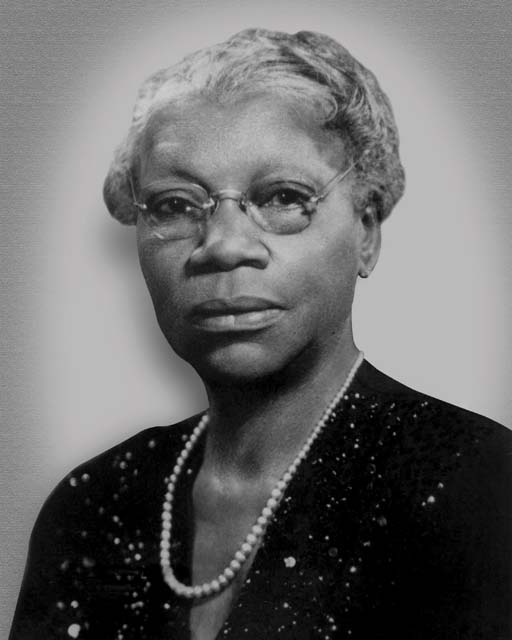
Artemisia Bowden Artemisia Bowden
The Rt. Rev. James Steptoe Johnston, Bishop of the Missionary District of Western Texas (1888–1916), desired to provide education and skill development for newly emancipated blacks in the mission field. Bishop Johnston traveled to Raleigh, North Carolina, in search of a young, black, female teacher. In 1902, Ms. Artemisia Bowden courageously accepted Bishop Johnston’s invitation and assumed leadership of the St. Philip’s Vocational Day School for Colored Children in San Antonio, Texas.

She began with less than ten students. After leading the school for 52 years, a small day school was transformed into a fully accredited junior college offering over 100 degree and certificate programs. In 2016, St. Philip’s College has an enrollment of over 11,000 students. St. Philip’s College carries the dual designation of being a Historically Black College and a Hispanic Serving Institution Bowden’s work, which began more than 110 years ago, continues to be an…

View original post 369 more words

Manteo and Virginia Dare (Aug 17)

Remembering our story


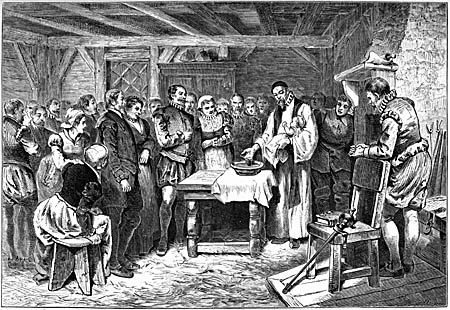
Baptism of Virginia Dare

In the late sixteenth century, Sir Walter Raleigh established three colonies along the northeastern coast of what is now the state of North Carolina. In July 1587, the third and final settlement, consisting of 120 men, women, and children under the leadership of John White, landed on Roanoke Island, near the present-day community of Nags Head.

With the colonists was Manteo, a Native American of the Algonquian nation and resident of Croatoan who had traveled to London in an earlier expedition to become a liaison between the English and the Native Americans. On August 13, 1587, Manteo was baptized, the first recorded baptism of the Church of England in the American colonies and the first recorded baptism of a Native American person in the Church of England. Read more

Holy Women, Holy Men

The Collect for the Commemoration

O God, you have created every human being in your image and each one is precious in your sight: Grant that in remembering the baptisms of Manteo and Virginia Dare, we may grow in honoring your gift of diversity in human life; become stronger in living out our baptismal vow to respect the dignity of every human being; and bring into the fellowship of the risen Christ those who come to him in faith, baptizing them in the name of the Father, and of the Son, and of the Holy Spirit. Amen.

As God answers our prayer may we well and truly “become stronger in living out our baptismal vow to respect the dignity of every human life.” ~Fr. Dan

Be well. Do good. Pay attention. Keep learning.

Moses

More than one way to view Moses with horns.

Moses by Michaelangelo

Moses, marble, c. 1513-1515, Michelangelo, 1475-1564

Commentary by Hovak Najarian

After Moses talked with God on Mt. Sinai, he returned to his people but was not aware that his face was glowing. Because of his radiance, people were reluctant to approach him, but when he called they came closer to hear what the Lord had commanded. Moses placed a veil on his face but removed it while in the presence of God. The veil was placed on his face again when he returned to the Israelites.

While he was still a young man, Michelangelo’s stone carving skills were recognized and he was invited to study at the Medici workshop in Florence under the patronage of Lorenzo the Magnificent. Commissions followed and at age twenty-four, the well-known Pieta (now in St. Peter’s Basilica) was carved. His next major commission would be a statue of David for the City of Florence.

Pope Julius II was impressed with David and invited Michelangelo to Rome to design what would be, in effect, a grandiose monument, a tomb that he envisioned for himself. After Michelangelo began carving figures for the tomb, he was not pleased when he was redirected to paint frescos on the ceiling of the Sistine Chapel. Michelangelo was working again on the tomb when Julius II died (a year after the ceiling was completed). By then funds had depleted and the size of the tomb was scaled back. It was during this period that the Moses was carved.

Giorgio Vasari, Michelangelo’s biographer, described the sculpture of Moses to be “…unequalled by any modern or ancient work. Seated in a serious attitude, he rests with one arm on the tablets, and with the other holds his long glossy beard, so difficult to render in sculpture, being soft … that it seems the iron chisel must have become a brush.” Although Michelangelo’s Moses displays remarkable carving skills, is engaging in its formal relationships, and is of psychological interest, tourists tend to be unduly preoccupied with the horns on his head.

Errors sometimes occur when languages are translated, and at times they lead to unusual descriptions (e.g. Cinderella’s “glass” slippers). In the fourth century, Jerome translated the Bible from Hebrew to Latin, and found that the word, keren had various meanings. One meaning was, “horn.” In translation, Jerome described Moses’ face as being, “horned,” which was to say it was “glorified” or “radiant.” At the time of translation, Jerome was well aware of the multiple meanings of, keren, but elected to use “horn” as a metaphor for strength and power. Medieval artists took the words of the Latin Bible literally and depicted Moses with actual horns. Michelangelo knew, of course, that Jerome’s use of “horned” had been misinterpreted but he chose, nevertheless, to place horns on Moses’ head to impart a sense of strength and authority. Other historical figures have been given horns to suggest strength. Alexander the Great and Attila the Hun have been depicted with horns, and images of warriors with horned helmets are very familiar to us.

Depictions of a “horned” Moses decreased during the Renaissance and was seldom seen beyond the sixteenth century.

Hovak Najarian © 2017

Be well. Do good. Pay attention. Keep learning.

Image: Pvasiliadis at Greek Wikipedia via Wikimedia Commons

The Man with a Hoe

Matthew 13:1-9. Pause. Look. Listen. Let the parable take you where it will.

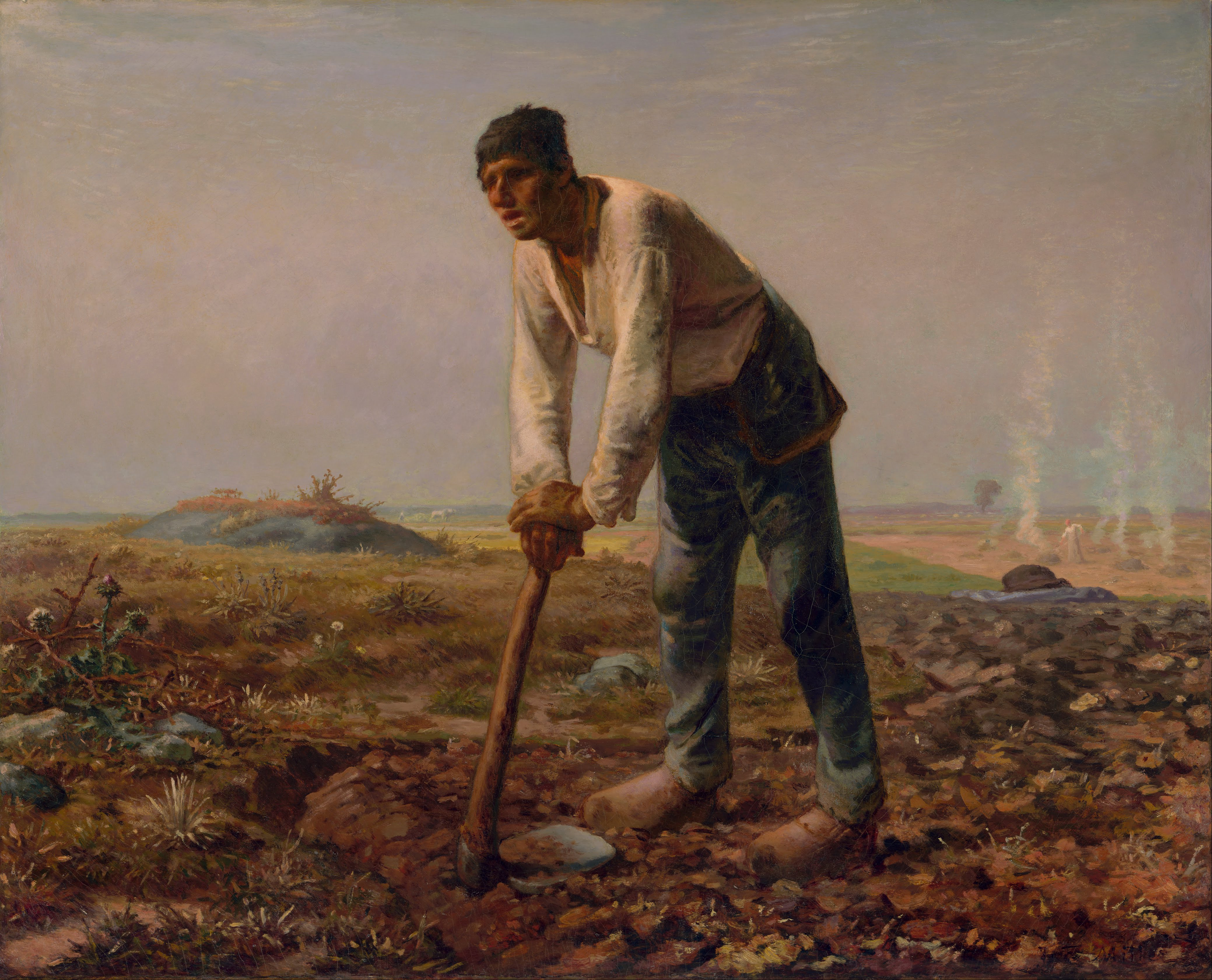
Millet,_Jean-François_-_Man_with_a_Hoe_-_Google_Art_Project

As the Sunday Morning Forum at St. Margaret’s Episcopal Church prepares to meet, Hovak Najarian and Kathleen Kelly shared observations, poetry, and questions to lead into the Gospel parable (Matthew 13:1-9, 18-23) and to inspire your learning.

From Hovak:

Sunday’s Gospel gives us the parable of the sower and Jean Francois Millet’s painting,The Sower, came to mind immediately.  This popular painting has been reproduced many times and it is likely you are familiar with it.  [it is available on T-shirts.]  There is a great deal that could be written about Millet’s Sower, but the focus of Christ’s parable was on what happens when seeds fall onto various surfaces … the message is not about the sower himself.

From, The Sower, my mind shifted to Millet’s, The Man With The Hoe, and a poem by Edwin Markham.  Instead of writing a commentary this week, I would like to share this painting and poem with you.  It is not related to either of the readings for Sunday but the painting is worth seeing and the poem worth reading.

From Kathleen:
In one sense, it could be said that the parable IS about the sower —  a farmer who is willing to “squander” seed by tossing it in all directions  (without regard for the conditions) as though there is no limit to the abundance of this resource.

Be well. Do good. Pay attention. Keep learning.

Image: Jean-François Millet [Public domain], via Wikimedia Commons (Link)