“Lead us not into temptation….” Wait. What?

One of my favorite teachers, Richard Rohr, has a weekly blog Unpacking Paradoxes. On June 17th he unpacked the phrase, “lead us not into temptation,” from the “Our Father.”

This line (In Matthew’s version of the Our Father) has never made sense to me, although I continue to say it since this is the way it is usually translated; but I cannot really appeciate it as is. Sometimes, it is translated “do not put us to the test” (In Luke’s version), which still seems strange and problematic. Why would God “lead” us into temptation or “put us to the test” to begin with? Is human life an obstacle course, a testing ground? Are we all on trial? I thought God’s usual job was to lead us away from temptation! Why would we need to ask God to NOT lead us INTO temptation? Does he?

Please read the rest of his post as he answers these questions. It is a different answer than you might expect. It is humbling and it makes a lot of sense to me.

When Goliath looked David over, he sneered at David because he was just a boy

And it’s no wonder he sneered. Goliath stood almost 10 feet tall and had been a warrior a long time. Of course this just sets the stage for God’s actions (then and now).

This Sunday (6/24/12) one of the appointed readings is the story of David and Goliath (1 Samuel 17). Our Forum member, Wendy, in an informative post titled: Child Capacity: Human and Divine, leads us to these questions:

These biblical passages speak to a “both/and” view of child capacity. Children BOTH have far more capacity than modern theories have led us to perceive AND they have limitless power when they are acting in the Spirit of God. How does this understanding speak to us as children’s teachers and pastors? How does this understanding speak to us as adults learning to walk with God?

I encourage you to read the entire post. You will find (in good Episcopal fashion) a lot of questions inviting you (and me) to a deeper understanding of God and children and faith.

Come back and share what you think, your own questions, observations you’ve made over the years, anything at all to keep the conversation going.

B Proper 7, Art for June 24, 2012

.
LEYDEN, Lucas van
(b. 1494, Leiden, d. 1533, Leiden)

Click to open Web Gallery of Art Artist Biography and to explore other works by this artist.

David Playing the Harp before Saul
c. 1508
Engraving, 254 x 184 mm
Metropolitan Museum of Art, New York
Click to open Web Gallery of Art commentary page. Click image for large view.

Note: This image depicts today’s ALTERNATE Hebrew Bible reading
(1 Samuel 17:57-18:5, 10-16).
The normal reading is David & Goliath (1 Samuel 17: [1a, 4-11, 19-23], 32-49).

Related art commentary by Hovak Najarian.

David Playing the Harp before Saul, 1530, Engraving, Lucas van Leyden (1494-1533)

Commentary by Hovak Najarian

Related post B Proper 7, Art for June 24, 2012

Dutch artist, Lucas van Leyden, was an extraordinary printmaker; only Albrecht Durer, whom he met and admired, was better known in his time. Like Durer, he was a master engraver and he too used Biblical stories as subject matter in his works. The engraving, David Playing the Harp before Saul, gives us an example of Lucas’ exceptional technical skill.

In the First Book of Samuel (16:23) we are given an account of the calming affect David’s music had on King Saul: “And it came to pass, when the evil spirit from God was upon Saul, that David took a harp, and played with his hand: so Saul was refreshed, and was well, and the evil spirit departed from him.”

In Lucas’ engraving, Saul is in a troubled state. David is standing to the left with fingers on the strings of his harp and the seated Saul is slumped in his throne and motionless. His face is passive, his eyes are turned aside unfocused, and he seems to be unable to understand or deal with his depression. There is nothing regal about him and in a different setting he could be overlooked as simply an old man. Following our initial study of David and Saul, our attention is shifted to two men standing behind the right arm of the throne. One gentleman, likely the court physician, is gesturing as they discuss Saul’s condition. Soldiers and guards with their halberd and spears are behind them in the shadows. The source of light, being from the front, leaves the background in darkness. This keeps our focus on the principal characters in the foreground and also adds to the sense of gloom overshadowing the scene.

In this composition, David, standing to the left with his harp, is the first to receive our attention. Our eyes move up to see his face and then we are led visually back down as we follow the edge of the harp and pause briefly at David’s spread fingers. From there the downward line of the harp curves to the right and leads us directly to Saul. The staff in Saul’s hand then points us back toward the center to the two men observing his despair. The back part of Saul’s throne keeps our focus contained and limits this composition to a tightly knit scene.

Note

David Playing the Harp before Saul is an engraving on a copper plate. In terms of where ink is placed, an engraving is the opposite of a woodcut. In a woodcut (known as a relief print), ink is rolled onto the raised portion of a plate (a carved wooden surface). In a metal engraving the ink is carried below the surface of a plate. An engraver uses a small chisel-like hardened steel tool (called a burin) to carve shallow v-shaped grooves into a plate of softer metal (often copper). After a composition is completed to an artist’s satisfaction, ink is rubbed into the grooves and the surface of the plate is wiped clean; the ink however, being below the surface, remains in the grooves. A piece of slightly damp paper is laid over the plate and it is run through a press. As it goes through the press, the paper is forced against the plate and makes contact with the ink. When the paper is pulled off the plate, the ink is lifted out of the grooves. The print on the paper will be a mirror image of the composition. An artist must prepare the plate in reverse of the image seen in the print.

All editions pulled directly from a plate are “originals” and thousands could be printed potentially. Today, however, an artist makes usually a limited edition and then destroys or “cancels” the plate. The artist numbers and signs each edition by hand.

______________

© 2012 Hovak Najarian
Seeing beyond outward appearances

Samuel was tasked by God to anoint a new king. The tone was set in Samuel’s first ‘interview’ as “the Lord said to Samuel, ‘Do not look on his appearance or on the height of his stature, because I have rejected him; for the Lord does not see as mortals see; they look on the outward appearance, but the Lord looks on the heart.’” 1 Samuel 16:7

This week, we shared the story of Samuel, of David, and God that grew into the wisdom of Paul…

…we regard no one from a human point of view; even though we once knew Christ from a human point of view, we know him no longer in that way. 2 Corinthians 5:16 …

…becoming part of our Baptismal Covenant

Will you seek and serve Christ in all persons, loving your neighbor as yourself?

Will you strive for justice and peace among all people, and respect the dignity of every human being?

May we have grace to see beyond physical appearances perceiving the integrity of the heart, God’s gift to us all.

What verses from Sunday’s (6/17/12) lessons spoke to your heart? What verses prompted questions and posed challenges? Let’s continue the conversation here.

Let’s light up the world

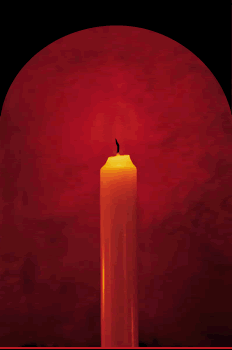
An unlit candle awaiting your attentionLighting a candle is a way to let Christ, the Light, into our lives; it is a way to let our light (of care, concern, hope, love, compassion, interconnectedness, peace) shine into the world;  it is an invitation to warmth; the fire of a candle ascends, like our prayer; it can be an offering of self, “our souls and bodies” to  God’s glory. … The lit candle can be our continuing prayer, even when our conscious praying is interrupted or distracted into oblivion.

The lit candle, especially in the darkest part of the night, is a symbol of an unquenchable hope; it is a symbol of a life-giving trust (in God).

I encourage you to light a candle, offer a prayer, give light (no, give the Light you know) to the world.

For further reading and reflection

“In many different traditions lighting candles is a sacred action. It expresses more than words can express. It has to do with gratefulness. From time immemorial, people have lit candles in sacred places. Why should cyberspace not be sacred?”
From the website of Gratefulness.org as an introduction to a sacred space in which you can light a candle.

I have started a Group for us on Gratefulness.org. The Group initials are 4 letters: a-m-e-n. Our group is “amen” (without the quotes). As you complete the guided process to light your candle in cyberspace you will have the opportunity to enter a set of Group initials. Use “amen” (without the quote marks). All candles with the Group initials amen will appear together. If you want to find your candle, use your initials in the space provided.

“Amen.” Of course, this is a common ending to our prayers. To say Amen to a prayer is to say to all who hear “Let it be so, even more than I can say, or more than I can ask or imagine, let it be so.”

Click here: Light a candle on Gratefulness.org: I will greet you there and you will be guided in your candle lighting effort; God will do the rest.

“So, Mom, how do these seeds grow?”

Jesus said, “The kingdom of God is as if someone would scatter seed on the ground,…” Mark 4:26

The Gospel text appointed for Sunday, June 17, 2012 is Mark 4:26-34. What follows is the opening paragraph of a reflection on Mark posted by Ynot on the Catholica Forum Blog.

Quote . . .Mark was finding it hard to concentrate on the papers spread across the table while a noisy group outside the door debated methods and strategies for proclaiming the kingdom. Get the message sorted out first, some were saying, to make sure everyone follows the same line. Others were talking about picking out the most likely converts. Then they started on the obstacles blocking the message, secularism, materialism, relativism in the Greco-Roman world, the hot-blooded youth who wanted a messiah to lead them against the Roman occupation back home in Palestine, and the biggest problem of all, the lack of spiritual hunger, seen in the poor attendance at synagogue, the waywardness of the young, the blindness of the pharisees. Finally, the leaders of the synagogue who didn’t care for the people. Some were even saying that you’ve got to start with the children and fill their young minds with the Way of Jesus before anything else. Mark threw up his hands in frustration. “They just don’t get it!” he muttered to himself, and put his head down to his work. He knew the key to all their searching was staring him in the face. How have they all got it so wrong? It’s not like organising a social revolution, it’s not like setting up a reform movement, it’s not like force-feeding the young, it’s not like an occupier’s re-education program among a subject people, it’s not indoctrination: It’s like sowing seed!  Read the entire reflection

After reading through this reflection let our Forum know what you think. Ask a question or leave a comment. We would like to continue the conversation.

____________
Image from the blog Phil0logy on WordPress.

B Proper 6, Art for June 17, 2012

MINIATURIST, English
(active 1140s)

The Tree of Jesse
1140s
Illumination on parchment
Lambeth Palace, London
Click to open Web Gallery of Art commentary page. Click image for large view.

Related art commentary by Hovak Najarian.

The Tree of Jesse, Twelfth Century, Illumination on Parchment, Unknown Miniaturist, English (active 1140s), Lambeth Palace Library, London

Commentary by Hovak Najarian

Related post B Proper 6, Art for June 17, 2012

During medieval times, light carried mystical and symbolic meaning as it passed through stained glass windows or was reflected from the surface of gold leafed icons. During this time, illuminated manuscripts were written painstakingly on parchment by hand with gold-leafed and vividly colored miniature paintings accompanying the text. Gold itself seemed magical and represented divine radiance; in its reflected light, images were “illuminated” literally.

In manuscripts, early Christian illustrators depicted usually the apostles and events in the life of Christ. During the eleventh century the range expanded to include the genealogy of Christ and from that time forward to the Renaissance, the “Tree of Jesse” remained a popular subject. Its source is found in Isaiah (11:1); “And there shall come forth a shoot from the stem of Jesse, and a Branch shall grow out of his roots.” Matthew at the outset of his gospel (1:1-16) gives us Christ’s genealogy and Luke (3:23-38) also gives us Christ’s ancestry. The subject is noted once again in the Book of Revelation (22:16); “…I am the root and the offspring of David, and the bright and shining star.”

In the Tree of Jesse from the Lambeth Bible, Jesse is seen lying at the bottom of the illumination. From his hip rises what may be interpreted as a trunk of a tree and its vine-like branches forms roundels. In the roundels at the bottom are four old prophets. Isaiah, on the left, holds the scroll of his prophesy and points upward. On the right, an old prophet also points upward as he looks toward the large central figure of Mary who is dressed in blue (the symbol of purity and heavenly grace). Branches move upward from Mary’s head to form a roundel containing a half figure of Christ; He is surrounded by seven doves that represent gifts of the Holy Spirit. In the upper left roundel two apostles are shown with a crowned female figure that represents the triumph of the Church. At the top right, the hand of God removes a veil (symbolizing blindness) from Synagoga, a figure representing the Jewish religion; Moses, depicted with horns on his forehead, is at her side. In the two center roundels are the four virtues noted in Psalm 85:10; “Mercy and Truth are met together; Righteousness [Justice] and Peace have kissed.” At the right, Justice holds scales as she and Peace embrace following a kiss. In the left roundel, Mercy, holding a vase, is with Truth. Mercy represents the Gentiles and Truth represents the Jews; they are holding hands to indicate the unity of the Old and New Testament.

Notes

Medieval describes life during the Middle Ages (from approximately 500A.D. to 1450 A.D.) The Middle Ages came after the fall of the Roman Empire and ended with the Renaissance of the fifteenth century.

Illuminated Manuscript is a term used loosely today to include all miniature book illustrations of the medieval period but true illuminations are only paintings on which gold leaf (or gold dust) has been applied.

Parchment is the surface used for illuminated manuscripts. It was made from calf, sheep, or goat skin. Vellum is a parchment of finer quality.

Lambeth Palace has been the official London residence of the Archbishops of Canterbury since the thirteenth century.

Moses Pictured with Horns is a result of a translator’s interpretation. When Moses returned from Mt. Sinai the second time with two tablets, his face was said to shine. When Jerome, the translator of the Bible into Latin in the fifth century interpreted the Hebrew verb karan, meaning to cast a glow, he took it to be the literal form of the noun keren which means horn. Henceforth, artists depicted Moses with horns. The most noted example is Michelangelo’s sculpture of Moses.

______________

© 2012 Hovak Najarian

Be Real AND Make Hope

It is a huge danger to pretend that awful things do not happen.
But you need enough hope to keep going.
I am trying to make hope.
Flowers grow out of darkness.

Corita Kent —Word for the Day on Gratefulness.org, 25 Sep. 2011

2 Corinthians 4:13–5:1 is appointed for reading on Sunday, June 10, 2012. We will hear Paul talk about hope. When awful things happen how do you “make hope”?