

Christ Taking Leave of His Mother, 1505, Woodcut, Albrecht Durer (1471-1528)
Commentary by Hovak Najarian
Related post B Proper 5, Art for June 10, 2012
During the Renaissance, the German artist Albrecht Durer was the most acclaimed printmaker of Northern Europe and his well deserved reputation can be seen in two notable series of woodcuts. Both of them include the theme of Christ saying farewell to his mother before leaving for the events awaiting him during the Passion. The first series called Life of the Virgin was started in 1501 but not completed until after he returned from an extended visit to Italy. A second series called The Small Passion was started after his return to Germany.
In his woodcuts, Durer deals with a wide range of emotional moments; sometimes there are elements of joy, as in Christ Entry into Jerusalem, yet often there are sorrowful events such as the Crucifixion. Durer used Biblical accounts usually for the subject of his woodcuts but many activities in the life of Christ, as well as in his family and disciples, were not recorded in the scriptures. When direct accounts are not available, artists, novelists, and dramatists often turn to their imagination or go to other sources as they try to depict how events might have occurred.
During the thirteenth and early fourteenth century there was much devotional material written but the exact authorship was not always known. Many works that were at one time attributed incorrectly to St. Bonaventura now are called generally, Pseudo-Bonaventura. Durer’s source for Christ Taking Leave of His Mother is from one of the most popular of these works; “Meditations on the Life of Christ.” The thought of Christ’s farewell is emotionally heart wrenching, especially in view of the fate awaiting him in the days that were to come. This subject received much attention from artists in Northern Europe during the fifteenth and sixteenth centuries and numerous variations of this theme were painted.
In Christ Taking Leave of His Mother (from the Life of the Virgin), Durer lays out the composition in three divisions. Mary is on the left side seated on the edge of a covered porch; her dress is crumpled, her face shows sorrow, and her hands are clasped below her chin. Two women, also with sorrowful expressions, are standing behind her and are part of this group. Christ, near center and a few feet away to the right of them, raises his hand to bless his mother. Two strong vertical elements, the post of the porch and a dead tree suggesting gloom, serve to frame him and at the same time they tend to visually separate him from his mother and the two women. As our attention moves to the right beyond the figure of Jesus we see a third division; open space and a road that will lead Christ to the world beyond. On the road at mid-distance are the disciples waiting for Jesus to join them. In the background, looming over this sorrowful farewell – and possibly intending to suggest the presence and weight of the physical world – is a huge fortress-like cluster of buildings that is based probably on buildings in Nuremberg during Durer’s time.
This woodcut is not quite nine by twelve inches in size; about the size of a standard sheet of notebook paper. Yet Durer filled it with an incredible amount of detail. He presents the primary action in the foreground and then takes us back convincingly into an illusion of very deep space. Durer was a master of black and white values and he skillfully created “gray” tones; even though there are no actual gray tones in this print. The entire surface of the woodblock is of a “yes-no” nature. That is, the surface of the block is either all cut away (to give the white areas) or left uncut (for the dark lines). The various degrees of gray values are achieved by how near or apart the cuts are made to each other.
______________
© 2012 Hovak Najarian
Remembering—a treasure trove of hope and inspiration
Loving God, we bless your Name for the witness of Ini Kopuria, police officer and founder of the Melanesian Brotherhood, whose members saved many American pilots in a time of war, and who continue to minister courageously to the islanders of Melanesia. Open our eyes that we, with these Anglican brothers, may establish peace and hope in service to others, for the sake of Jesus Christ; who with you and the Holy Spirit lives and reigns, one God, for ever and ever. Amen. Collect for the Commemoration in Holy Women, Holy Men.
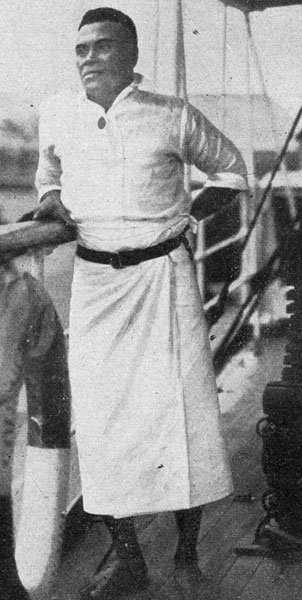
From the time Jesus said “Do this in remembrance of me” (and even before) faithful men and women have remembered, not just the meal and words of Jesus, but, the stories of those who went before them and those contemporaries who inspired hope in them. We have followed Jesus’ command and we have added the stories of Holy Women and Holy Men to our (Eucharistic) meals.
The Standing Commission on Liturgy and Music of the Episcopal Church is revising our “Memory Book.” You may remember the book Lesser Feasts and Fasts. This book collected short stories of “saintly” forebearers, men and women, commemorated throughout the year (see the Book of Common Prayer, pp. 15-33). In 2009 the Commission was asked to expand the number and kinds of commemorations. The Commission will report to General Convention this summer. However, the “Trial Use” of the old and new commemorations, now called Holy Women, Holy Men, will continue.
All of that is said so that I can introduce Ini Kopuria, Founder of the Melanesian Brotherhood, 1945. You may read his story here: June 6: [Ini Kopuria, Founder of the Melanesian Brotherhood, 1945]. You can see from the Collect to be used in the commemoration that the work of the Melanesian Brotherhood continues to this day.
Do you have a saintly woman or man (women or men) whose memory inspires your best actions and gives you hope? Please share.
THOSE SERVED by Wounded Warrior Project
THOSE SERVED by Wounded Warrior Project
In our Opportunity Calendar you will find a description of the Wounded Warrior Project with links to other Veteran’s resources. Today, via their Facebook Page, Wounded Warrior Project shares who they serve and why
More about THOSE SERVED by Wounded Warrior Project
In our Opportunity Calendar you will find a description of the Wounded Warrior Project with links to other Veteran’s resources. Today, via their Facebook Page, Wounded Warrior Project shares who they serve and why
Isaiah 6:1-8
An insight into the reading from Isaiah used on Trinity Sunday by Professor (Emeritus) Ralph W Klein.
An insight into the reading from Isaiah used on Trinity Sunday by Professor (Emeritus) Ralph W Klein.
Some questions to try out today
We’ll gather in our Sunday Morning Forum at 9am PDT this morning and take up the questions posed by our Forum Member, Wendy:
“Life and peace. Good life. We are invited to access it by freeing ourselves to be open to and led by the Spirit of God to become children of God (Romans 8:14 NRSV). Through our Western lens, to become spirit-focused seems to ignore the real world and to become a child almost seems to be a condescension, but are either of these fears accurate?
“Perhaps the greatest question to ponder is the destiny of a child? Is it to become an adult? Or, according to the Bible, here, is it to become in close relationship with God? Is the child an incomplete adult or is the child an image of one in closest relationship with God in Spirit? Here in Romans, we are invited to become as a child to enter into the Spirit of God. ” from Children of God by Wendy Sanders
- What images (verbal or otherwise) come to mind when you hear that you are “a child”?
- “Paul, you are such a child.” Can you imagine Paul’s reaction to that statement? What kind of response might he give?
- Is it the destiny of a child to “become an adult”? Explain.
- Is it the destiny of a child enter into “a close relationship with God”? Explain.
- Have you ever used the word “Abba” in your prayers? If yes, please share what you experienced.
To the Trinity be praise!
To the Trinity be praise!
God is music, God is life
that nurtures every creature in its kind.
Our God is the song of the angel throng
and the splendor of secret ways
hid from all humankind,
But God, our life is the life of all.
–Hildegard of Bingen (1098-1179)
Trying a new look
We have just switched to a new theme for our blog. Let us know what you think.
Feast of the Visitation (May 31)
Take a moment, now that you have found this, to consider the visit of Mary to Elizabeth. May 31st is the Feast of the Visitation in the Episcopal Liturgical Calendar.
In those days Mary set out and went with haste to a Judean town in the hill country, where she entered the house of Zechariah and greeted Elizabeth. When Elizabeth heard Mary’s greeting, the child leaped in her womb. And Elizabeth was filled with the Holy Spirit and exclaimed with a loud cry, “Blessed are you among women, and blessed is the fruit of your womb. And why has this happened to me, that the mother of my Lord comes to me? For as soon as I heard the sound of your greeting, the child in my womb leaped for joy. And blessed is she who believed that there would be a fulfillment of what was spoken to her by the Lord.” Luke 1:39-45
Take my life, and let it be consecrated, Lord, to Thee
We have titled Mary’s response to Elizabeth, “the Magnificat” Luke 1:4-55.
Earlier today Sojourners posted this in its “Verse and Voice” blog: “Take my life, and let it be consecrated, Lord, to Thee. Take my moments and my days; let them flow in ceaseless praise. Take my hands, and let them move at the impulse of Thy love. Take my feet, and let them be swift and beautiful for Thee. Amen.”
From the first verse of the hymn, “Take My Life and Let It Be” Post: Prayer of the Day: Take My Life and Let It Be
Finally, if you like to listen to different voices speaking on women in the Bible, and Mary on the Feast of the Visitation try this podcast: Lifting up the lowly offered by America: the national Catholic weekly
In what ways do these women model for you what it means to listen to the Spirit, to hear the Spirit, and to act on what you hear the Spirit saying to you? Leave a comment.

 Hear what the Spirit is saying