Bishop Welby is joined by his wife, Caroline, as members of the Vineyard movement ‘lay hands’ on them as they prepare to move to Lambeth Palace. Photo: Trent Vineyard
The wind picks up. There is change in the air. What do you hear?
The (almost) new Archbishop of Canterbury
This Monday, February 4, 2013, Justin Welby, Bishop of Durham, will become the 105th Archbishop of Canterbury in a ceremony at St. Paul’s Cathedral in London. In January, speaking to an audience at Trent Vineyard near Nottingham, Bishop Welby said,
I think we are in the greatest moment of opportunity for the Church since the Second World War, … In 2008 we had the most significant financial collapse in this country, in terms of the banking system, since the mid-19th century. One of the reasons the recession has been so deep and may be going into a triple dip is because there has been such a loss of confidence. … But the side effect of that has been that the state has run out of the capacity to do the things it had taken over since 1945. All the idols on which our society was based have fallen, they have been toppled. They have been toppled by the financial crisis, by scandal. Trust has broken down.
In the middle of yesterday’s (8/5/12) conversation about being called (to know Christ, to be holy as our God is holy) and calling (to be a wife, a husband, a father, a mother, a member of the choir, a member of the Altar Guild, an intercessor in prayer, a team member working in the food distribution ministry, a neighbor, a co-worker, a teacher and you get the idea) I read this from Professor Hanvik in his commentary on Ephesians 4:1-16
Paul pairs the words “called” and “callings” in two different places in the passage (4:1 and 4:4). The reader is reminded of the relationship between our being called by God and the subsequent assignment of a calling in the world. The language of calling links the church with the election of Israel. God has chosen for himself (1:4) a people and this election depends firmly on God’s decision. It is done “before the foundation of the world” (1:4) and it relies solely on God’s gracious initiative (2:8). And the result of being called is that the faithful now have callings where they lead lives marked by humility, love and patience (4:2).
It is easy to get confused about the dual nature of a call. It is worth underlining that being called and having a calling must be distinguished but never separated. Our relationship with God simultaneously involves a relationship with neighbor or community. And these callings are multiple as it is impossible for a Christian to not be in some type of calling at all times of life.
Just as God is active in every nook and cranny of creation so God uses his people to make sure people are fed, clothed, comforted, educated, protected, etc. Proclaimers would be wise to remind listeners that a calling should not be pared down to a job or occupation. This would mean wide stretches of human experience would be outside of God’s providence. God calls us not only to work but to friendship, family life, citizenship, etc. —WorkingPreacher.com for August 5, 2012
It was a terrific conversation. Thank you. I learned a lot. Please continue the conversation here using the Comment section which follows the post. Bless you, dear reader, bless you as you bless others by exercising the ministries to which you have been called.
“I am the bread of life. Whoever comes to me will never be hungry,
and whoever believes in me will never be thirsty.”
Jesus (John 6:35)
These words are the inspiration of the hymn “I am the bread of life” by Suzanne Toolan, RSM (Hymn 335 in our 1982 Episcopal Hymnal). The original wording has often been adapted to be more inclusive—even as Jesus was inclusive. Here is one arrangement of this hymn as you prepare for (or celebrate) Sunday’s Gospel text, John 6:24-35.
What a great gift we have been given. We will never exhaust the mystery of Emmanuel: God with us.
Today, July 31st, the Church remembers St. Ignatius of Loyola. Much has been written about Ignatius and many (including me) incorporate all or some of what is now called “Ignatian Spirituality” as a daily exercise of body, mind, and spirit.
Here is a video meditation (32 minutes) on the saint and his spirituality, on art, on the creativity of humans, on why we continue to find ways (like sculptures) to use material objects to enter more deeply into spiritual mysteries, and on the possibility that a 16th century human can still speak powerfully to us 21st century humans.
The process of making and placing “Examen” by Joan Benefiel and Jeremy Leichman (Figuration LLC) on the campus of Fairfield University.
The last 3 weeks we have read from “Paul’s Letter to the Ephesians” in our worship. In the discussion on Sunday (7/29/12) Stan and I raised the question about who authored the letter to the Ephesians. In part, our question arises from our reading of commentaries and essays by a variety of scholars including, most recently, the scholarship of Marcus Borg and John Dominic Crossan.
THREE PAULS
Mainstream scholarship as it has developed over the last two centuries has concluded that some of the thirteen letters attributed to Paul were not written by him. Rather, they fall into three categories.
First, a massive scholarly consensus: at least seven letters are “genuine” – that is, written by Paul himself. These seven include three longer ones (Romans, I and II Corinthians), and four shorter ones (I Thessalonians, Galatians, Philippians, and Philemon). Written in the 50s of the first century, plus or minus a year or two, they are the earliest documents in the New Testament, earlier than the gospels (recall that Mark, the first gospel, was written around 70). Thus the genuine letters of Paul are the oldest witness we have to what was to become Christianity.
Second, an almost equally strong consensus: three letters were not written by Paul. These are I and II Timothy and Titus, commonly known as “the pastoral epistles” or simply “the pastorals.” Scholars estimate that they were written around the year 100, possibly a decade or two later. The reasons these are seen as “non-Pauline” include what looks like a later historical setting as well as a style of writing quite unlike the Paul of the seven genuine letters.
Thus the letters to Timothy and Titus were written in the name of Paul several decades after his death. In case some readers may think that writing in somebody else’s name was dishonest or fraudulent, we note that it was a common practice in the ancient world. It was a literary convention of the time, including within Judaism.
Third, letters about which there is no scholarly consensus, though a majority see them as not coming from Paul. Often called the “disputed” epistles, they include Ephesians, Colossians, and II Thessalonians. We are among those who see these as “post-Paul,” written a generation or so after his death, midway between the genuine letters and the later pastoral letters.
In your reading and study have you formed an opinion? What role does the Holy Spirit play in the writing, preserving, handing on, and interpreting of these letters? What role does the Spirit play as you grapple with this kind of information? Let’s keep the conversation going.
A July 25 nighttime fire destroys St. James Church in Cannon Ball, North Dakota.
The Epistle for Proper 8 Year B read on July 1, 2012: 7 Now as you excel in everything—in faith, in speech, in knowledge, in utmost eagerness, and in our love for you —so we want you to excel also in this generous undertaking. 8 I do not say this as a command, but I am testing the genuineness of your love against the earnestness of others. 9 For you know the generous act of our Lord Jesus Christ, that though he was rich, yet for your sakes he became poor, so that by his poverty you might become rich. 10 And in this matter I am giving my advice: it is appropriate for you who began last year not only to do something but even to desire to do something— 11 now finish doing it, so that your eagerness may be matched by completing it according to your means. 12 For if the eagerness is there, the gift is acceptable according to what one has—not according to what one does not have. 13 I do not mean that there should be relief for others and pressure on you, but it is a question of a fair balance between 14 your present abundance and their need, so that their abundance may be for your need, in order that there may be a fair balance. 15 As it is written, “The one who had much did not have too much, and the one who had little did not have too little.” 2 Corinthians 8:7-15
How believers use their resources — time, money, talents, and attention — is a reflection of what they believe about God and God’s actions in the world. Furthermore, how those resources are used preaches a message to others. Paul wants the Corinthians’ actions to be a reflection of the gospel in which they believe.
This passage fits in a larger section of 2 Corinthians (8:1-9:15) that is chiefly concerned with Paul’s collection for the Jerusalem church.…
In 2 Corinthians 9, Paul gets more mileage out of the Macedonian success story by shaming the Corinthian church into acting.…
Before he resorts to shaming them directly, he reminds the believers that their actions to support the Jerusalem poor demonstrate the earnestness of their faith (2 Corinthians 8:8). Paul reframes the whole collection as the gospel enacted. In 2 Corinthians 8:9, Paul retells the good news through the lens of generosity. Christ gave up extraordinary riches so that others might receive the abundant wealth of God’s grace.
A July 25 nighttime fire has destroyed St. James’ Episcopal Church in Cannon Ball, North Dakota.
Sioux County, where Cannon Ball is located, is one of the poorest counties in North Dakota and among the top ten poorest in the nation
“At 10 p.m. Central Time a parishioner who lives across the road from St. James’ saw that there was smoke and fire coming from the church,” said the Rev. Canon John Floberg, who has served as St. James’ rector for 21 years and is canon missioner for native ministry in the Diocese of North Dakota. “Flames spread quickly through the parish hall to the church itself, and by quarter of eleven the whole structure was engulfed in flames. It’s all ash today.” Read more: NORTH DAKOTA: Fire destroys St. James’ Episcopal Church
I propose that we take up a collection in the Sunday Morning Forum for the people of St. James Episcopal Church. With the Apostle and the with the Professor I believe that how we use our resources tells a lot about what we believe about God and God’s actions in the world.
In Advent 2011, with input from Forum members, our (online) Advent Calendar (and 12 Days of Christmas Calendar) featured different individuals and organizations dedicated to serving others (and in serving also helping others). One of the goals of the Sunday Morning Forum (online and in real time) is for us to grow/mature in faith through the actions we take. We want to allow our faith to inform our actions and have our actions inspire a deeper faith in a ever expanding way.
One of the featured organizations in Advent was charity: water. Here is my introduction to their important work:
If you have ever hiked or camped in the wilderness you KNOW how precious water is to your survival. Drink contaminated water and you become sick. Go without water, become dehydrated, and you are in peril within 48 hours. A person can survive without food for days or weeks, a person deprived of water will likely be dead within days, not lasting even a week. ~dan rondeau
charity: water is a non-profit organization bringing clean and safe drinking water to people in developing nations. (from the Mission Statement of charity: water)
Here is a video sample of the work being done by charity: water. The video tells Rachel’s story (have your kleenex ready), but I also encourage you to read the blog post.
My “go-to” book on discernment is Hearing with the heart: A gentle guide to discerning God’s will for your life (San Francisco, CA: Jossey-Bass, 2003) by Debra K. Farrington. She begins Chapter 1 with this prayer by Thomas à Kempis whom the Episcopal Church commemorates today (July 24):
Grant me, O Lord, to know what I ought to know, to love what I ought to love, to praise what delights you most, to value what is precious in your sight, to hate what is offensive to you. Do not allow me to judge according to the sight of my eyes, nor to pass sentence according to the hearing of my ears; but to discern with a true judgment between things visible and spiritual, and above all things, always to inquire what is the good pleasure of your will.
The wisdom of Thomas has helped and continues to help shape my spirituality. My prayer is frequently not as eloquent as this prayer, but it is nonetheless fervent in seeking to know and do God’s will.
What do you think—is his prayer something you have prayed? Something you would like to pray? Something that a Christ-follower might actually achieve (knowing and doing God’s will)? Let us know.
Jesus matured in wisdom and years, and in favor with God and with people. Luke 2:52 CEB
Mary Magdalene: Apostle to the Apostles
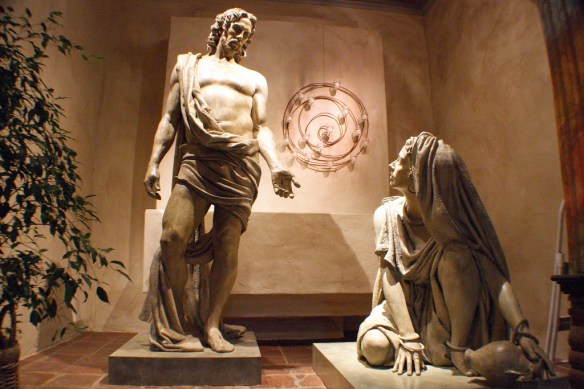
Jesus with Mary Magdalene by Bruce Wolfe in the Mission Santa Barbara
Every July 22nd the Episcopal Church commemorates Mary Magdalene, Apostle to the Apostles. This year her commemoration is moved to Monday, July 23rd.
Misidentification of Mary as reformed public sinner achieved official standing with a powerful homily by Pope Gregory the Great (540-604).
Henceforth, Mary of Magdala became known in the west, not as the strong woman leader who accompanied Jesus through a tortuous death, first witnessed his Resurrection, and proclaimed the Risen Savior to the early church, but as a wanton woman in need of repentance and a life of hidden (and hopefully silent) penitence. Interestingly, the eastern church never identified her as a prostitute, but honored her throughout history as “the Apostle to the Apostles”. Read more at Mary of Magdala– Apostle to the Apostles
The Gospel narratives give a prominence to women in the Jesus movement unusual in ancient society; this culminates in the extraordinary part which they play in Matthew’s, Mark’s and John’s accounts of the human discovery of the Resurrection. All three evangelists make women the first witnesses to the empty tomb and resurrection of Jesus; this is despite the fact that in Jewish Law women could not be considered as valid witnesses. The most prominent named woman, first in all three accounts, is Mary Magdalene (‘from Magdala’ in Galilee). She was a close associate of Jesus in his public ministry and has continued to arouse a set of variously motivated fascinations among Christians throughout the ages. Some overexcited modern commentators and mediocre novelists have even elevated her (on no good ancient evidence) to the status of Jesus’s wife.
(MacCulloch, Diarmaid (2010-02-25). Christianity: The First Three Thousand Years, Kindle Edition. Search word: Magdalene
As far as we know, all the House for all Sinners and Saints folks are safe, but many of us had friends and loved ones who were at that theater last night who are quite shaken. Kyrie. Let us pray for all those involved including the shooter. It’s one of the less pleasant elements of the Christian faith, but loving the enemy was not a suggestion.
–(The Rev.) Nadia Bolz-Weber (on Facebook)
After the killing in Aurora, CO our bishop wrote …
The horrific tragedy in Aurora, Colorado rightly brings us to our knees in prayer. Our emotions are myriad: shock, sorrow, anger, and disbelief. While we pray for those who have died, their families, and indeed the perpetrator and his family, we should pause to question the culture of violence that is pervasive in our country.
Guns, violent films and video games did not commit murder yesterday night; a very disturbed individual did. However, it is not a remarkable supposition to think that a contributing factor to this senseless massacre is the lethal combination of available guns and the relentless presentation of violent acts. The latter makes violence seem incidental and inconsequential.
As followers of the prince of peace, we must redouble our efforts to stop senseless violence before it happens. We can go a long way as a society by having sensible gun control and by saying no to entertainment through violence. This will not bring back the victims of this dark moment, but perhaps it will prevent others.
—The Rt. Rev. James R. Mathes Bishop


 I think we are in the greatest moment of opportunity for the Church since the Second World War, … In 2008 we had the most significant financial collapse in this country, in terms of the banking system, since the mid-19th century. One of the reasons the recession has been so deep and may be going into a triple dip is because there has been such a loss of confidence. … But the side effect of that has been that the state has run out of the capacity to do the things it had taken over since 1945. All the idols on which our society was based have fallen, they have been toppled. They have been toppled by the financial crisis, by scandal. Trust has broken down.


 Hear what the Spirit is saying