Items of General Interest about liturgy, the liturgical calendar, church customs and culture, our unique “Episcopal vocabulary,” the intersection of faith and culture, and all other items not fitting into the other categories (or fitting into multiple categories).
March 8th is “International Women’s Day, a day of remembrance and reflection celebrated around the world since 1913,” according to Episcopal News Service.
Here are a few of the posts on our blog that have sought to increase awareness of the needs and issues of women and girls throughout our world and right in our own neighborhoods. As always, my hope and prayer is that with increased awareness of need and the whisper of the Holy Spirit, individual and collective action to meet these needs will result. Blessings on this International Women’s Day. ~dan
Two Against Gender Violence – introduced in our Advent Calendar Day 14, this post links to ECS Julian’s Housing Program for Women and Children and Shelter from the Storm
charity: water – posted in our Advent Calendar, Day 24, this post raises awareness about how women and girls are adversely impacted by doing the work of obtaining water for the household (“women’s work”) and how charity: water by bringing water to a village (via wells, or filtration and storage systems) positively impacts the lives of these women and girls (Recommended: Water Changes Everything video)
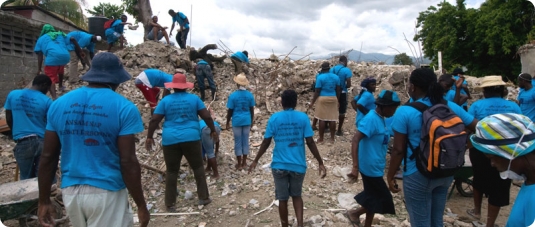
On Sunday, March 4th, over a dozen Forum participants gathered with other parishioners to hear Sandra Swan talk about Haiti, about Episcopal Relief and Development, and about the efforts of every diocese and parish within the Episcopal Church—including St. Margaret’s—to learn about and “give alms” for the rebuilding of Haiti. Lane and Chet, the Vestry and its Outreach Commission, have made this our charitable effort in Lent 2012 (you can see the bricks in the Narthex every Sunday to remind you of this project).
Today, I challenge our Sunday Morning Forum (you and me) to contribute $1,000 to this Lenten alms giving. This seems like a modest goal for us who seek to be “doers of the word.” (James 1:22)
We are averaging over 20 folks in our Sunday morning gathering on campus. With just the Sunday morning crowd and a donation of $50 each we can make this goal. Reaching out to our friends and family and online Forum members we may exceed this goal for the glory of God and the relief of his people in Haiti.
If you have already given to the Haiti effort, let me know and we’ll add that to our total. Today Carol and I have donated $100 for the rebuilding of Haiti. Let’s do this as part of our effort to put our faith into action. Thank you. ~father dan
Donate Now as a doer of the word
Use ParishPay (a secure website used by the church). Under One-Time Donations designate Rebuild Haiti to make your donation. (The option Carol and I used)
Use the Episcopal Relief and Development secure website to make your donation; designate “Haiti Earthquake Response” to make your donation
Write a check to St. Margaret’s Episcopal Church and indicate “Rebuild Haiti” on the Memo Line. Send check to: St. Margaret’s Episcopal Church | 47535 Highway 74 | Palm Desert, CA 92260 or drop the check into the Sunday collection at worship.
All contributions to St. Margaret’s for Haiti Relief will be sent to Episcopal Relief and Development whose workers and whose aid arrived in Haiti within hours of the January 12th earthquake in 2010 and whose commitment is to continue “its support throughout the recovery and rehabilitation process” (no matter how long it takes).
Additional information about how donations to ERD are used:
Having introduced Hovak Najarian I share his first post as an author. For those who pray the “Way of the Cross” also known as the “Stations of the Cross” the legend/tradition presented here is preserved in Station 6: “A woman wipes the face of Jesus.” Growing up Roman Catholic I KNEW the name of this woman: Veronica. But did I know the truth? Decide for yourself. Leave a comment. ~dan rondeau
The image of a face from the Shroud of Turin
King Abgar V of Edessa
In the early part of the first century AD, a time when the Romans and the Parthians were dominant powers in Asia Minor and the Near East, Abgar V, a nephew to Tigranes the Great, was the king of Armenia. In order to stay out of the way of both major powers, he moved his court to the Mesopotamian city of Edessa where he could remain on good terms with both nations. Edessa prospered during this time but while Abgar was away on a trip to settle a dispute between the Armenians and Persians, he became ill. He remained ill after he returned home. Having heard reports of Jesus’ miracles of healing, he decided to invite him to Edessa.
The legend:
King Abgar sent his archivist and court painter, Hannan, with a letter asking Jesus to come to Edessa to heal his illness. Hannan also was asked to paint a portrait of Jesus in order that Abgar could see his image. A return letter from Jesus stated he was unable to come to Edessa but later would send one of his disciples. Hannan made a portrait and returned to Edessa with the letter and painting. In his Historia Ecclesiastica (AD 325), Bishop Eusebius of Caesarea wrote of the correspondence between Abgar and Jesus and included a text of the two letters. There may have been letters exchanged but both letters published by Bishop Eusebius have been proven to be fabrications. A painted image of Jesus (known as The Holy Face) is of questionable origin as well. Several early icons depicting the face of Jesus are known but there is no evidence to confirm that any of them were painted from life or if one of them was painted by Hannan. A few centuries later it was said Jesus produced The Holy Face himself by pressing a wet cloth to his face and causing the image to appear miraculously.
After the death of Jesus, his disciple, Thaddeus, came to Edessa and gave Abgar a cloth on which there was an image of Jesus (known as the Image of Edessa) – as a result of the visit and the power of the cloth, according to the legend, Abgar was converted and healed. The cloth was folded in such a manner that only the face could be seen. In 942 AD, under the threat of being overrun, the Image of Edessa was turned over to the Byzantines as part of a bargain to maintain peace. When it was taken to Byzantium (later called Constantinople and now Istanbul) and unfolded, the full figure of a man was revealed. It is believed this is the cloth that now is known as the Shroud of Turin (a linen cloth with an unexplained imprinted image of a man who had been crucified). It has been suggested this may have been the actual cloth placed on Jesus at the time of his burial.
Inasmuch as the cloth remained folded for many years and only the face was seen, it is speculated the legend of Veronica’s veil also is based on this shroud. According to a story that has no scriptural bases, a woman used her veil to wipe the sweat off Jesus’ face while he was carrying his cross to Golgotha. Afterward, a miraculous image of his face appeared on the cloth. Church fathers accepted this story as fact and gave this mythical woman the name Veronica; a name derived from vera icon (Latin for true image). The story has become part of Roman Catholic Church legend.
In ancient times it was not unusual for myths, legends, and partial facts to be blended, modified and embellished; later they would be recounted as “tradition” or even reported as fact. If a tradition were of a religious nature, often it would be incorporated into church worship services and festival days.
The current status of these legends:
The Armenian Apostolic Church:
In the Armenian Church, Abgar is regarded to be a saint and his story continues to be told as tradition. The Church calendar honors “St. Abgar” in a worship service in December of every year and the name Abgar continues as an Armenian given name. It also is the root of the surname Abgarian (also spelled Abkarian, or Abcarian); from the family of Abgar.
The Roman Catholic Church:
Despite an absence of Biblical reference or historical evidence that a person given the name Veronica ever existed, canonization took place and now “St. Veronica” is celebrated on special church festival days. The whereabouts of the veil is obscure; it is said to be in the Vatican archives but other locations have been suggested. A great number of churches and schools are named in honor of Veronica and it is a popular given name.
The Shroud of Turin
The Shroud of Turin underwent radiocarbon testing in 1988 and the result of the test indicated the cloth was made during the Middle Ages approximately 1300 years after the death of Jesus. Unanswered questions remain, however, and the test result neither satisfied nor was accepted by people who believe the Shroud is, in fact, the actual cloth used to cover the body of Jesus. The tested portion, they believe, was from a section that was a restoration and not part of the original cloth. It has not been tested again.
College of the Desert Professor Emeritus (Art) Hovak Najarian
Updated: May 14, 2024
If you are new to this blog, I am pleased to introduce you to (Dr.) Hovak Najarian. Since 2011 Hovak has introduced us to artists, art techniques, and art history to keep us growing in the knowledge and love of the Lord.
After receiving his MA in Art at Columbia University Hovak and his wife, Margie, spent 3 years in Normal, IL on the art faculty of Illinois State University. In his own words, “We soon found that natives of Florida and California were no match for winters in Illinois.”
In 1966 Hovak and Margie relocated to Southern California when Hovak accepted a teaching position at College of the Desert in Palm Desert. He retired in 1994 and was honored with the title Professor Emeritus (Art) by the College of the Desert. Again, Hovak: “During that time [1966-1994], I was Chair of the Art Department for many years, returned to Columbia University and completed my doctorate, and with Margie, raised three wonderful sons.”
In his retirement, Hovak continues his own creative work, and, has been an active participant in the Sunday Morning Forum and a regular contributor to this blog. Hovak is active in St. Margaret’s Episcopal Church and in the Armenian community in the Coachella Valley which gives him a unique perspective to share.
As we journey together I expect to learn more about art, art history, art as an expression of faith, and art as a shaper of faith. Together, let us hear what the Spirit is saying. ~Fr. Dan
On last Sunday, David Burgdorf pointed out that Mark gives us a succinct pilgrimage as Jesus travels to be baptized and identified, is tempted, and returns to begin his ministry.
All the elements of pilgrimage are there – a change of venue leading to insight and a period of assimilation and then return with a new or renewed sence of purpose.
Some of you may have heard that I have set a Lenten task for myself; to invite every one I meet at Church to come visit St. Margaret’s Outreach Center on San Pablo Drive. My asking is not the pilgrimage. The pilgrimage is yours, if you decide to come.
My hope is that you may find and bring insight, assimilation and renewal to this work of the church.
Current hours of operation are Tuesday 7am-5pm for preparation and client services and Thursday 9am-10am for “Not by Bread Alone” a prayer service and discussion.
If you come Tuesday morning (back door) find Bob Kimball. If you come Tuesday afternoon find Chet Hecht. If you come Thursday for prayers see David Rhodes.
“A traditional view of Lent is that it’s a time of restriction, sacrifice, and giving up things. But it can also be a time for expansion, rededication, and connection with others. Many people take on special devotional practices during Lent; others also make more time during this season to be in conversation with their spiritual communities.”Spirtuality & Practice email dated Feb. 18, 2012
Expand your mind and heart with the folks of St. Margaret’s this Lent, rededicate yourself to following Jesus Christ, find a connection with those you work with, socialize with and with whom you worship. Forty members of St. Margaret’s have each written a meditation for one of the days of Lent. We invite you “to observe a holy Lent” with us:
Three ways to receive the daily Lenten Meditations
Go daily to the St. Margaret’s website and click the image to see the meditation of the day. This banner will be visible throughout Lent.
“Follow” the Lenten Meditations blog (on WordPress) by using the Follow button in the right side bar (or at the bottom of blog page).
Bookmark the Lenten Meditations blog in your browser and, in the 40 days of Lent, use the bookmark to go back to the blog where you will find a new meditation each day.
About the image: a close up of Ocotillo flowers taken in the Santa Rosa Mountains above Palm Desert in March 2005 by Stan Shebs and posted on Wikimedia Commons.
On February 2nd we annually recall the Prestation of our Lord in the Temple. Here is an excellent summary of the commemoration (with some additional links).
Counting forward from December 25 as Day One, we find that Day Forty is February 2. A Jewish woman is in semi-seclusion for 40 days after giving birth to a son, and accordingly it is on February 2 that we celebrate the coming of Mary and Joseph with the infantJesus to the Temple at Jerusalem to offer sacrifice, both on behalf of Mary and on behalf of Jesus as a first-born male. As they did so, they were greeted by the aged Simeon.
In a Sunday-School pageant I once saw, the narrator said, “And now Simeon bursts into a spontaneous song of praise, assisted by the Temple Choir.” His song, called the Nunc Dimittis, has always had a prominent role in Christian worship. It has often been rendered in verse. [ … ]
On the other hand, Groundhog Day (“If the groundhog (or woodchuck, a kind of marmot, which burrows and hibernates) sees his shadow on 2 February, there will be six more weeks of winter.”) is strictly a secular holiday, confined, as far as I know, to the United States.
A short history of Candlemas Day (also from Daily Prayer for Feb 2nd)
By the seventh century it had become the custom to begin the worship service on February 2 with candlelighting by the congregation gathered outside the worship area followed by a procession into the Church with all carrying their lighted candles. This was to relive Simeon’s experience of meeting the “light of nations” at the temple. The pastor Sophronius wrote in that century
Everyone should be eager to join the procession and to carry a light.
Our lighted candles are a sign of the divine splendor of the one who came to expel the dark shadows of evil and to make the whole universe radiant with the brilliance of his eternal light. Our candles also show how bright our souls should be when we go to meet Christ.
So let us hasten to meet our God.
The custom of beginning the worship on this festival with a candlelight procession is the origin of the day’s other name, “Candlemas.”
The festival day’s position at midwinterexactly midway between the winter solstice December 21 or 22 each year in the Northern Hemisphere, and June 20 or 21 in the Southern Hemisphere. and the spring equinox the day when daylight lasts for exactly 12 hourscaused it to be a time for taking inventory of one’s winter supplies. One English poem goes:
The provident farmer on Candlemas Day,
Hath half of his fires and half of his hay.
The day’s emphasis on light and life at midwinter gave rise to many superstitions and legends. Some believed that “if the day be clear and sunshiny, it portends a hard weather to come; if cloudy and lowing, mild and gentle season ensuing.” From that piece of weather folklore it is not too difficult to understand how our Pennsylvania Dutch descendants of Germanic peoples who emigrated to the United States (primarily to Pennsylvania), from Germany, Switzerland and The Low Countries prior to 1800 legend of Groundhog Day began.
By the seventeenth century the Presentation of Our Lord was understood to be the absolute end of the Christmas season. Indeed, Ash Wednesday the first day in the season of Lent can follow as early as just two days later on February 4. As the end of the Christmas festivities, it was the day to complete the removal of all the holiday decorations. This, too, became the cause of superstition:
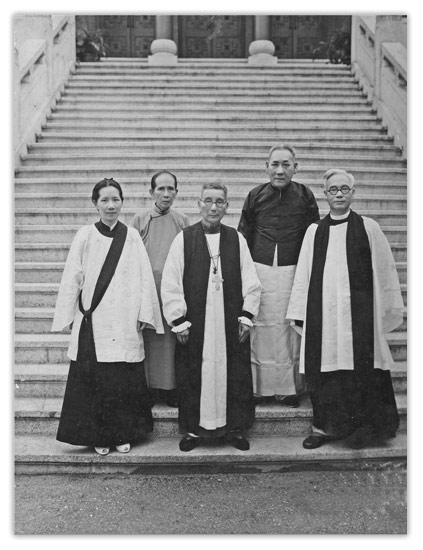
Li Tim-Oi, her mother, Bishop Mok, her father, Archdeacon Lee Kow Yan after her ordination as Deacon by Bishop R 0 Hall at St John’s Cathedral HK. Ascension Day 22 May 1941 Photo from Li Tim-Oi Story
Today (Jan, 24) the Episcopal Church commemorates Florence Li Tim-Oi: the first woman priest in the Anglican Communion (ordained on 25 January 1944). I encourage you to read her story:
At her birth in Hong Kong on 5 May 1907 Li Tim-Oi’s father called her “Much Beloved” because he valued her as a daughter even if others prefered sons.
The Li Tim-Oi Foundation was established in 1994. The Foundation funds It takes ONE woman: “It takes ONE woman sums up the story and aim of the LI TIM-OI FOUNDATION – founded in memory of the first Anglican woman priest – to empower Christian women to be agents of change in the Two-Thirds World.” (from the Foundation website)
In yesterday’s (1/22/12) Forum our group wondered aloud about God changing his mind: ” When God saw what they did, how they turned from their evil ways, God changed his mind about the calamity that he had said he would bring upon them; and he did not do it.” Jonah 3:10 NRSV
It was a lively discussion among Episcopalians and there was a spectrum of faith statements and realizations. When one of our members observed that the answer to the question about God’s ability to change God’s mind really makes a difference in how we pray there were many affirmations and nods of agreement. It does make a difference.
The questions we were responding to in the light of the reading from Jonah:
Does God change his mind?
Does he ever change it in response to our prayers?
How do Bible statements that God ordains the future and that he alters his plans relate to each other?
Does God know your next move—whether it’s a life-changing decision or a routine choice at the grocery store?
And if he really knows it all, are you truly free?
Does God know the future?
Does he know it precisely or just with a high degree of probability?
Was God taking a risk in making the human race?
If God doesn’t know the future, how do we make sense of Bible prophecy?
And if God doesn’t know the future, what are we to make of the Bible’s teaching that “those whom God foreknew, he also predestined to be conformed to the image of his Son”?
Questions posed in Christianity Today, May 21, 2001 in an article on Open Theism http://bit.ly/x1LGln
We also looked at how various translators have presented this one verse (Jonah 3:10), commenting on the thoughts and feelings evoked by these translations:
And God saw their works, that they turned from their evil way; and God repented of the evil, that he had said that he would do unto them; and he did it not. KJV
When God saw what they did and how they turned from their evil ways, he had compassion and did not bring upon them the destruction he had threatened. NIV
When God saw by their actions how they turned from their evil way, he repented of the evil he had threatened to do to them; he did not carry it out. NABRE
God saw what they did, how they were turning back from their evil ways. And God renounced the punishment He had planned to bring upon them, and did not carry it out. NJPS
When God saw what they did and how they gave up their wicked ways, he relented and did not inflict on them the punishment he had threatened. REB
God saw what they were doing—that they had ceased their evil behavior. So God stopped planning to destroy them, and he didn’t do it. CEB
Please join the conversation. Leave a comment. Does God change his mind? Does it make a difference?






 Hear what the Spirit is saying