7/25/12—Maturing in wisdom and age

charity: water

In Advent 2011, with input from Forum members, our (online) Advent Calendar (and 12 Days of Christmas Calendar) featured different individuals and organizations dedicated to serving others (and in serving also helping others). One of the goals of the Sunday Morning Forum (online and in real time) is for us to grow/mature in faith through the actions we take. We want to allow our faith to inform our actions and have our actions inspire a deeper faith in a ever expanding way.

One of the featured organizations in Advent was charity: water. Here is my introduction to their important work:

If you have ever hiked or camped in the wilderness you KNOW how precious water is to your survival. Drink contaminated water and you become sick. Go without water, become dehydrated, and you are in peril within 48 hours. A person can survive without food for days or weeks, a person deprived of water will likely be dead within days, not lasting even a week. ~dan rondeau

charity: water is a non-profit organization bringing clean and safe drinking water to people in developing nations. (from the Mission Statement of charity: water)

Here is a video sample of the work being done by charity: water. The video tells Rachel’s story (have your kleenex ready), but I also encourage you to read the blog post.

Rachel Beckwith’s Mom Visits Ethiopia. from charity: water on Vimeo.

Finally, I encourage you to make a donation to Rachel’s Birthday Wish for Sienna or donate directly to charity: water and, please, leave a comment here or on their blog.

B Proper 12, Art for July 29, 2012

SALVIATI, Cecchino del
(b. 1510, Firenze, d. 1563, Roma)
Click to open Web Gallery of Art Artist Biography and to explore other works by this artist.

Bathsheba Goes to King David
1552-54
Fresco
Palazzo Sacchetti, RomeClick to open Web Gallery of Art commentary page. Click image for large view.

Related art commentary by Hovak Najarian.

Bathsheba Goes to King David, 1552-1554, Fresco, Cecchino del Salviati (1510-1563)

Commentary by Hovak Najarian

Related post B Proper 12, Art for July 29, 2012

As a young man, Francisco de’Rossi (before taking the name Cecchino del Salviati), studied with several artists in Florence, the city of his birth. Among his teachers was Andrea del Sarto, whose skills were so highly regarded he was called, “the faultless painter.” After two years in del Sarto’s studio, de’Rossi’s left to work on an unfinished fresco at the palace of Cardinal Giovanni Salviati in Rome and through his connections, further commissions were received. While there, he also determined it would be a good career move to take his patron’s surname as his own. Now, in addition to the name, Cecchino del Salviati, he continues to be known by his given name, Francisco de’Rossi, as well as Francisco Salviati and Il Salviati.

As the classicism of the Renaissance waned, Mannerist characteristics increased. In painting, sculpture, and architecture of this period there was frequently novelty, artificiality, discrepancy in scale, and linear movement (Vasari referred to this as a “serpentine line”). Also, in many Mannerist works there was a manipulation of pictorial space. Instead of staying with the exactness of Renaissance perspective, they modified space and often made it ambiguous; at times, a viewer is unable to determine what the artist was intending. In his paintings, Salviati used many of these Mannerist devices; note particularly the background, curvilinear staircase, and Bathsheba’s melodramatic pose in Bathsheba Goes to King David

This painting of Bathsheba is one of the frescos based on the life of King David painted by Salviati at the Palazzo Sacchetti in Rome. The presentation of this story, however, differs from the usual paintings of Bathsheba. In a typical painting, Bathsheba is bathing while King David is ogling her from the rooftop of his palace. Often, the primary focus is on a voluptuous Bathsheba at her bath. Salviati moves this story forward to the time she has come to the palace to see David. It is a rather unusual painting in that Salviati presents us with a look at Bathsheba from both back and front as she pauses before ascending the stairs. In the lower right corner of this painting we see her from the back; her fingers are lifting a portion of her dress coquettishly. Her left hand is holding her outer garment and she is turning her head to the left. Next we see her again at the foot of a spiral staircase. Bathsheba is now in the same pose but we see her from an opposite point of view; from the front we are shown she is wearing a diaphanous dress. At the top of the stairs King David is in a toga and finally the sequence ends in the shadow of David’s chamber where we are given a glimpse of the couple embracing.

Note

Venus, Bathsheba and Odalisque: In art, the portrayal of Venus was not to be seen in medieval art; Mary was the image venerated during those years. During the Renaissance, Mary continued to be honored but Venus made a comeback. Not only did artists paint scenes of the dalliances of Venus and other goddesses but the Bible also became a source of titillating subjects such as Bathsheba. Later, in the nineteenth century, the romanticists were enamored with the exotic Near East and in art the odalisque (harem woman) replaced Venus as one of the favorite subjects.

Color: When black pigment is added to a color it is called a “shade.” When white pigment is added it becomes a “tint.” When water based paints are absorbed into wet plaster (as when painting a fresco) the white of the plaster combines with the pigment and this makes its color a little lighter; it becomes, in effect, a “tint.” Also it decreases the saturation (intensity) of the colors, thus frescos tend to be soft in tone.

______________

© 2012 Hovak Najarian

7/24/12—Maturing in wisdom and age

Thomas à Kempis

My “go-to” book on discernment is Hearing with the heart: A gentle guide to discerning God’s will for your life (San Francisco, CA: Jossey-Bass, 2003) by Debra K. Farrington. She begins Chapter 1 with this prayer by Thomas à Kempis whom the Episcopal Church commemorates today (July 24):

Grant me, O Lord, to know what I ought to know, to love what I ought to love, to praise what delights you most, to value what is precious in your sight, to hate what is offensive to you. Do not allow me to judge according to the sight of my eyes, nor to pass sentence according to the hearing of my ears; but to discern with a true judgment between things visible and spiritual, and above all things, always to inquire what is the good pleasure of your will.

The wisdom of Thomas has helped and continues to help shape my spirituality. My prayer is frequently not as eloquent as this prayer, but it is nonetheless fervent in seeking to know and do God’s will.

What do you think—is his prayer something you have prayed? Something you would like to pray? Something that a Christ-follower might actually achieve (knowing and doing God’s will)? Let us know.

7/22/12—Maturing in wisdom and age

Jesus matured in wisdom and years, and in favor with God and with people. Luke 2:52 CEB

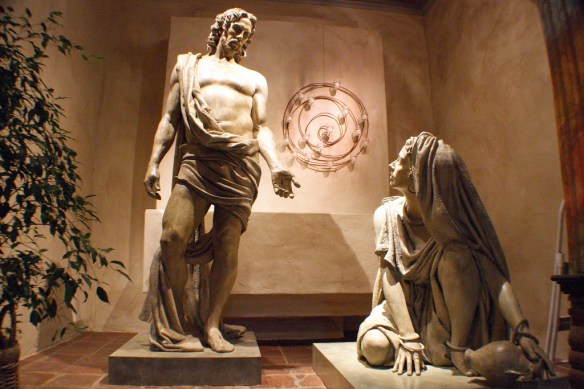
Mary Magdalene: Apostle to the Apostles

Jesus and Mary Magdalene by Bruce Wolfe in the Mission Santa Barbara
Jesus with Mary Magdalene by Bruce Wolfe in the Mission Santa Barbara

Every July 22nd the Episcopal Church commemorates Mary Magdalene, Apostle to the Apostles. This year her commemoration is moved to Monday, July 23rd.

Misidentification of Mary as reformed public sinner achieved official standing with a powerful homily by Pope Gregory the Great (540-604).
Henceforth, Mary of Magdala became known in the west, not as the strong woman leader who accompanied Jesus through a tortuous death, first witnessed his Resurrection, and proclaimed the Risen Savior to the early church, but as a wanton woman in need of repentance and a life of hidden (and hopefully silent) penitence. Interestingly, the eastern church never identified her as a prostitute, but honored her throughout history as “the Apostle to the Apostles”. Read more at Mary of Magdala– Apostle to the Apostles
Mary Magdalene looking to the Risen Christ
The Gospel narratives give a prominence to women in the Jesus movement unusual in ancient society; this culminates in the extraordinary part which they play in Matthew’s, Mark’s and John’s accounts of the human discovery of the Resurrection. All three evangelists make women the first witnesses to the empty tomb and resurrection of Jesus; this is despite the fact that in Jewish Law women could not be considered as valid witnesses. The most prominent named woman, first in all three accounts, is Mary Magdalene (‘from Magdala’ in Galilee). She was a close associate of Jesus in his public ministry and has continued to arouse a set of variously motivated fascinations among Christians throughout the ages. Some overexcited modern commentators and mediocre novelists have even elevated her (on no good ancient evidence) to the status of Jesus’s wife.
(MacCulloch, Diarmaid (2010-02-25). Christianity: The First Three Thousand Years, Kindle Edition. Search word: Magdalene

7/20/12—Maturing in wisdom and age

Jesus matured in wisdom and years, and in favor with God and with people. Luke 2:52 CEB

The wisdom of a Lutheran Pastor …

Note: The House for All Sinners and Saints is in Denver, CO.

As far as we know, all the House for all Sinners and Saints folks are safe, but many of us had friends and loved ones who were at that theater last night who are quite shaken. Kyrie. Let us pray for all those involved including the shooter. It’s one of the less pleasant elements of the Christian faith, but loving the enemy was not a suggestion.
–(The Rev.) Nadia Bolz-Weber (on Facebook)

After the killing in Aurora, CO our bishop wrote …

The horrific tragedy in Aurora, Colorado rightly brings us to our knees in prayer. Our emotions are myriad: shock, sorrow, anger, and disbelief. While we pray for those who have died, their families, and indeed the perpetrator and his family, we should pause to question the culture of violence that is pervasive in our country.

Guns, violent films and video games did not commit murder yesterday night; a very disturbed individual did. However, it is not a remarkable supposition to think that a contributing factor to this senseless massacre is the lethal combination of available guns and the relentless presentation of violent acts. The latter makes violence seem incidental and inconsequential.

As followers of the prince of peace, we must redouble our efforts to stop senseless violence before it happens. We can go a long way as a society by having sensible gun control and by saying no to entertainment through violence. This will not bring back the victims of this dark moment, but perhaps it will prevent others.
—The Rt. Rev. James R. Mathes Bishop

Long on Jesus

The Rev. Gay Clark Jennings is the newly elected President of the House of Deputies. She has written an op-ed essay published in the Washington Post. I’m proud to be Episcopalian:

Episcopal churches: Short on politics, sexuality debates and long on Jesus

7/18/12—Maturing in wisdom and age

Jesus matured in wisdom and years, and in favor with God and with people. Luke 2:52 CEB

World Water Day video from charity: water

World Water Day is observed on March 22nd every year. However, the need for clean water is constant. This short video was prepared by charity: water. The video speaks volumes. The need is great. I want to be part of the solution; I hope you do, too.

The Tabernacle of Peretola, 1442, Marble, Glazed Terra cotta, and Bronze, Luca della Robbia (1400-1482)

Commentary by Hovak Najarian

Related post B Proper 11, Art for July 22, 2012

During his lifetime, Luca della Robbia was said to be among the finest artists of the early Renaissance. Critics continue to hold him in high regard but they are mixed in their appraisal. It is believed he could have grown much more as a sculptor if he had worked only in stone or bronze. Yet his relief work in terra cotta was of such remarkable quality that his name and fame has been linked with it forever. In his “Tabernacle,” della Robbia includes terra cotta alongside marble and bronze, and the figures are surrounded by an architectural frame that is carved in relief and is part of the sculpture itself. The subject of each section is part of the overall trinity theme.

The uppermost section is a pediment in marble with a figure of God the Father being represented as an old man with a long beard. He is giving a blessing with his right hand while his left hand is holding a tablet with the first and last letters of the Greek alphabet; a reference to a statement in the Book of Revelation (22:13), “I am Alpha and Omega, the beginning and the end.”

The central section of the tabernacle is a lamentation in a lunette made of terra cotta. The figures include an angel with an anguished expression holding up the figure of the crucified Christ. His grieving mother, Mary, is on the left side and St. John with his head bowed is on the right. At the time this sculpture was commissioned, della Robbia had been experimenting with clay and glazes and this tabernacle is the first piece in which he used glazed terra cotta. Even after being fired, terra cotta is not as dense as marble; the white glaze that della Robbia formulated and used extensively added hardness to its the surface. He often used blue glaze as a background for the white figures.

The lower section of the sculpture is carved in marble and contains two bronze elements within it. The dove, representing the Holy Spirit, was cast in bronze by della Robbia himself. It is surrounded by a laurel wreath that is being held at the top and bottom by an angel on each side. Under the arms of the two angels is a bronze door to the locked tabernacle where the consecrated wine is kept. From a compositional standpoint, the bronze door at this location seems out of place and it is speculated a white door was there originally; this would have allowed the dove to be a central focal point as seems to have been the intent. The door was changed to its present form in the eighteenth century. The relief on the bronze door depicts a standing Christ holding a cross in his left arm. On the floor is a large chalice to receive blood being shed from his right hand.

Note

Terra cotta (Italian for “cooked earth”): This is red clay that is hardened by firing in a kiln. It is also used for bricks, pavers, and flower pots.

Relief Sculpture: This is the term for sculpture that is not “in the round.” It is raised from a surface (like a relief map) and usually attached to a wall. Three types of relief are: Bas relief (low): Sculpture that is raised from a surface but not very much. [Bas is pronounced “bah.”] Metzo relief (middle): Sculpture that is raised from a surface but not high. Alto relief (high): Sculpture that is elevated from the surface and, at times, almost in the round. [In music the terms bas(s), metzo and alto are used also. Since “alto” means high it may seem odd that in music it refers to the low female voice. This comes from a time when choirs were all male; “alto” was the high male voice. When women began singing in choirs, the ones with lower voices sang the “alto” part.]

Pediment: This is a gable formed when two roofs meet. In Greek and Roman temples, this triangular area was filled with relief sculpture.

Lunette: In architecture, a semicircular opening or surface as under an arch.

Lamentation: This is an expanded version of a pieta (Italian for “pity”). In a pieta, only the crucified Christ and his mother Mary are depicted; in a “lamentation,” additional figures are included.

______________

© 2012 Hovak Najarian

7/17/12—Maturing in wisdom and age

Jesus matured in wisdom and years, and in favor with God and with people. Luke 2:52 CEB

The Lord’s Prayer as you’ve (probably) never heard it before

The Lord’s Prayer in Lakota.

Some of you were as privileged as me to receive the wisdom, experience, and ministry of The Rev. Margaret Watson at St. Margaret’s in Palm Desert, CA. Currently Margaret is serving Episcopal churches from Eagle Butte, SD on the Cheyenne River Reservation. She has a daily blog post—leave it lay where Jesus flang it—written as part of her morning prayer time. I encourage you to check out my “Garden & Compost” note of 7/13/2012. As we listen for the whispers of the Spirit we may hear the voices of our brothers and sisters in Christ from as far away as South Dakota and as near as the Reservations in our own Coachella Valley.